
Comparing LLMs and Diffusion Models
This post compares Large Language Models and diffusion models, explaining how each works, what output it produces, and which use cases each model type is best suited for. It includes a practical comparison table and guidance on choosing the right model for your needs. The post maps to Cisco AI Tech

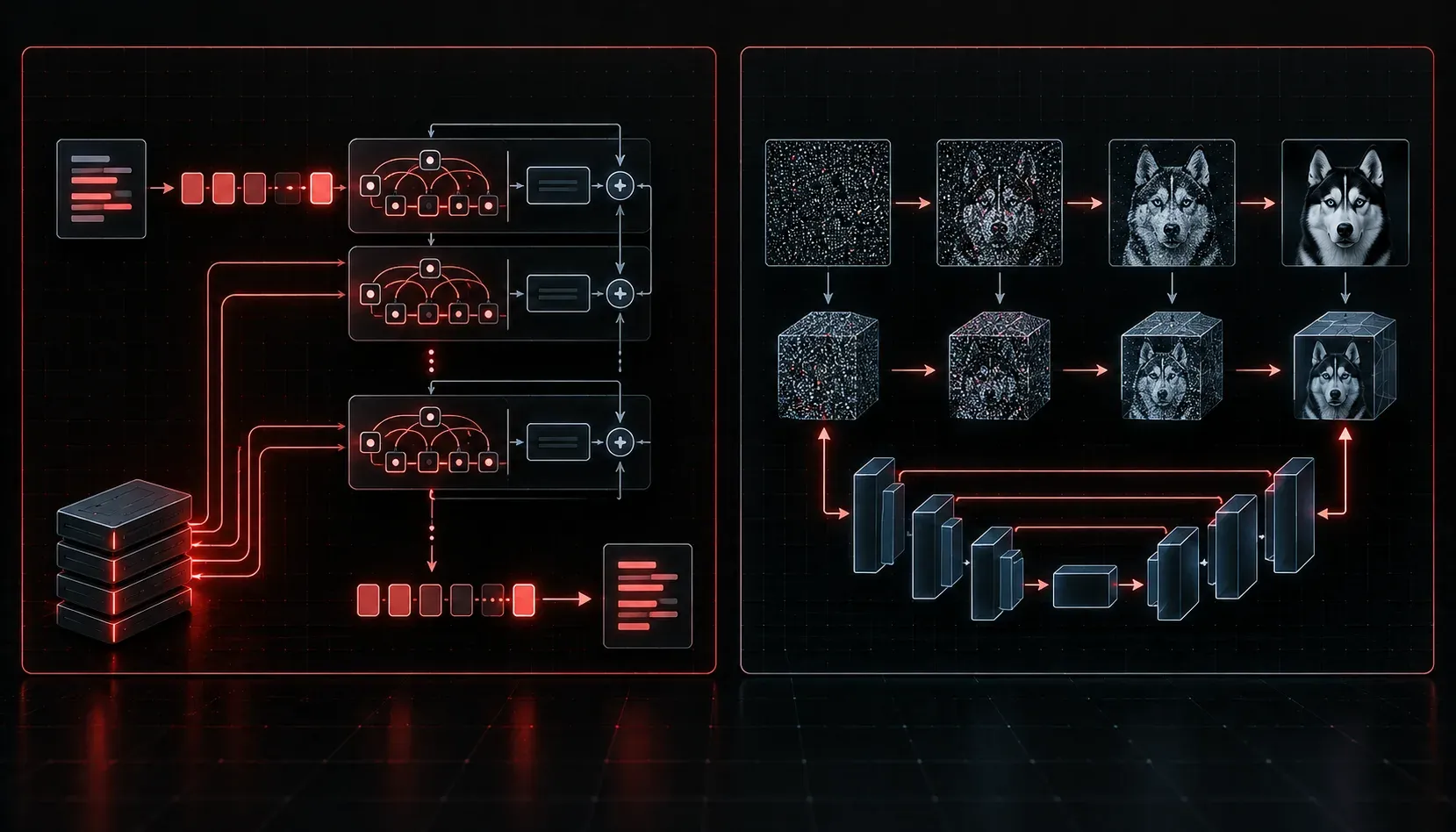
When you start exploring generative AI, one of the first things that can trip you up is understanding that not all AI models work the same way. Two of the most talked-about categories are Large Language Models (LLMs) and diffusion models. They are both generative AI, but they solve different problems in fundamentally different ways. Understanding the distinction helps you choose the right tool and, if you are studying for the Cisco AI Technical Practitioner exam, it maps directly to Domain 1.1.
What Are Large Language Models?
LLMs are neural networks trained on massive amounts of text data. They learn statistical relationships between words and tokens, and they generate output by predicting what comes next in a sequence. Examples you have almost certainly used include ChatGPT (OpenAI), Claude (Anthropic), and Gemini (Google).
LLMs use a transformer architecture under the hood. The model processes an input prompt through layers of attention mechanisms that weigh the importance of different tokens in relation to each other. The output is generated one token at a time, each new token conditioned on everything that came before it.
LLMs are best suited for:
- Text generation and summarization
- Question answering and conversational AI
- Code generation and debugging
- Translation and document classification
What Are Diffusion Models?
Diffusion models take a completely different approach. During training, the model learns to model the probability distribution of the data by first having noise progressively added to clean examples (such as images), and then learning to reverse that process by predicting and removing the noise step by step. This trains the model to understand the structure of realistic data. At inference time, you start with pure noise and the model iteratively refines it into a coherent output.
Well-known diffusion models include Stable Diffusion, DALL-E 3 (OpenAI), and Midjourney. While image generation is the most common use case, diffusion models are also used for audio synthesis and video generation.
Diffusion models are best suited for:
- Image generation from text prompts
- Image editing and inpainting
- Audio and music synthesis
- Video generation
Key Differences at a Glance
Here is a side-by-side comparison to make the AI model differences concrete:
Feature              LLMs                      Diffusion Models
-----------------------------------------------------------------
Primary Output       Text / Code               Images, Audio, Video
Core Architecture    Transformer (attention)   Iterative denoising
Generation Method    Sequential token output   Progressive noise removal
Input Type           Text prompts              Text prompts + noise seed
Common Examples      GPT-4, Claude, Gemini     DALL-E, Stable Diffusion
Inference Speed      Fast (streaming tokens)   Slower (many denoising steps)
Fine-tuning          Instruction tuning, LoRA  LoRA, DreamBooth, textual inversion
One important nuance in this language models comparison: some modern systems combine both model types. For example, DALL-E 3 uses an LLM to interpret and refine your prompt before passing it to the diffusion model for image generation. In these hybrid pipelines, the LLM handles language understanding and prompt expansion, while the diffusion model handles the visual synthesis, with the two components communicating through shared text embeddings or structured intermediate representations. This pattern is increasingly common in production AI systems.
Choosing the Right Model
The practical question is simple: what output do you need?
- Text output: reach for an LLM like GPT-4, Claude 3.5, or Gemini 1.5 Pro.
- Image output: reach for a diffusion model like Stable Diffusion via stability.ai or DALL-E 3 via the OpenAI API.
- Both: consider a multi-modal platform or build a pipeline that chains an LLM with a diffusion model.
For networking professionals and IT practitioners moving into AI, LLMs will typically be your primary tool for tasks involving text, code, and conversational interfaces. Diffusion models become relevant when your use cases extend into content creation, training data generation, or building AI-assisted documentation with visual assets.
What's Next
Now that you understand the two major categories of generative AI models, the next step is diving deeper into how LLMs actually process input. In the next post, we will look at tokenization and context windows, specifically how LLMs break down text and why the size of a model's context window matters for real-world tasks. That foundational knowledge will make working with LLM APIs significantly less mysterious.