
Floating Static Routes

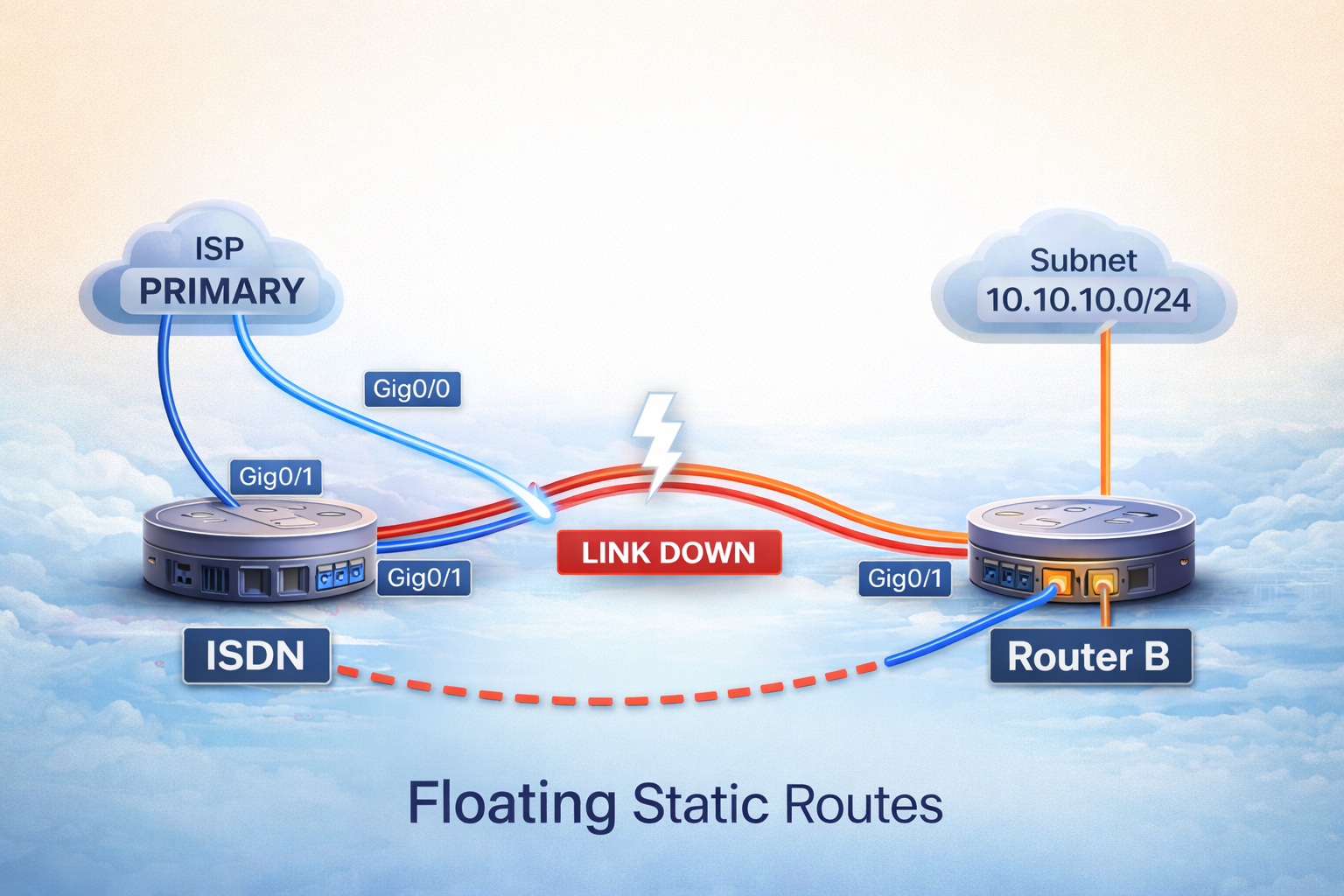
Floating static routes are static routes that are not installed in the routing table until the primary path fails. They are configured with a higher administrative distance (AD) than the primary route, which prevents them from being installed in the routing table.
When the primary route fails, the floating static route is then installed in the routing table and used to forward packets to the destination network.
Configuring Floating Static Routes
To configure a floating static route, you need to specify the destination network, the next-hop IP address or exit interface, and a higher administrative distance than the primary route.
The syntax for configuring a floating static route is:
Router(config)# ip route destination_network subnet_mask next_hop_ip administrative_distanceFor example, if you have a primary route to network 192.168.10.0/24 via 10.0.0.2 (which has the default static route AD of 1), you could configure a floating static route as a backup:
Router(config)# ip route 192.168.10.0 255.255.255.0 10.0.0.3 5In this example:
- 192.168.10.0 255.255.255.0 is the destination network
- 10.0.0.3 is the backup next-hop IP address
- 5 is the administrative distance (higher than the primary route's AD of 1)
Administrative Distance Values
Here are the default administrative distance values for different routing protocols:
- Connected interface: 0
- Static route: 1
- EIGRP: 90
- OSPF: 110
- RIP: 120
When configuring floating static routes, ensure the administrative distance is higher than your primary routing method but lower than any routing protocols you want it to override.
Verification
To verify your floating static routes, use the following commands:
Router# show ip route
Router# show ip route static
When the primary route is active, you won't see the floating static route in the routing table. Only when the primary path fails will the floating static route appear and be used for packet forwarding.
Use Cases
Floating static routes are commonly used in scenarios such as:
- Backup WAN connections
- Redundant paths to critical networks
- Load balancing with unequal cost paths
- Providing connectivity when dynamic routing protocols fail
They provide a simple and effective way to implement basic redundancy in your network without the complexity of dynamic routing protocols.