
Understanding Network Topology Architectures
An introduction to network topology architectures covering bus, star, ring, and mesh topologies with their advantages, disadvantages, and real-world applications. Essential foundation knowledge for CCNA candidates and networking beginners.
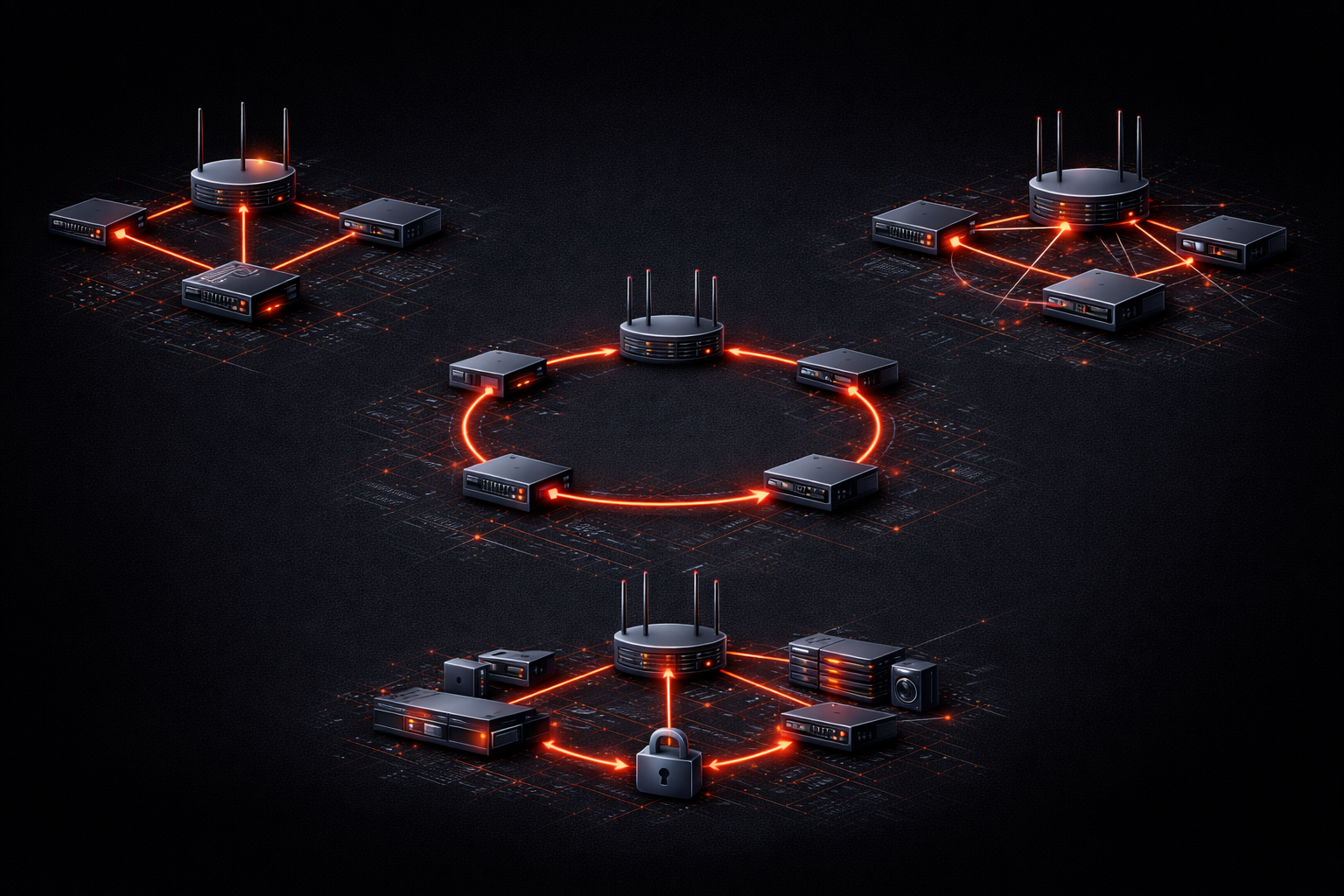
Network topology architectures form the backbone of how devices connect and communicate in any network environment. As a foundational concept in networking, understanding these architectures is crucial for anyone pursuing their CCNA certification or working with network infrastructure.
Think of network topology as the blueprint of your network; it defines how devices are physically or logically arranged and how data flows between them. Each topology type has distinct characteristics that affect performance, scalability, fault tolerance, and cost.
Physical vs. Logical Topologies
Before diving into specific architectures, it's important to distinguish between physical and logical topologies. Physical topology refers to the actual cable layout and hardware connections, while logical topology describes how data flows through the network regardless of physical connections.
For example, you might have devices physically connected in a star pattern, but the data could logically flow in a ring pattern through switching protocols.
Common Network Topology Architectures
Bus Topology
In a bus topology, all devices connect to a single central cable called the backbone or bus. Data travels along this shared medium, and each device receives all transmissions but only processes data intended for it.
Advantages: Simple to implement, requires minimal cable, cost-effective for small networks
Disadvantages: Single point of failure, performance degrades as devices are added, difficult to troubleshoot
Star Topology
Star topology features a central hub or switch with individual connections to each device. This is the most common topology in modern enterprise networks, particularly with Ethernet switching.
Switch01---PC1
    |
   PC2
    |
   PC3
    |
  Server1
Advantages: Easy to troubleshoot, failure of one connection doesn't affect others, simple to add new devices
Disadvantages: Central device represents a single point of failure, requires more cable than bus topology
Ring Topology
In ring topology, devices connect in a circular pattern where each device connects to exactly two others. Data travels in one direction around the ring, with each device acting as a repeater.
Advantages: No collisions, predictable performance, fault detection is straightforward
Disadvantages: Single device failure can break the entire ring, adding devices requires network downtime
Mesh Topology
Mesh topologies provide multiple paths between devices. In a full mesh, every device connects directly to every other device. Partial mesh provides multiple paths but not necessarily direct connections between all devices.
Advantages: High redundancy, excellent fault tolerance, multiple data paths prevent bottlenecks
Disadvantages: Expensive to implement, complex configuration and management, requires significant cabling
Hybrid Topologies
Most real-world networks combine multiple topology types. For instance, you might have star topologies at the access layer connected through a mesh backbone, or ring topologies connecting different star networks.
A common example is the three-tier hierarchical model used in enterprise networks:
- Access Layer: Star topology connecting end devices to access switches
- Distribution Layer: Partial mesh connecting access switches to distribution switches
- Core Layer: Full or partial mesh providing high-speed backbone connectivity
Choosing the Right Topology
Selecting appropriate network topology architectures depends on several factors:
- Scale: How many devices need connectivity?
- Budget: What are the cost constraints for equipment and cabling?
- Reliability: How much fault tolerance is required?
- Performance: What bandwidth and latency requirements exist?
- Growth: How easily can the network expand?
For most small to medium businesses, star topology with hierarchical design provides the best balance of cost, performance, and manageability. Large enterprises typically implement hybrid approaches combining multiple topology types based on specific requirements for different network segments.
What's Next
Now that you understand the fundamental network topology architectures, the next step is exploring how these topologies implement different network models and protocols. In our next post, we'll dive into the OSI model and how data flows through these various topological structures during network communication.