
What Are Fundamental Security Concepts?
This post introduces the fundamental security concepts essential for Security+ beginners, covering the CIA Triad, authentication vs. authorization, least privilege, defense in depth, and risk management basics. These core principles form the foundation for all cybersecurity learning.
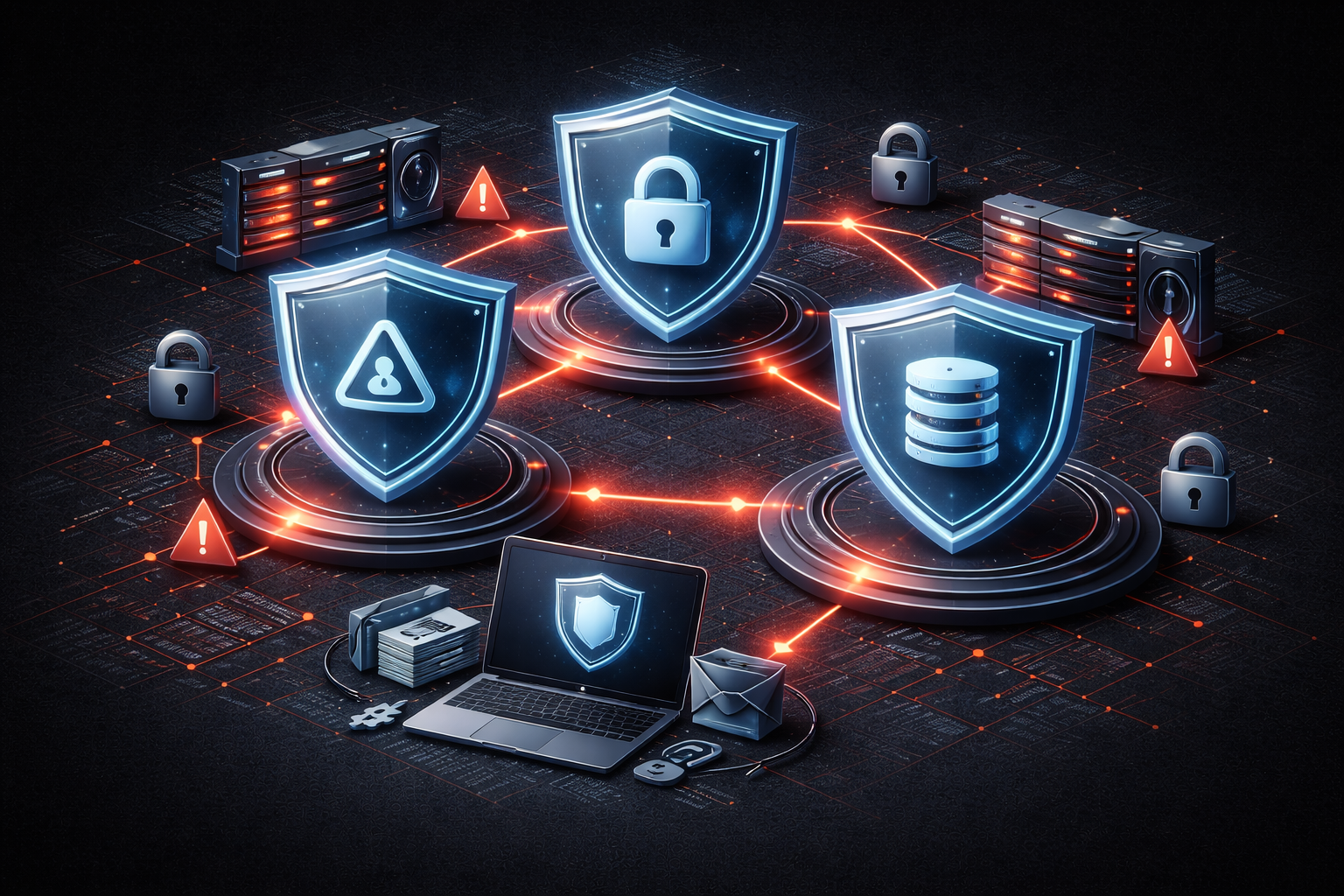
Before diving into complex cybersecurity topics, understanding fundamental security concepts creates the foundation for everything else you'll learn in the Security+ exam. These core principles guide how security professionals think about protecting systems, data, and networks in today's digital landscape.
The CIA Triad: The Foundation of Security
The CIA Triad represents the three pillars of information security that every security professional must understand:
- Confidentiality: Ensuring that information is only accessible to authorized individuals. This includes encryption, access controls, and data classification.
- Integrity: Maintaining the accuracy and completeness of data throughout its lifecycle. Hash functions and digital signatures help verify data hasn't been tampered with.
- Availability: Ensuring systems and data remain accessible when needed by authorized users. This involves redundancy, backups, and disaster recovery planning.
Think of these as interconnected concepts. Strong encryption protects confidentiality, checksums verify integrity, and load balancing maintains availability.
Authentication vs. Authorization
These fundamental security concepts work together but serve different purposes:
Authentication answers "Who are you?" It's the process of verifying identity through credentials like passwords, biometrics, or certificates. When you enter your username and password, you're authenticating.
Authorization answers "What can you do?" After authentication confirms your identity, authorization determines your permissions. For example, an authenticated user might read files but cannot delete them.
Modern systems often implement multi-factor authentication (MFA), requiring multiple authentication factors like something you know (password) and something you have (phone token).
The Principle of Least Privilege
This basic security principle states that users should receive the minimum access necessary to perform their job functions. Instead of granting broad permissions, organizations implement role-based access controls (RBAC) that match specific job requirements.
For instance, a database administrator needs CREATE and DROP permissions, while a data analyst might only need SELECT permissions on specific tables.
Defense in Depth
Rather than relying on a single security measure, defense in depth creates multiple layers of protection. If one layer fails, the others continue to provide security.
A typical defense in depth strategy includes:
- Perimeter security: Firewalls and intrusion detection systems
- Network segmentation: VLANs and access control lists
- Endpoint protection: Antivirus and host-based firewalls
- Application security: Input validation and secure coding practices
- Data protection: Encryption at rest and in transit
Risk Management Fundamentals
Security professionals think in terms of risk rather than absolute security. Risk combines three elements:
Risk = Threat × Vulnerability × Impact
- Threats: Potential dangers like malware, hackers, or natural disasters
- Vulnerabilities: Weaknesses that threats can exploit
- Impact: The potential damage if a threat exploits a vulnerability
Understanding these cybersecurity basics helps prioritize security investments and focus on the most critical risks first.
Security Controls Categories
Security controls fall into three main categories based on their function:
- Preventive controls: Stop security incidents before they occur (firewalls, access controls)
- Detective controls: Identify security incidents in progress (intrusion detection systems, log monitoring)
- Corrective controls: Respond to and recover from incidents (incident response procedures, backups)
Effective security programs combine all three types to create comprehensive protection.
What's Next
Now that you understand these fundamental security concepts, you're ready to explore specific security principles in detail. Our next post will dive deep into the principle of least privilege and how to implement it effectively in real-world environments.