
Understanding Ethernet Connections: Shared Media vs Point-to-Point
Explores the key differences between Ethernet shared media and point-to-point connections, covering collision domains, bandwidth utilization, and their impact on modern network design. Essential knowledge for understanding network topology fundamentals.

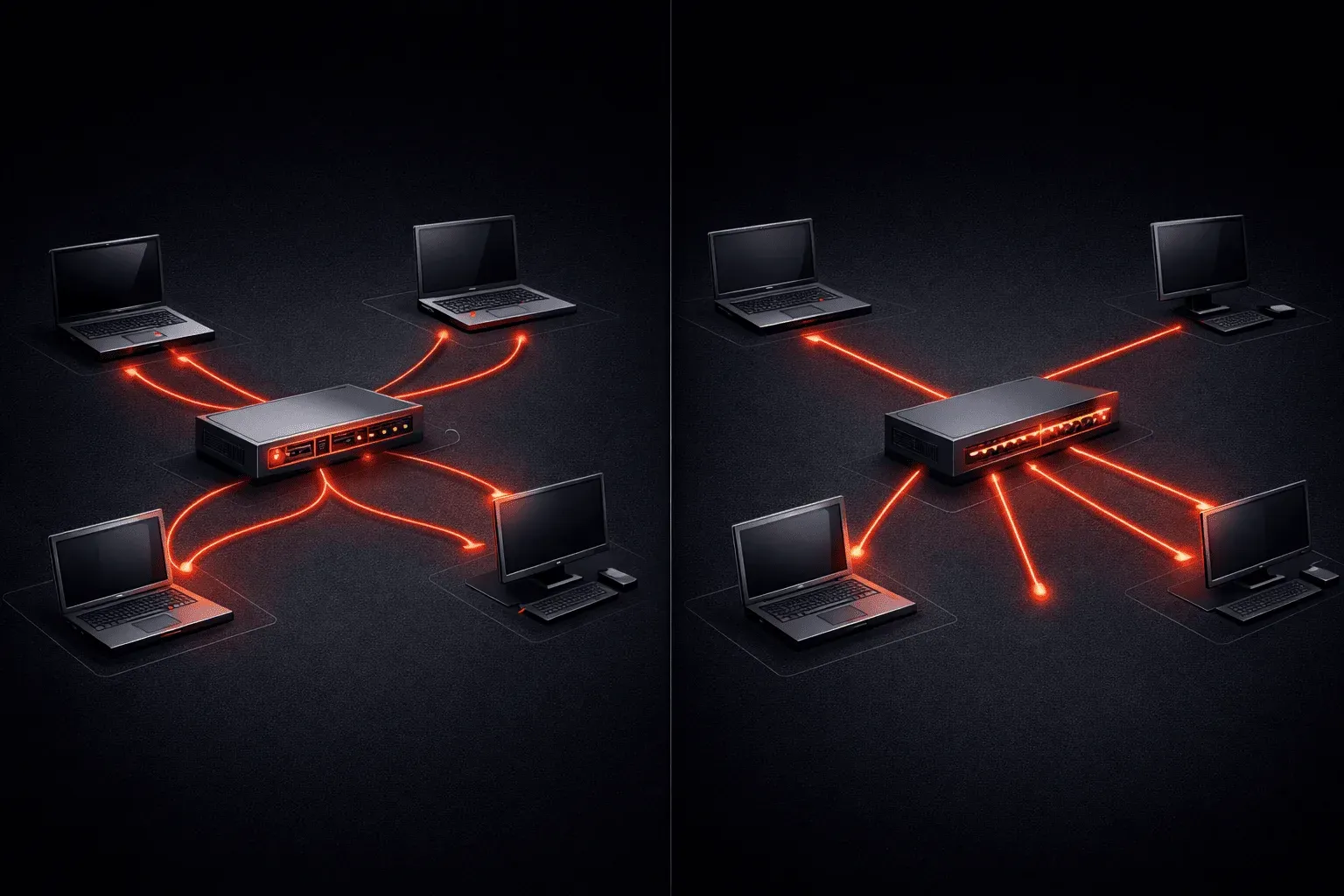
Understanding the difference between shared media and point-to-point Ethernet connections is fundamental to grasping how modern networks operate. These two connection types represent different approaches to handling network traffic, and knowing when to use each is crucial for network design and troubleshooting.
What is Shared Media Ethernet?
Shared media Ethernet operates on a single collision domain where all devices compete for access to the transmission medium. Think of it like a busy conference room where only one person can speak at a time, and everyone must listen before talking to avoid interruptions.
Classic examples of shared media include:
- Traditional Ethernet hubs (10BASE-T hubs)
- Coaxial cable networks (10BASE2, 10BASE5)
- Any network where multiple devices share the same physical transmission medium
In shared media networks, devices use CSMA/CD (Carrier Sense Multiple Access with Collision Detection) to manage access. Before transmitting, a device listens to ensure the medium is free. If two devices transmit simultaneously, a collision occurs, both devices detect it, stop transmitting, and retry after a random backoff period.
Hub Network Example:
PC1 ----\
         \
PC2 ---- HUB ---- Server
         /
PC3 ----/
(All devices share 10 Mbps bandwidth)
What is Point-to-Point Ethernet?
Point-to-point Ethernet creates a dedicated connection between two devices, typically through a switch. Each connection operates in its own collision domain, eliminating the need for CSMA/CD and allowing for full-duplex communication.
Key characteristics of point-to-point connections:
- Dedicated bandwidth per connection
- Full-duplex operation (simultaneous send and receive)
- No collisions possible
- Each port on a switch creates a separate collision domain
Switched Network Example:
PC1 ---- [Switch Port 1]
PC2 ---- [Switch Port 2] ---- Server
PC3 ---- [Switch Port 3]
(Each connection has dedicated 100 Mbps)
Key Differences in Practice
The practical differences between these connection types significantly impact network performance:
Bandwidth Utilization
In shared media, all connected devices share the total available bandwidth. A 10 Mbps hub shared among 10 devices means each device competes for a portion of that 10 Mbps. Point-to-point connections provide dedicated bandwidth per port, so 10 devices on 100 Mbps switch ports each get their full 100 Mbps.
Collision Handling
Shared media networks experience collisions that reduce effective throughput, especially as more devices are added. Point-to-point connections eliminate collisions entirely, allowing for maximum throughput utilization.
Security Considerations
In shared media, all devices receive all frames (though they typically ignore frames not addressed to them). Point-to-point connections through switches only forward frames to the intended recipient, improving security.
Modern Network Topology Impact
Today's Ethernet networks primarily use point-to-point connections through switches. Understanding both types helps you:
- Troubleshoot legacy network equipment
- Design efficient network topologies
- Optimize bandwidth allocation
- Implement proper security measures
When working with network devices, you can verify the connection type by checking interface statistics:
Switch# show interface fastethernet 0/1
FastEthernet0/1 is up, line protocol is up
  Hardware is Fast Ethernet, address is 0012.4356.7890
  Full-duplex, 100Mb/s, media type is 10/100BaseTX
The Full-duplex indication confirms this is a point-to-point connection, as shared media can only operate in half-duplex mode.
What's Next
Now that you understand the fundamental differences between shared and point-to-point Ethernet connections, the next logical step is exploring how switches actually learn MAC addresses and make forwarding decisions. This MAC address learning process is what enables switches to create those efficient point-to-point connections we've discussed.
CCNA study resources
- CCNA Official Cert Guide Library (Wendell Odom) — Both volumes covering the full 200-301 exam blueprint. The definitive CCNA study resource.
- Wendell Odom CCNA Vol 1 — Networking fundamentals, switching, VLANs, STP, and IPv4 routing.