
Comparing HITL AI with Fully Autonomous Systems
This post compares human-in-the-loop (HITL) AI with fully autonomous systems, walking through the trade-offs in control, efficiency, and risk. It provides a practical decision framework and explains when each approach is appropriate, helping beginners make informed architectural choices for agentic

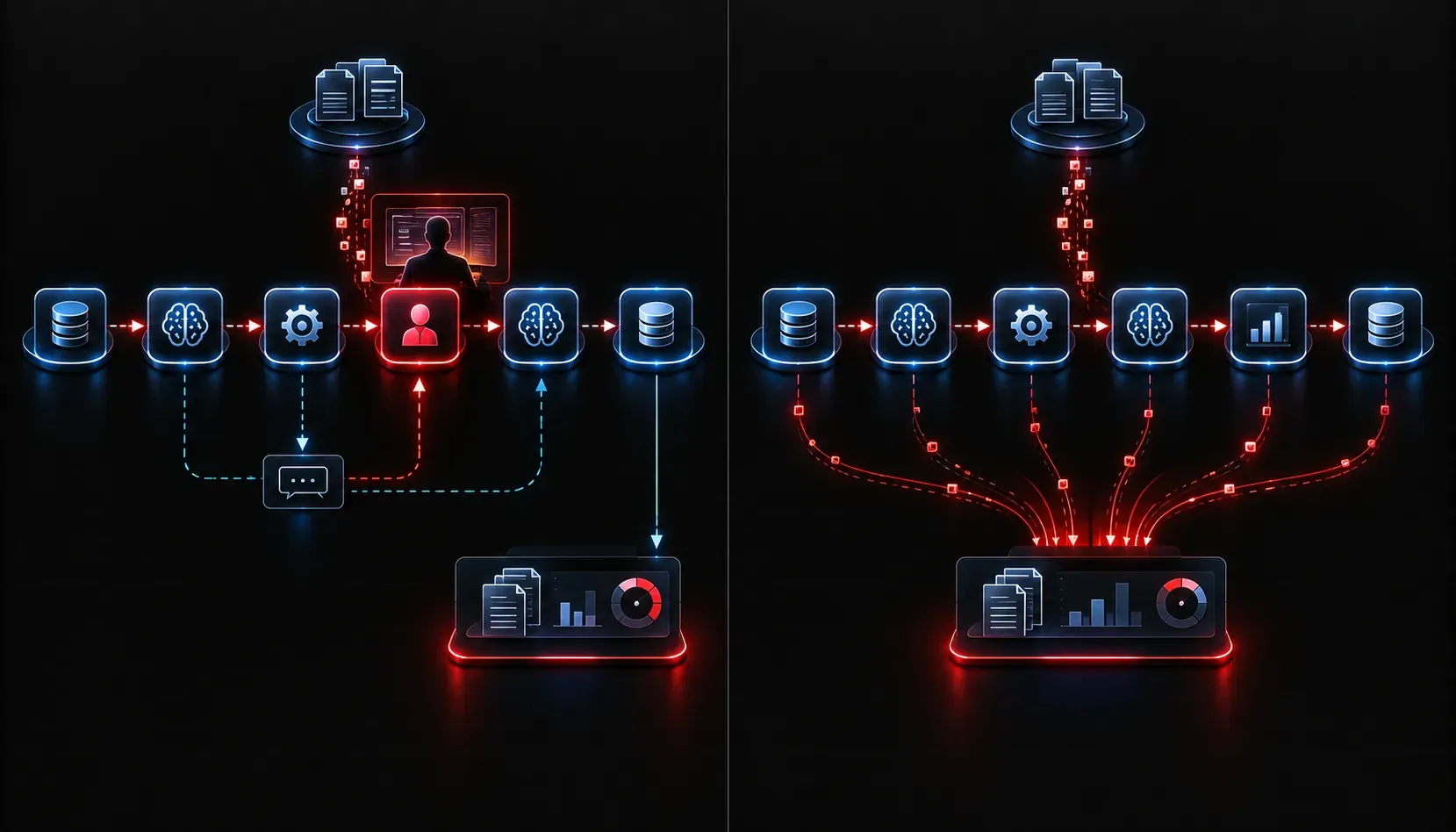
When you start exploring agentic AI systems, one of the first decisions you will face is how much control to hand over to the machine. This is the heart of the HITL vs autonomous AI debate, and understanding the trade-offs will shape how you design, deploy, and trust AI in real-world workflows.
What Are We Actually Comparing?
At a high level, you are comparing two ends of a control spectrum:
- Human-in-the-Loop (HITL): A human reviews, approves, or corrects AI decisions at defined points in the workflow before the system proceeds.
- Fully Autonomous AI: The system executes decisions end-to-end without requiring human intervention at any step.
Neither approach is universally better. The right choice depends on your use case, your risk tolerance, and how mature your AI system is. Most production systems today actually live somewhere between these two extremes.
The Case for Human-in-the-Loop
HITL design patterns exist because AI systems make mistakes, and some mistakes are more expensive than others. When the cost of a wrong decision is high, keeping a human in the loop is not inefficiency; it is risk management.
Key HITL Benefits
- Error catching: Humans intercept low-confidence or high-stakes decisions before they cause downstream damage.
- Regulatory compliance: Many industries (finance, healthcare, legal) require human accountability for certain decisions.
- Trust building: Early-stage AI deployments benefit from human oversight while the system earns confidence through demonstrated accuracy.
- Edge case handling: Humans can recognize situations the model was never trained on and route them appropriately.
A practical example: imagine an AI agent that drafts customer refund responses. In a HITL design, a human agent reviews the draft before it is sent. The AI handles speed and consistency; the human handles judgment and tone. The customer gets a faster, more consistent response, and the business avoids costly errors.
The Case for Full Autonomy
Fully autonomous systems shine when decisions need to happen at a speed or scale that humans simply cannot match. The autonomous system comparison is straightforward in these scenarios: no human can review ten thousand transactions per second.
Where Autonomy Makes Sense
- High-volume, low-stakes decisions: Spam filtering, ad bidding, content tagging, and log classification are all tasks where speed matters more than individual precision.
- Well-defined, predictable environments: When the problem space is narrow and the training data covers it well, autonomous systems perform reliably.
- Real-time requirements: Fraud detection, network anomaly response, and automated trading all require decisions in milliseconds.
The trade-off is that when an autonomous system fails, it can fail at scale. A misconfigured autonomous agent could send thousands of incorrect responses before anyone notices.
Understanding the AI Control Trade-offs
The honest answer to "which is better?" is: it depends on where you are on three axes.
Axis 1: Risk
  Low risk   ─────────────────────────────►  High risk
  Autonomy favored                          HITL favored

Axis 2: Volume
  Low volume ─────────────────────────────►  High volume
  HITL feasible                             Autonomy required

Axis 3: Model Maturity
  Unproven   ─────────────────────────────►  Proven
  HITL required                             Autonomy possible
A new AI system handling high-risk decisions should almost always start with HITL. As the system proves itself and your confidence in its accuracy grows, you can gradually reduce human touchpoints, a process sometimes called progressive autonomy. You do not have to choose one or the other from day one.
A Practical Decision Framework
Before choosing your design pattern, ask these questions:
- What is the worst-case outcome if the AI makes a wrong decision?
- How quickly does a decision need to be made?
- How much labeled data and real-world validation does the model have?
- Is there a legal or regulatory requirement for human accountability?
- Can the system flag its own uncertainty and escalate appropriately?
If your answers point toward high risk, low volume, and an unproven model, start with HITL. If they point toward low risk, high volume, and a well-validated model, autonomy becomes viable.
What's Next
Now that you understand the difference between HITL and fully autonomous systems, the next step is understanding where in a workflow to place human checkpoints. The next post covers specific HITL design patterns: approval gates, confidence thresholds, and escalation paths, giving you the tools to build HITL into your own agentic systems deliberately and effectively.