
VoIP Security: Protecting Your Voice Communication
VoIP systems face unique security threats because voice traffic shares the same IP networks as data. This post covers practical strategies including encryption with TLS and SRTP, VLAN segmentation, SIP hardening, Session Border Controllers, and continuous monitoring to protect voice communication i

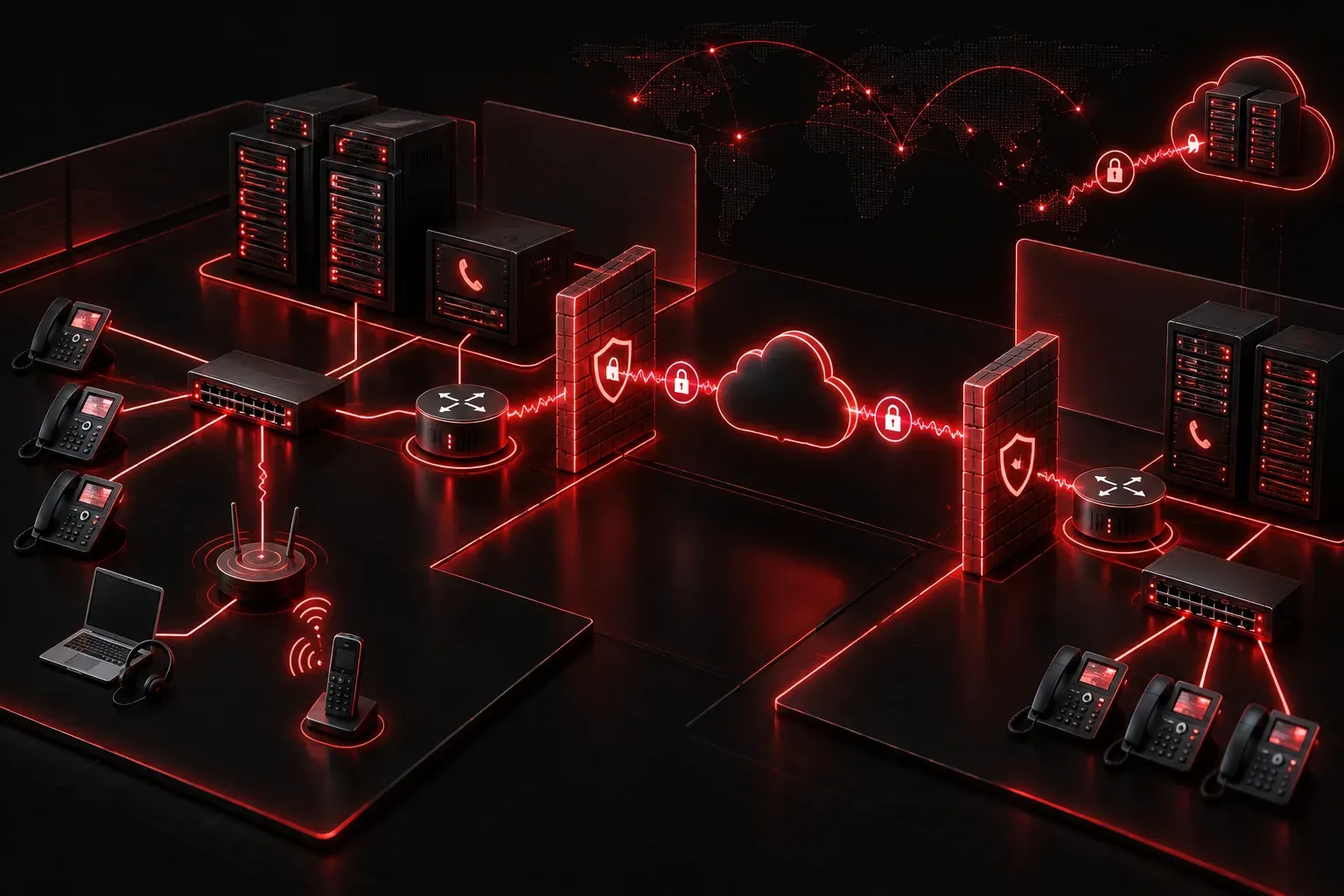
Voice over IP has transformed how businesses communicate, replacing expensive traditional phone systems with flexible, cost-effective solutions. But with that flexibility comes risk. VoIP traffic travels over the same networks as your data, which means it faces the same cyber threats, and some unique ones of its own. If you are managing or planning to manage a VoIP deployment, understanding how to secure it is not optional.
Why VoIP Security Deserves Serious Attention
Traditional phone systems were largely isolated. VoIP systems are not. Your voice traffic rides on IP networks, passes through routers and firewalls, and often traverses the public internet. That exposure opens the door to a range of attacks that simply did not exist in the PSTN world.
Common threats targeting VoIP environments include:
- Eavesdropping: Attackers capturing unencrypted RTP (Real-time Transport Protocol) streams and reconstructing conversations
- Toll fraud: Unauthorized use of your VoIP infrastructure to make calls, often racking up massive international call bills
- Denial of Service (DoS): Flooding SIP servers or endpoints with traffic to disrupt call availability
- SIP scanning: Automated tools probing for open SIP ports and weak credentials
- Vishing: Voice phishing attacks that exploit VoIP infrastructure to spoof caller ID and deceive users
Core Strategies for Securing VoIP
Encrypt Your Signaling and Media
This is the single most impactful step you can take. Two protocols work together to protect VoIP traffic:
- TLS (Transport Layer Security): Encrypts the SIP signaling channel, preventing attackers from reading or tampering with call setup messages
- SRTP (Secure Real-time Transport Protocol): Encrypts the actual voice media stream, making captured packets useless without the encryption keys
On a Cisco Unified Communications Manager (CUCM) deployment, you can enforce encrypted signaling by configuring the device security profile to use Encrypted mode and assigning a certificate to the endpoint. Without both TLS and SRTP working together, you are only solving half the problem.
Segment Voice Traffic with VLANs
Mixing voice and data traffic on the same VLAN is a bad practice both for quality and security. A dedicated voice VLAN isolates your IP phones from workstations, limits the blast radius of a compromised endpoint, and allows you to apply targeted security policies.
On a Cisco switch, you configure the voice VLAN on an access port like this:
interface GigabitEthernet0/1
 switchport mode access
 switchport access vlan 10
 switchport voice vlan 100
 spanning-tree portfast
This keeps PC traffic on VLAN 10 while phones tag their traffic to VLAN 100, giving you a clean separation point for firewall rules and QoS policies.
Lock Down Your SIP Infrastructure
SIP is the most widely targeted VoIP protocol. A few hardening steps go a long way:
- Change default credentials: IP phones and SIP trunks often ship with well-known default usernames and passwords. Change them immediately.
- Restrict SIP registration: Only allow endpoints from known IP ranges to register with your call manager
- Rate limit SIP OPTIONS and REGISTER messages: This slows down automated scanning tools significantly
- Disable unnecessary SIP methods: If your deployment does not use
SUBSCRIBEorNOTIFY, block them at the border
Use a Session Border Controller
A Session Border Controller (SBC) sits at the edge of your VoIP network, acting as a security and policy enforcement point for all external SIP traffic. It hides your internal topology, performs media anchoring, enforces codec policies, and can detect and block toll fraud patterns in real time. If your organization connects SIP trunks to a service provider, an SBC is not a luxury; it is a necessity.
Monitor and Audit Continuously
Even well-hardened VoIP environments need ongoing monitoring. Watch for unusual call volumes, calls to unexpected international destinations, failed authentication attempts on SIP endpoints, and sudden spikes in concurrent calls. Many of these indicators point to active toll fraud or a compromised endpoint being used as a stepping stone.
What's Next
Now that you have a solid foundation in VoIP security concepts, the next step is understanding how Quality of Service (QoS) works alongside security to keep voice traffic performing reliably on your network. Properly classifying and prioritizing voice packets ensures that your encrypted, segmented VoIP traffic actually sounds good when it arrives. We will cover QoS strategies for voice networks in an upcoming post.