
Network Topologies: Choosing the Right Architecture for Your Needs
This post breaks down the most common network topologies including star, bus, ring, mesh, and hybrid designs. It explains the strengths and weaknesses of each, when to use them, and how to approach architecture selection decisions for both the CCNA exam and real-world network design.

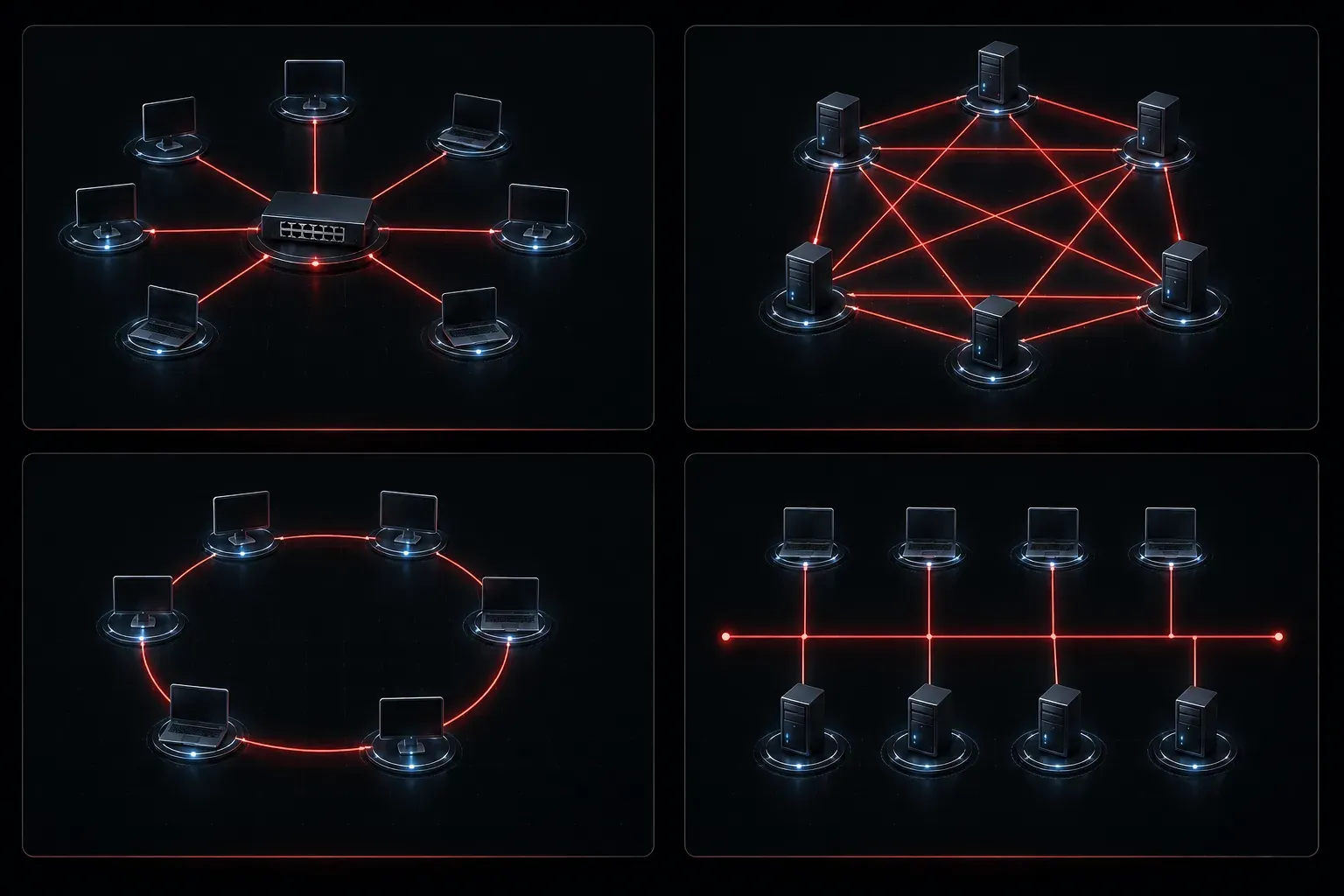
When you start designing a network, one of the first decisions you face is how to physically and logically connect your devices. This is your network topology, and choosing the right one can mean the difference between a resilient, high-performing infrastructure and a fragile network that brings down your entire organization when a single cable fails.
This post walks through the most common topologies you will encounter on the CCNA exam and in real-world network design, and helps you understand when to use each one.
The Common Topologies You Need to Know
Star Topology
The star topology is the most widely used architecture in modern LANs. Every end device connects to a central device, typically a switch. Traffic flows from a device up to the switch, which then forwards it to the destination.
- Strength: A single cable failure only affects one device, not the entire network.
- Weakness: The central switch becomes a single point of failure. If it goes down, all connected devices lose connectivity.
- Best for: Office environments, small business networks, and anywhere you need easy troubleshooting and device management.
Bus Topology
In a bus topology, all devices share a single communication medium, a coaxial cable in older implementations. This architecture is largely historical, but it appears on the CCNA exam as a reference point for comparison.
- Strength: Simple and inexpensive to implement.
- Weakness: A break anywhere in the shared cable kills the entire network. Collisions are also a major problem under load.
- Best for: You would not deploy this today. Understand it for exam purposes.
Ring Topology
Devices connect in a closed loop, with data traveling around the ring in one or both directions. Token Ring and FDDI are classic examples. Like bus topology, this is primarily historical in the context of the CCNA exam.
- Strength: Predictable performance under heavy load since token passing controls access.
- Weakness: A single break in the ring disrupts the entire network unless dual-ring redundancy is implemented.
- Best for: Legacy environments. Understand the concept for exam comparison questions.
Mesh Topology
In a full mesh, every device connects directly to every other device. A partial mesh provides connections between only the most critical nodes. You will see this architecture most often in WAN environments and service provider networks.
- Strength: Exceptional redundancy. Multiple paths exist between any two points, so traffic can reroute around failures automatically.
- Weakness: Expensive and complex. The number of connections grows rapidly as you add devices.
- Best for: WAN core infrastructure, data center interconnects, and any environment where uptime is critical.
Hybrid Topology
Real-world networks almost always combine topologies. A typical enterprise uses a star topology within each floor (access layer), those stars connect to distribution switches, and the core uses a partial mesh for redundancy. This layered approach is the foundation of the Cisco three-tier hierarchical model: access, distribution, and core.
Making the Architecture Selection Decision
When choosing a network topology for a real environment, ask yourself these questions:
- What is the failure tolerance requirement? If downtime is unacceptable, you need redundant paths, which points toward mesh or hybrid designs.
- What is the budget? More redundancy means more hardware and cabling costs.
- How many devices need to connect? Scale affects both topology choice and equipment selection.
- How easy does troubleshooting need to be? Star topologies isolate faults more easily than bus or ring designs.
For the CCNA exam, be comfortable recognizing each topology by its diagram, understanding its advantages and disadvantages, and identifying which environments each one suits best. Topology comparison questions are common and straightforward once you internalize the trade-offs.
A Quick Topology Comparison at a Glance
Topology   | Redundancy | Cost    | Complexity | Common Use Case
-----------|------------|---------|------------|-------------------------
Star       | Low        | Low     | Low        | LAN / Office
Bus        | None       | Lowest  | Lowest     | Legacy / Exam reference
Ring       | Low        | Low     | Medium     | Legacy / Exam reference
Full Mesh  | High       | High    | High       | WAN Core / Data Center
Hybrid     | Variable   | Medium  | Medium     | Enterprise Networks
Recommended Study Resource
For deeper coverage of network fundamentals including topology design, the Cisco Press CCNA 200-301 Official Cert Guide by Wendell Odom is the definitive resource. It covers every topology you need for the exam with clear diagrams and practice questions.
What's Next
Now that you understand the foundational topologies, the next step is learning how physical topology relates to logical topology, and how Ethernet and switching operate within a star-based LAN. We will dig into how switches learn MAC addresses and make forwarding decisions, which builds directly on the star topology you now understand.
Tools and resources for this topic
- Wendell Odom CCNA Vol 1 — Covers networking fundamentals, switching, and routing basics.
- Wendell Odom CCNA Vol 2 — Covers advanced routing, WAN, infrastructure services, and security.