
WAN Network Architecture Explained for Beginners
This post explains WAN network architecture fundamentals, covering common topologies like hub-and-spoke and mesh networks, connection types including leased lines and MPLS, and key design considerations for wide-area networking.

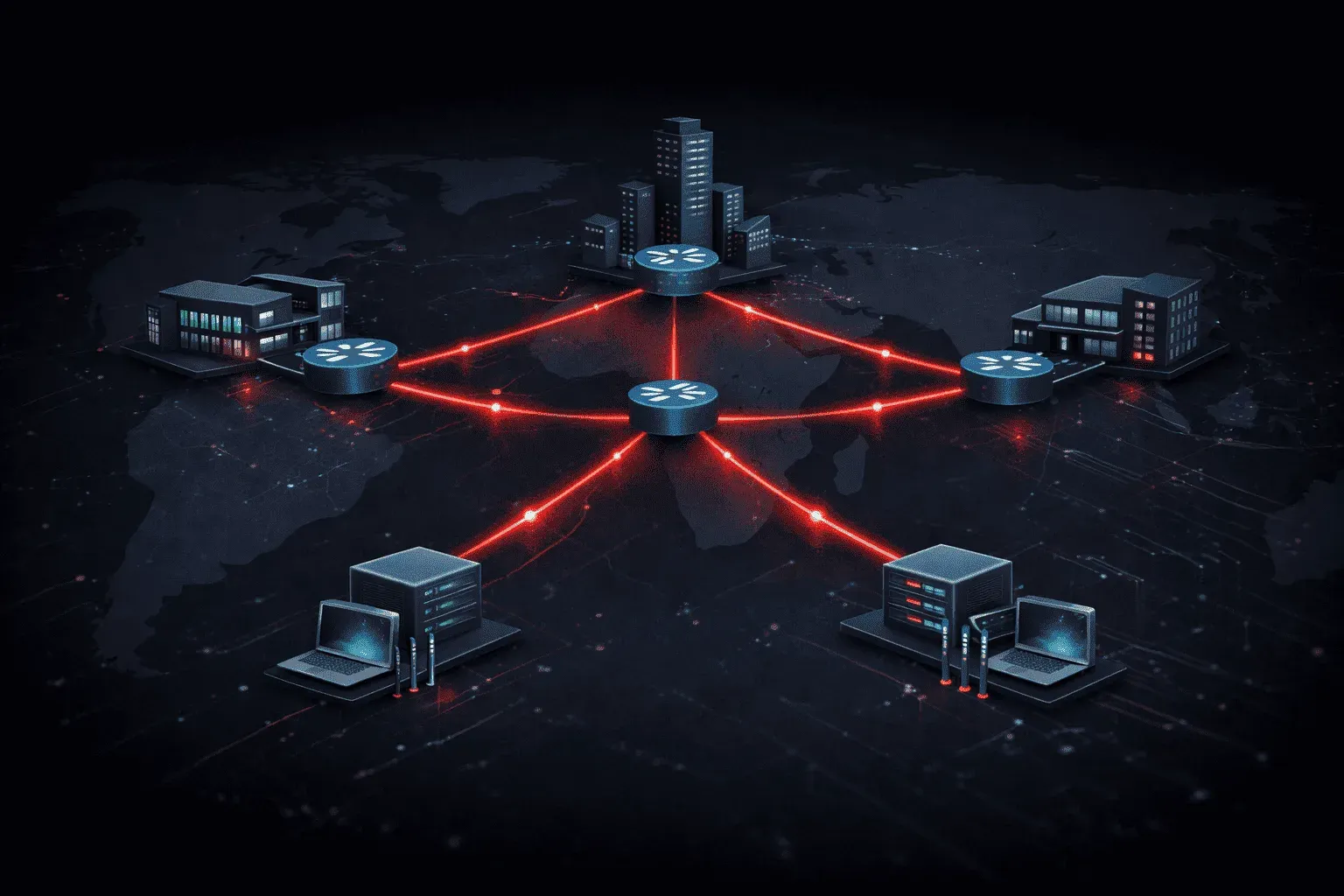
Wide Area Networks (WANs) connect networks across large geographical distances, linking offices, data centers, and remote locations that could be cities or even countries apart. Understanding WAN network architecture is fundamental for anyone studying networking, as it forms the backbone of modern business communications.
What Is WAN Network Architecture?
WAN network architecture refers to the design and structure of networks that span large geographical areas. Unlike Local Area Networks (LANs) that connect devices within a building or campus, WANs use various technologies and service providers to establish connections across vast distances. Think of it as the highway system that connects different cities, while LANs are like the local roads within each city.
The architecture typically involves three key components: customer premises equipment (CPE), the service provider network, and the connection methods that tie everything together.
Common WAN Topologies
Point-to-Point
The simplest WAN topology connects two locations directly. This might be a dedicated leased line between your main office and a branch office. It's reliable and secure, but doesn't scale well as you add more locations.
Hub-and-Spoke
In this centralized model, one main site (the hub) connects to multiple remote sites (spokes). All communication between spokes must go through the hub. This is cost-effective but creates a single point of failure at the hub location.
Full Mesh
Every site connects directly to every other site, providing maximum redundancy and optimal performance. However, the number of connections grows significantly with each new site (following an n(n-1)/2 formula), making this expensive for large networks.
Partial Mesh
A compromise between hub-and-spoke and full mesh, where critical sites have multiple connections while less important locations might only connect to the hub. This balances cost with redundancy.
WAN Connection Types
Understanding the physical layer is crucial for WAN setup. Here are the most common connection methods:
- Leased Lines: Dedicated point-to-point circuits that provide guaranteed bandwidth and low latency. Historically delivered via technologies such as T1 (1.544 Mbps) or T3 (44.736 Mbps), but today often implemented over fibre or Ethernet circuits from a service provider.
- Fibre (Metro Ethernet / Fibre WAN): High-speed fibre-optic connections provided by ISPs or carriers. These can deliver symmetrical bandwidth ranging from hundreds of Mbps to multiple Gbps, with low latency and high reliability. Fibre is now the preferred medium for enterprise WAN links.
- MPLS: A provider-managed WAN service that routes traffic using labels rather than IP lookups. MPLS networks provide predictable performance, traffic prioritization, and QoS guarantees, making them common for connecting enterprise branch offices.
- Internet VPN: A cost-effective WAN option that uses the public internet with encrypted tunnels (IPsec or SSL VPNs). It provides flexibility and low cost, but does not guarantee performance like private WAN services.
- Satellite: Used in remote or rural locations where terrestrial infrastructure is unavailable. Modern services (such as LEO satellite systems) offer improved latency and throughput compared to traditional geostationary satellites.
- Cellular: Wireless WAN connectivity used for temporary links, mobile deployments, or failover connectivity. Performance depends on signal strength, coverage, and carrier infrastructure.
Key WAN Protocols and Technologies
Several protocols enable WAN communications. PPP (Point-to-Point Protocol) is commonly used for serial connections, while Frame Relay (though legacy) helped establish packet-switched WAN concepts. Modern WANs often use MPLS for traffic engineering and QoS.
For routing, protocols like OSPF and EIGRP work within your network, while BGP (Border Gateway Protocol) handles routing between different autonomous systems across the internet.
WAN Architecture Considerations
When designing a WAN architecture, consider these factors:
- Bandwidth Requirements: How much data will flow between locations?
- Latency Sensitivity: Do you have real-time applications like VoIP or video conferencing?
- Redundancy Needs: What's the cost of downtime versus backup connections?
- Security Requirements: Will you encrypt traffic or rely on provider security?
- Scalability: How will the network grow over time?
Modern WAN Evolution
Traditional WAN architectures are evolving with Software-Defined WAN (SD-WAN) solutions. These technologies allow more flexible routing decisions, better use of multiple connection types simultaneously, and centralized policy management. Cloud connectivity has also changed WAN design, as many applications now reside in public clouds rather than corporate data centers.
What's Next
Now that you understand the fundamentals of WAN network architecture, the next step is exploring the specific protocols that make WAN communications possible. We'll dive into PPP configuration and Frame Relay concepts, showing you the actual router commands used to establish these connections.
CCNA study resources
- CCNA Official Cert Guide Library (Wendell Odom) - Both volumes covering the full 200-301 exam blueprint. The definitive CCNA study resource.
- Wendell Odom CCNA Vol 1 - Networking fundamentals, switching, VLANs, STP, and IPv4 routing.
- Wendell Odom CCNA Vol 2 - Advanced routing, WAN, security, automation, and network management.