
Comparing 2-Tier vs 3-Tier Network Designs
This post compares 2-tier (collapsed core) and 3-tier network architectures, explaining their key differences, use cases, and decision factors. It provides practical guidance for choosing the right design based on organization size, budget, and scalability requirements.

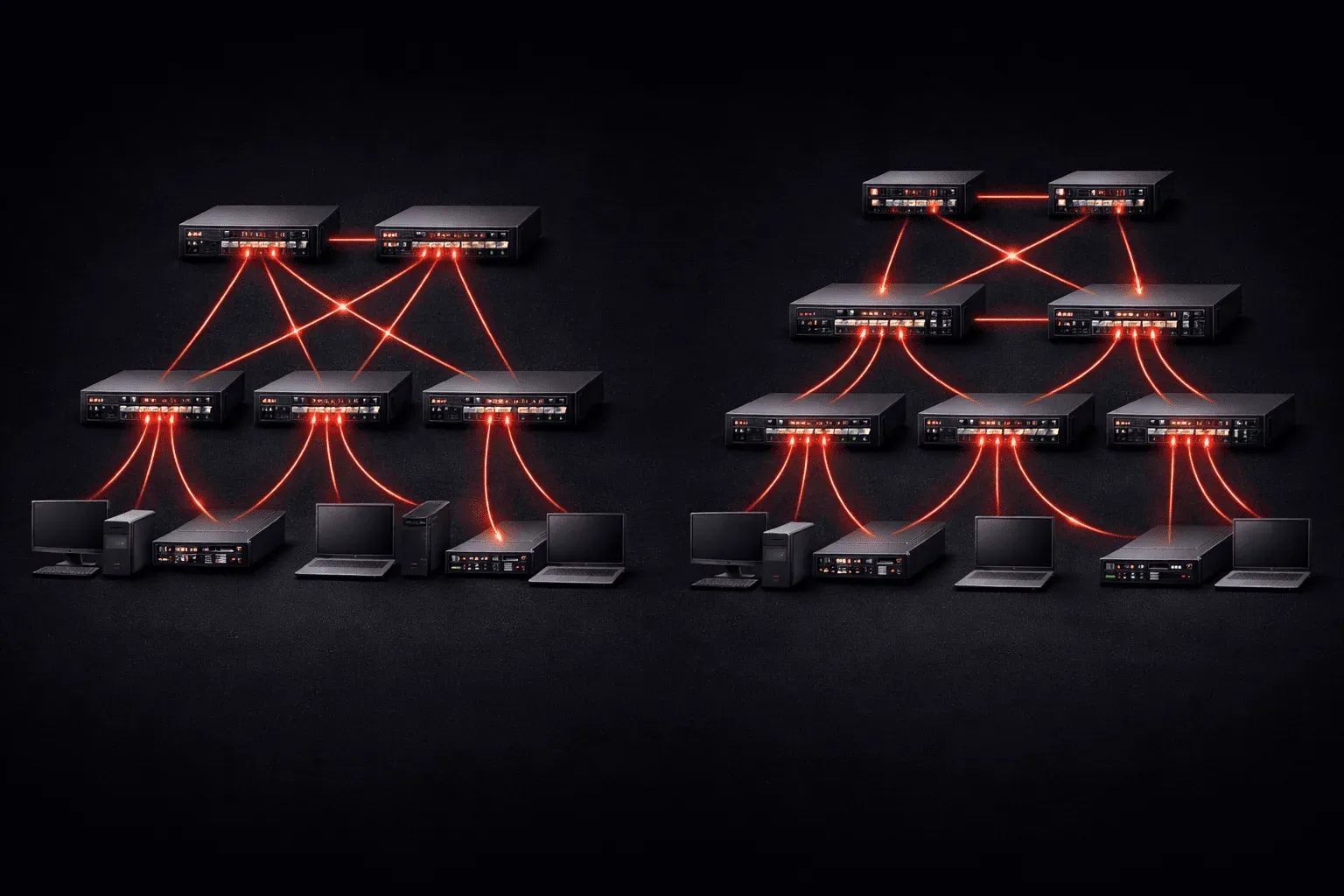
When designing enterprise networks, one of the fundamental decisions you'll face is choosing between a 2-tier (collapsed core) or 3-tier (traditional hierarchical) network architecture. This network architecture comparison isn't just academic; it directly impacts your network's performance, scalability, and cost. Let's explore both designs to help you make the right network design choice for your organization.
Understanding 2-Tier Network Design
A 2-tier network design, also called a collapsed core design, combines the core and distribution layers into a single tier. This creates two distinct layers:
- Core/Distribution Layer: High-performance switches that handle both inter-VLAN routing and high-speed connectivity
- Access Layer: Edge switches that connect end devices like workstations, phones, and wireless access points
In this design, your distribution switches perform dual roles; they provide the high-speed backbone connectivity traditionally handled by core switches while also managing VLAN routing and policy enforcement.
2-Tier Example:
Access Switch --- Core/Distribution Switch --- WAN/Internet
     |                    |
End Devices         Other Distribution
                       Switches
Understanding 3-Tier Network Design
The traditional 3-tier design maintains distinct separation between all three hierarchical layers:
- Core Layer: High-speed packet forwarding with minimal processing
- Distribution Layer: Policy enforcement, VLAN routing, and aggregation
- Access Layer: End device connectivity and basic security
Each layer has a specific function, creating clear boundaries and allowing for optimized hardware selection at each tier.
3-Tier Example:
Access Switch --- Distribution Switch --- Core Switch --- WAN/Internet
     |                   |                    |
End Devices         Policy/Routing      High-Speed Backbone
Key Differences in Practice
The most significant difference lies in where routing and policy decisions occur. In a 2-tier design, your distribution switches must handle both high-speed forwarding and complex processing tasks. Consider this routing configuration on a collapsed core switch:
interface Vlan100
 ip address 192.168.100.1 255.255.255.0
 ip helper-address 192.168.1.10
!
interface GigabitEthernet1/0/1
 switchport trunk encapsulation dot1q
 switchport mode trunk
 spanning-tree portfast trunk
This same switch handles both VLAN routing (distribution function) and high-speed trunk connections (core function).
Performance Implications
3-tier designs typically offer better performance isolation. Your core switches can dedicate all resources to packet forwarding, while distribution switches focus on routing and policy enforcement. This separation becomes critical in high-traffic environments where processing overhead at the core can create bottlenecks.
When to Choose Each Design
Choose 2-Tier When:
- Building smaller to medium-sized networks (under 500 users)
- Budget constraints require minimizing equipment costs
- Limited rack space or power availability
- Network traffic patterns are relatively predictable
- Administrative simplicity is prioritized
Choose 3-Tier When:
- Supporting large enterprise networks (500+ users)
- High availability requirements demand redundancy at each layer
- Complex routing policies or traffic engineering needs
- Future growth projections indicate significant expansion
- Different performance requirements exist across network segments
Cost and Scalability Considerations
While 2-tier designs reduce initial hardware costs by eliminating dedicated core switches, they can become more expensive to scale. When your collapsed core switches reach capacity, you often need to replace them with higher-end models rather than simply adding parallel devices.
3-tier designs typically have higher upfront costs but offer more granular scalability. You can upgrade individual layers independently based on specific bottlenecks or requirements.
Making the Right Choice
Your enterprise network design decision should align with both current needs and future growth plans. Consider factors like user count, application requirements, budget constraints, and administrative capabilities. Many modern networks actually implement hybrid approaches, using 3-tier designs in the data center while deploying 2-tier architectures for campus access networks.
What's Next
Now that you understand the fundamental differences between 2-tier and 3-tier designs, the next step is exploring spine-and-leaf architectures—the modern approach that's revolutionizing data center networking. We'll examine how this newer design pattern addresses the limitations of traditional hierarchical models.