
IPv4 vs IPv6: Key Differences Explained
IPv4 and IPv6 represent different generations of Internet Protocol, with IPv6 offering expanded addressing, improved efficiency, and built-in security. Understanding their key differences is essential as networks transition to support both protocols simultaneously.

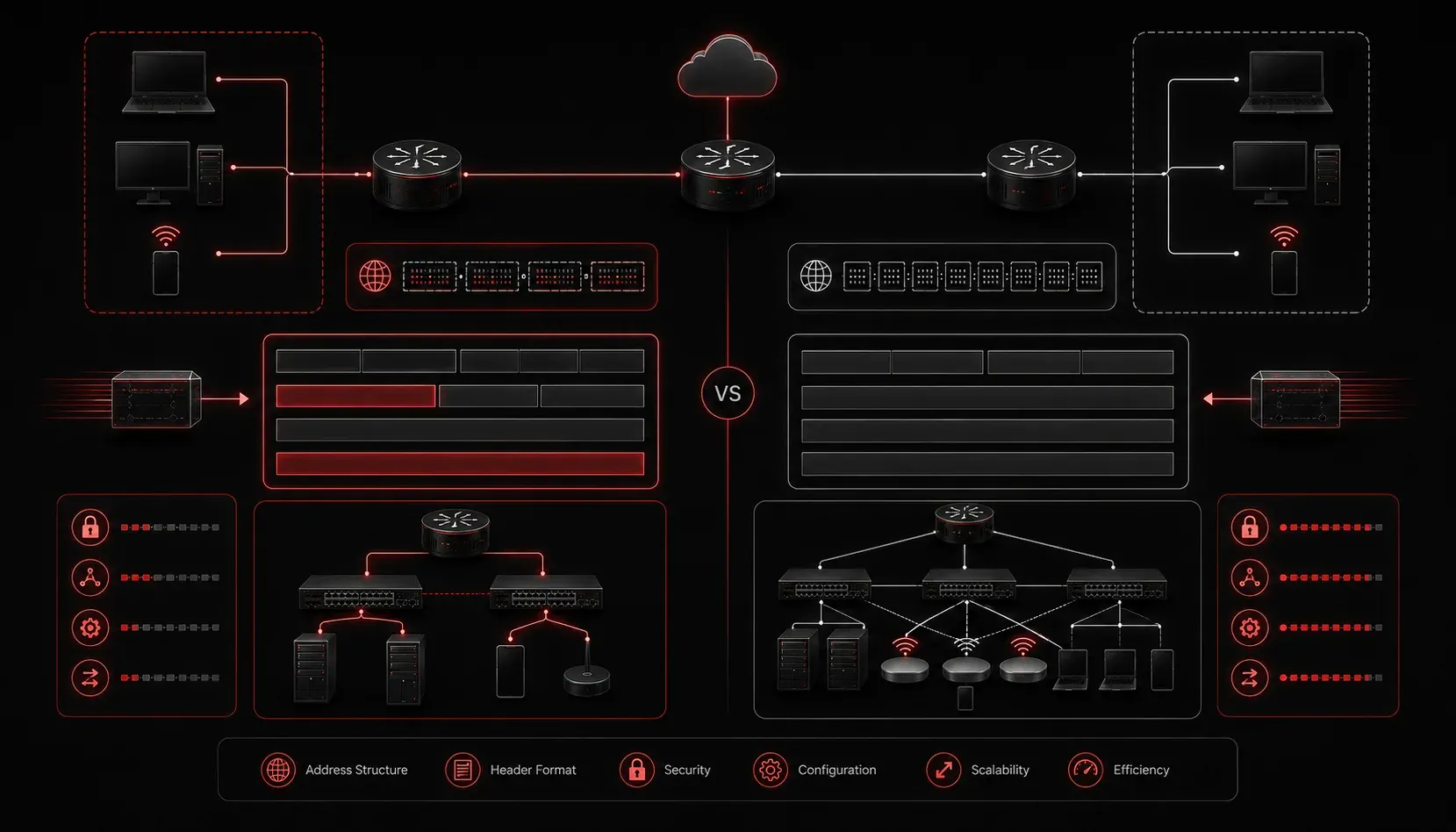
The Internet Protocol (IP) serves as the foundation of all network communication, but we're currently in the middle of a major transition. IPv4, which has powered the internet for decades, is giving way to IPv6. Understanding the key differences between these protocols is essential for any network professional.
Address Structure and Size
The most obvious difference lies in address structure. IPv4 uses 32-bit addresses, providing approximately 4.3 billion unique addresses. These addresses look familiar: 192.168.1.1 or 10.0.0.1.
IPv6 dramatically expands this with 128-bit addresses, creating roughly 340 undecillion addresses. An IPv6 address looks like this: 2001:0db8:85a3:0000:0000:8a2e:0370:7334. You'll often see these shortened using compression rules, such as 2001:db8:85a3::8a2e:370:7334.
This expansion solves IPv4's address exhaustion problem. We've essentially run out of IPv4 addresses, which is why Network Address Translation (NAT) became so widespread as a temporary solution.
Header Complexity and Efficiency
IPv6 actually simplifies the packet header despite having larger addresses. The IPv4 header contains 14 fields, while IPv6 streamlines this to just 8 fields. This simplification improves processing efficiency at routers and reduces overhead.
Key header improvements in IPv6 include:
- Removed checksum field (handled by other layers)
- Eliminated fragmentation fields from main header
- Simplified options handling through extension headers
- Fixed header length for faster processing
Built-in Security and Quality of Service
IPv6 was designed with security in mind. IPSec, which provides encryption and authentication, is part of the IPv6 specification. While IPSec can be added to IPv4 networks, it's integrated into the IPv6 standard, though its actual use remains optional and depends on implementation choices.
Quality of Service (QoS) also sees improvements. IPv6's flow label field allows routers to identify and prioritize traffic streams more efficiently than IPv4's Type of Service field.
Address Configuration
IPv4 typically relies on DHCP or manual configuration for address assignment. IPv6 introduces Stateless Address Autoconfiguration (SLAAC), allowing devices to automatically configure their own addresses using Router Advertisement messages.
For example, a device can combine the network prefix announced by a router with its own MAC address to create a unique IPv6 address. This reduces administrative overhead and simplifies network deployment.
Broadcast vs Multicast
IPv4 uses broadcast traffic for certain functions, sending packets to all devices on a network segment. IPv6 replaces broadcast communication with more efficient multicast and anycast mechanisms, fundamentally changing how devices communicate on the same network segment.
This change reduces unnecessary network traffic. Instead of every device processing broadcast packets, only interested devices receive multicast traffic, improving overall network efficiency.
The IPv6 Transition Reality
The IPv6 transition isn't happening overnight. Most networks currently run dual-stack configurations, supporting both IPv4 and IPv6 simultaneously. Tunneling mechanisms like 6to4 and Teredo help IPv6 traffic traverse IPv4-only infrastructure.
Major content providers like Google, Facebook, and Netflix now serve significant portions of their traffic over IPv6. However, many enterprise networks still rely heavily on IPv4 for internal operations.
Practical Configuration Examples
Here's how these protocols look in practice. An IPv4 interface configuration might look like:
interface GigabitEthernet0/1
 ip address 192.168.1.1 255.255.255.0
 no shutdown
The equivalent IPv6 configuration:
interface GigabitEthernet0/1
 ipv6 address 2001:db8:1::1/64
 ipv6 enable
 no shutdown
Notice how IPv6 uses CIDR notation directly rather than separate subnet masks.
What's Next
Understanding these fundamental differences prepares you for the practical aspects of IP addressing. In our next post, we'll dive deep into IPv4 subnetting concepts, exploring how to efficiently divide networks and calculate subnet ranges, a crucial skill for network design and troubleshooting.
Tools and resources for this topic
- CompTIA Network+ Study Guide — Comprehensive N10-009 exam preparation covering all five domains.