
IPv6 Prefix Explained: A Beginner's Guide
Learn IPv6 prefixes from the ground up, including how they differ from IPv4, calculation methods, and common prefix lengths used in real networks. Essential knowledge for modern networking.

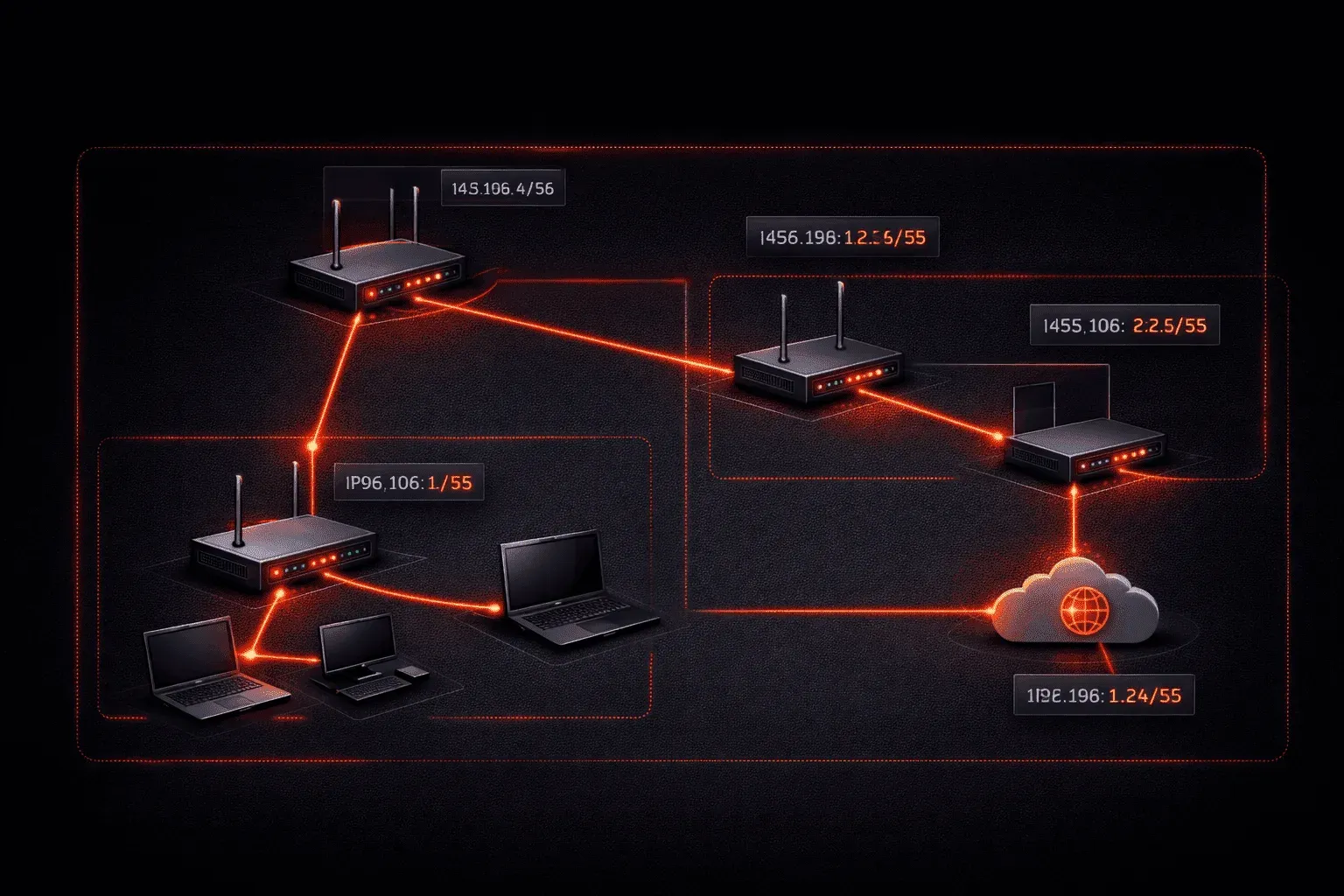
Understanding IPv6 prefixes is crucial for anyone learning modern networking. As IPv4 addresses become increasingly scarce, IPv6 adoption continues to grow, making prefix knowledge essential for network engineers. Let's break down this fundamental concept in a way that makes sense.
What Is an IPv6 Prefix?
An IPv6 prefix identifies the network portion of an IPv6 address, similar to how subnet masks work in IPv4. However, IPv6 uses a much simpler notation called CIDR (Classless Inter-Domain Routing). Instead of complex subnet masks like 255.255.255.0, IPv6 uses a forward slash followed by a number indicating how many bits represent the network portion.
For example: 2001:db8::/32 means the first 32 bits identify the network, and the remaining 96 bits are available for host addresses.
IPv6 vs IPv4 Prefix Differences
The key differences between IPv6 and IPv4 prefixes highlight why IPv6 is more scalable:
- Address Length: IPv4 uses 32 bits total, while IPv6 uses 128 bits
- Notation: IPv4 uses dotted decimal with subnet masks, IPv6 uses hexadecimal with CIDR notation
- Common Prefixes: IPv4 typically uses /24, /25, /26, while IPv6 commonly uses /64, /48, /56
- Host Portions: IPv6's longer addresses allow for massive host ranges even with longer prefixes
Real-World Example
Compare these equivalent network sizes:
IPv4: 192.168.1.0/24 = 254 usable host addresses
IPv6: 2001:db8:1::/64 = 18,446,744,073,709,551,616 host addresses
How to Calculate IPv6 Prefix
Calculating IPv6 prefixes follows the same binary logic as IPv4, but with 128 bits instead of 32. Here's the step-by-step process:
Understanding the Structure
IPv6 addresses are divided into 8 groups of 4 hexadecimal digits (16 bits each). Each hex digit represents 4 bits, so:
- One hex digit = 4 bits
- One group (4 hex digits) = 16 bits
- Eight groups = 128 bits total
Practical Calculation Example
Let's work with 2001:db8:abcd:1234::/64:
2001:db8:abcd:1234:: /64

Breaking it down:
- 2001 = 16 bits (network)
- db8  = 16 bits (network)
- abcd = 16 bits (network)
- 1234 = 16 bits (network)
Total: 64 bits for network portion

Remaining: 128 - 64 = 64 bits for host portion
Common IPv6 Prefix Lengths
Understanding standard IPv6 subnetting practices helps with network design:
- /32: Typically assigned to ISPs by regional registries
- /48: Standard allocation for enterprise networks
- /56: Common for smaller businesses or residential broadband
- /64: Standard subnet size for end networks (LANs)
Subnetting Example
If you receive a /48 allocation, you can create subnets:
Allocated: 2001:db8:1000::/48

Possible /64 subnets:
2001:db8:1000:0::/64
2001:db8:1000:1::/64
2001:db8:1000:2::/64
...up to...
2001:db8:1000:ffff::/64

Total subnets possible: 2^16 = 65,536 subnets
Practical Tips for IPv6 Prefix Management
When working with IPv6 prefixes in real networks:
- Always use
/64for end-user subnets to support SLAAC (Stateless Address Autoconfiguration) - Plan your addressing scheme before implementation
- Document your prefix allocation strategy
- Use tools like
ipv6calcor online calculators to verify your work
What's Next
Now that you understand IPv6 prefixes, the next logical step is learning about IPv6 address types and their specific use cases. We'll explore unicast, multicast, and anycast addresses, plus how link-local addressing works in practical network scenarios.
CCNA study resources
- CCNA Official Cert Guide Library (Wendell Odom) — Both volumes covering the full 200-301 exam blueprint. The definitive CCNA study resource.
- Wendell Odom CCNA Vol 1 — Networking fundamentals, switching, VLANs, STP, and IPv4 routing.