
Preventing Data Exposure in AI: Best Practices
This post covers essential strategies for preventing data exposure in AI systems, including data minimization, privacy-preserving techniques, secure development practices, and deployment security measures. IT professionals learn practical approaches to protect sensitive information throughout AI wo

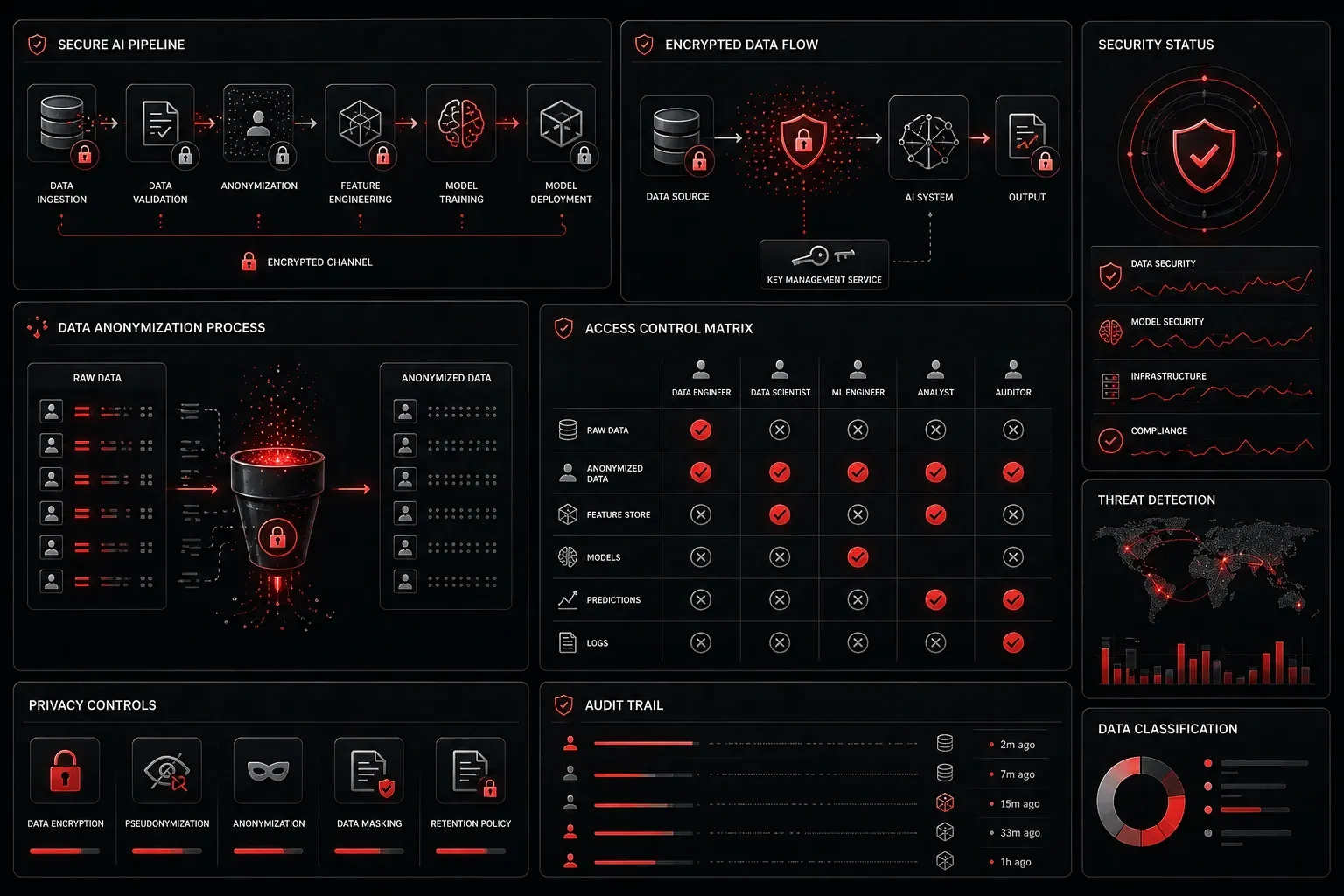
When working with AI systems, protecting sensitive data isn't just a best practice; it's essential for compliance, trust, and business continuity. Data exposure in AI workflows can happen at multiple points, from training data preparation to model deployment. Let's explore practical strategies to prevent data exposure in AI systems and maintain robust security throughout your AI pipeline.
Understanding Data Exposure Risks in AI
AI systems process vast amounts of data, creating unique exposure risks. Unlike traditional applications, AI models can inadvertently memorize and later reveal sensitive information from their training data. This phenomenon, often called "model memorization" or "training data extraction," means that models might reproduce sensitive patterns from their training data in their outputs.
It's important to distinguish this from "data leakage" in machine learning, which typically refers to the improper use of future information or target variables during training, leading to overly optimistic performance estimates.
Common exposure points include:
- Training data repositories containing personal information
- Model outputs that reveal patterns about individuals
- API endpoints that don't properly sanitize responses
- Development environments with inadequate access controls
Data Minimization and Classification
Start your data exposure prevention strategy by implementing data minimization. Only collect and process data that's absolutely necessary for your AI objectives. Create a data classification system that identifies sensitive information levels:
# Example data classification schema
data_classifications = {
    "public": "No restrictions",
    "internal": "Company employees only",
    "confidential": "Authorized personnel only",
    "restricted": "Highest security, minimal access"
}
Apply different security controls based on these classifications. For instance, restricted data should never be used in development environments and requires additional encryption layers.
Implementing Privacy-Preserving Techniques
Modern AI data security relies heavily on privacy-preserving techniques. Differential privacy adds carefully calibrated mathematical noise to datasets, ensuring individual records cannot be identified while maintaining statistical utility for AI training.
Consider these approaches:
Differential Privacy: In practice, differential privacy can be implemented using libraries like Google's differential-privacy library or Microsoft's SmartNoise. For example, you might add Laplacian noise to aggregate statistics or use the Private Aggregation of Teacher Ensembles (PATE) framework for training classifiers with privacy guarantees.
Data Anonymization: Remove or hash personally identifiable information (PII) before processing. However, be aware that anonymization isn't foolproof; sophisticated attacks can sometimes re-identify individuals. Properly implemented encryption, when used correctly with secure key management, should prevent data reconstruction from encrypted sources.
Synthetic Data Generation: Create artificial datasets that maintain the statistical properties of real data without exposing actual records. Tools like synthcity or DataSynthesizer can generate realistic synthetic datasets for training.
Federated Learning: Train models across distributed datasets without centralizing the data. Real-world applications include Google's Gboard keyboard learning from typing patterns without sending raw text data to servers, and healthcare consortiums training diagnostic models across hospitals while keeping patient data local. Frameworks like TensorFlow Federated and PySyft make federated learning implementation more accessible.
Secure Development Practices
Your development workflow significantly impacts AI privacy. Implement these secure coding practices:
Use environment-specific data controls. Development environments should never access production data directly. Instead, create sanitized datasets or synthetic alternatives for testing:
# Environment check before data access
import os

if os.environ.get('ENVIRONMENT') == 'production':
    data_source = get_production_data()
else:
    data_source = get_synthetic_data()
Implement proper logging without exposing sensitive data. Log model performance metrics and system events, but exclude actual data values:
# Good: Log aggregated metrics
logger.info(f"Model accuracy: {accuracy_score}")

# Bad: Log individual predictions with user data
# logger.info(f"User {user_id} prediction: {prediction}")
Access Controls and Monitoring
Establish strict access controls for AI systems and data repositories. Use role-based access control (RBAC) to ensure team members only access data necessary for their specific responsibilities.
Implement continuous monitoring to detect unusual data access patterns. Set up alerts for:
- Bulk data downloads outside normal patterns
- Access attempts from unusual locations or times
- Model queries that might be probing for sensitive information
- Unauthorized access to training datasets
Regular security audits should include reviewing data flows, access logs, and model outputs for potential exposure risks.
Model Deployment Security
When deploying AI models, ensure your APIs don't inadvertently expose training data. Implement input validation, output filtering, and rate limiting to prevent malicious queries designed to extract sensitive information.
Consider using model serving platforms that provide built-in security features, such as request logging, access controls, and automatic threat detection.
What's Next
Now that you understand the fundamentals of data exposure prevention, the next step is to implement comprehensive data governance frameworks for AI projects. We'll explore how to establish data lineage tracking, automated compliance checking, and cross-functional governance processes that scale with your AI initiatives.