
QoS in VoIP: Ensuring Quality Communication
Learn how Quality of Service (QoS) ensures reliable VoIP communications through traffic prioritization and bandwidth management. Covers DSCP marking, Low Latency Queuing, and end-to-end QoS implementation strategies.

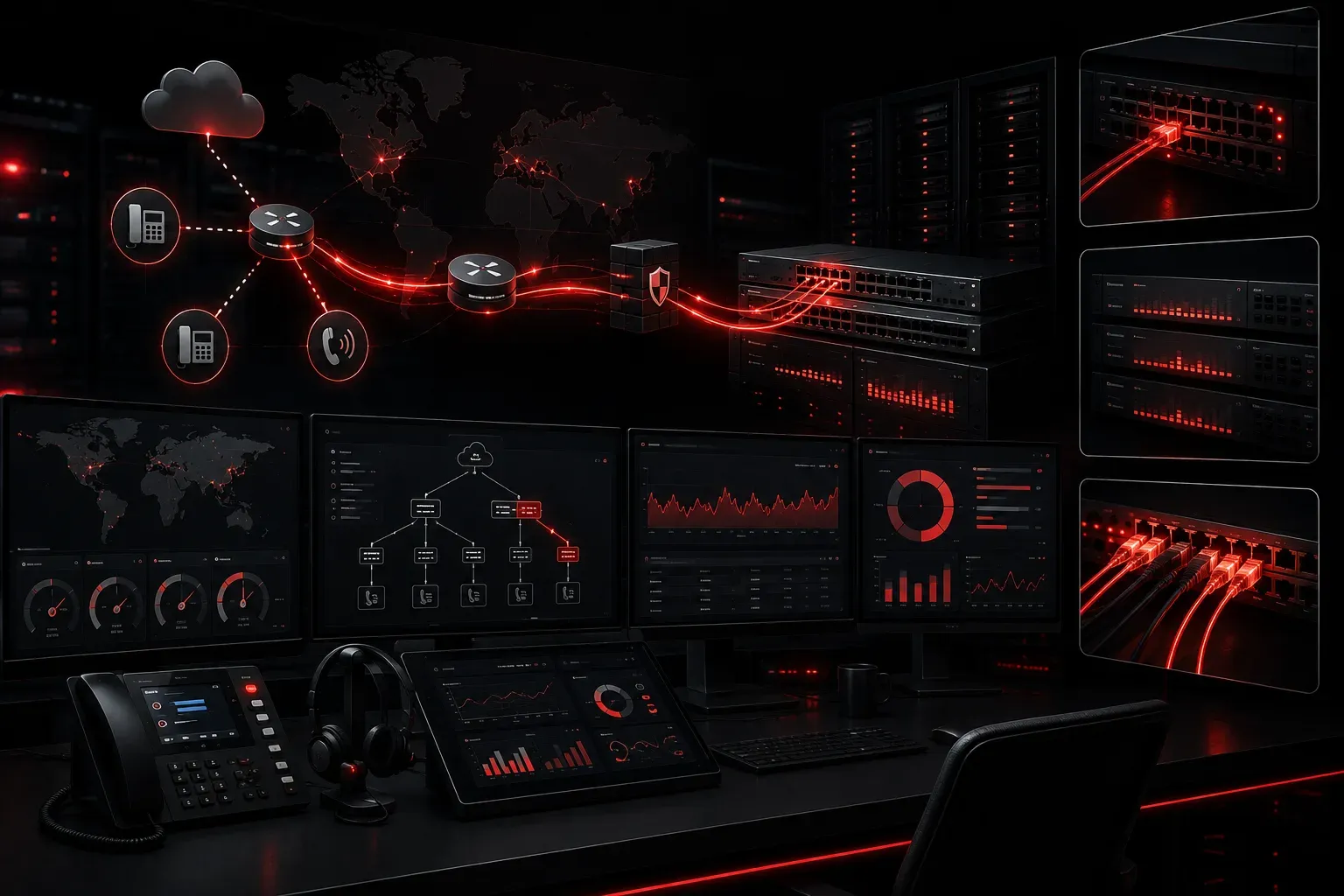
Voice over IP (VoIP) has revolutionized business communications, but it comes with unique challenges. Unlike traditional data that can tolerate delays and packet loss, voice traffic demands real-time delivery with minimal latency, jitter, and packet loss. This is where Quality of Service (QoS) becomes critical for ensuring quality communication.
Understanding VoIP's Network Requirements
VoIP packets are small but time-sensitive. Bandwidth requirements vary significantly depending on the codec used:
- G.711 - Uncompressed audio, requires 64 Kbps
- G.729 - Compressed codec, uses around 8 Kbps
- G.722 - HD voice codec, typically uses 48-64 Kbps
- Opus - Adaptive codec, ranges from 6-510 Kbps
Regardless of codec choice, these packets must arrive consistently and in order. Even a 150-millisecond delay can make conversations feel awkward, while packet loss above 1% creates noticeable audio quality degradation.
The three main enemies of VoIP quality are:
- Latency - One-way delay should stay below 150ms
- Jitter - Variation in packet arrival times should ideally be under 20ms (30ms is acceptable but not optimal)
- Packet Loss - Should remain below 1% for acceptable quality
Traffic Prioritization for VoIP
The foundation of QoS VoIP implementation is traffic prioritization. VoIP packets must receive preferential treatment over other network traffic like file downloads, web browsing, and email.
Most QoS implementations use Differentiated Services Code Point (DSCP) marking. DSCP values are 6-bit codes in the IP header that indicate how packets should be treated by network devices. For VoIP, the standard markings are:
Voice Bearer Traffic: DSCP EF (Expedited Forwarding) - Value 46
Voice Signaling: DSCP AF31 (Assured Forwarding) - Value 26
On a Cisco router, you can configure VoIP traffic classification like this:
class-map match-all VOICE-BEARER
 match dscp ef

class-map match-all VOICE-SIGNALING
 match dscp af31

policy-map QOS-POLICY
 class VOICE-BEARER
  priority percent 20
 class VOICE-SIGNALING
  bandwidth percent 5
Bandwidth Management Strategies
Effective bandwidth management ensures VoIP traffic gets the resources it needs without starving other applications. A common approach is the "20-5-75" rule:
- 20% bandwidth reserved for voice bearer traffic
- 5% bandwidth reserved for voice signaling
- 75% available for data traffic
Low Latency Queuing (LLQ) is particularly effective for VoIP. It creates a strict priority queue for voice traffic while preventing it from monopolizing the entire link:
policy-map WAN-QOS
 class VOICE-BEARER
  priority 1000
 class class-default
  fair-queue
  random-detect
End-to-End QoS Implementation
Quality communication requires QoS implementation across the entire network path. This includes:
Access Layer: Trust DSCP markings from IP phones or apply marking based on switch ports connected to phones.
Distribution/Core: Maintain DSCP markings and implement queuing policies that prioritize voice traffic.
WAN Edge: Apply traffic shaping and prioritization, especially critical on bandwidth-constrained links.
A simple switch configuration to trust markings from IP phones:
interface GigabitEthernet1/0/1
 switchport mode access
 switchport voice vlan 100
 mls qos trust dscp
Monitoring and Troubleshooting
Continuous monitoring is essential for maintaining VoIP quality. Key metrics to track include:
- Mean Opinion Score (MOS) - Should stay above 4.0
- Packet loss percentage
- Latency measurements
- Jitter buffer performance
Use tools like show policy-map interface to verify QoS policies are working, and show ip rtp header-compression to check RTP stream statistics.
What's Next
Now that you understand QoS fundamentals for VoIP, the next step is to explore advanced QoS mechanisms like Call Admission Control (CAC) and how to integrate QoS policies with SD-WAN solutions for modern enterprise networks.