
Routing Protocol Metrics Explained Simply
Routing protocol metrics are values used by routers to determine the best path when multiple routes exist to the same destination. This post explains how RIP, OSPF, and EIGRP each use different metrics, with a practical OSPF cost calculation example. It also clarifies the distinction between metric

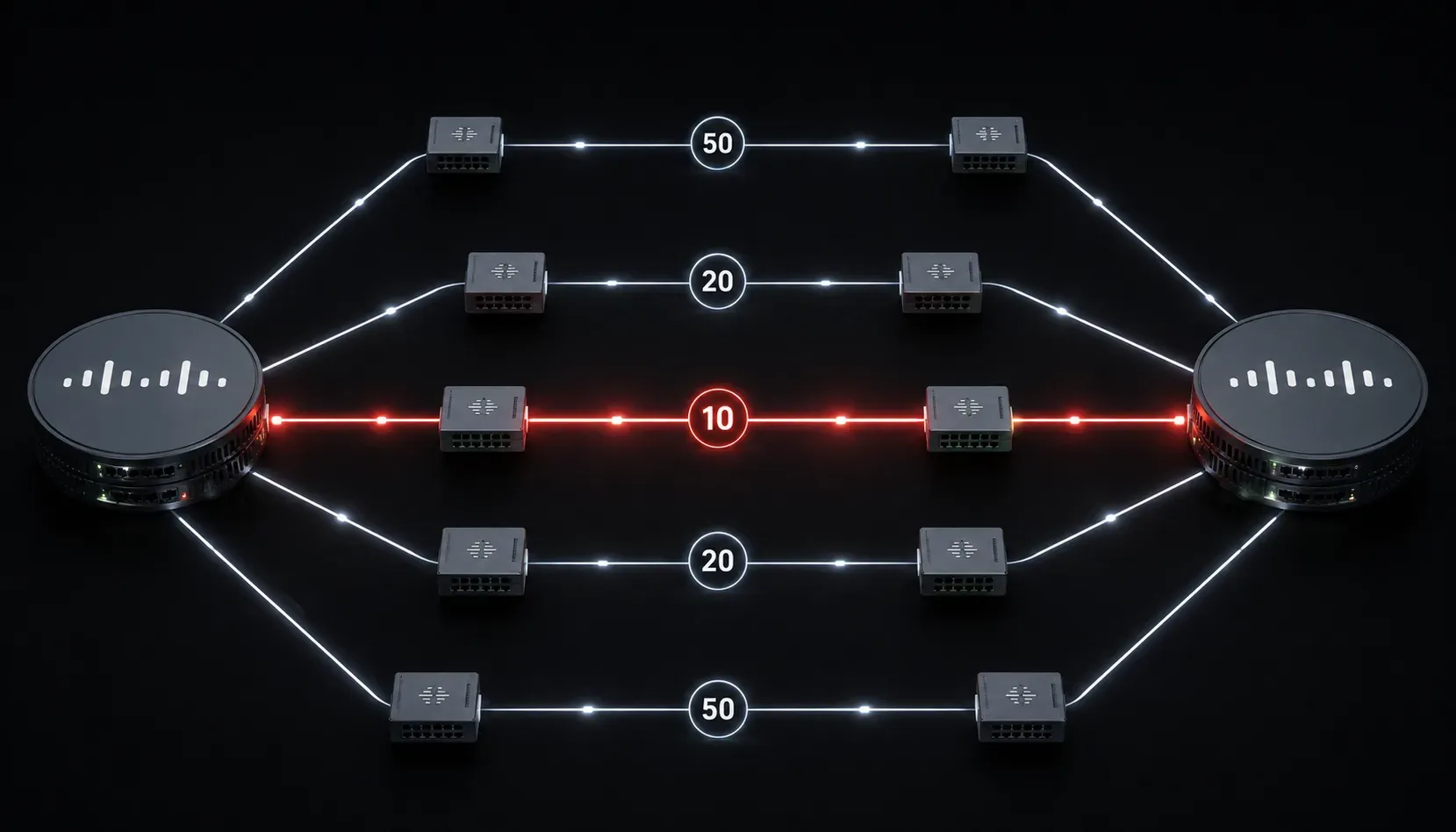
When a router receives a packet, it needs to decide where to send it next. If there's only one path available, that's easy. But what happens when multiple paths exist to the same destination? This is where routing protocol metrics come in.
A metric is simply a value that a routing protocol uses to measure the "cost" of a particular path. The lower the metric (in most cases), the better the path. Think of it like a GPS app comparing routes: it considers distance, traffic, and road type before recommending the fastest option. Routers do the same thing, just with different variables depending on the protocol.
Why Metrics Matter for Network Path Selection
Without metrics, routers would have no way to compare competing paths in a consistent, logical way. Imagine your network has two routes to the same destination server: one through a fast fiber link and one through a slow satellite connection. A routing metric gives the router a way to mathematically prefer the fiber link and send traffic there automatically.
Each routing protocol uses its own metric, and they are not interchangeable. A metric value from OSPF means something completely different than a metric value from EIGRP. Understanding which metric belongs to which protocol is an important part of the CCNA exam and real-world troubleshooting.
Common Routing Protocol Metrics
Here is a breakdown of the most common routing protocols you will encounter at the CCNA level, along with the metric each one uses:
- RIP (Routing Information Protocol): Uses hop count as its metric. Each router a packet passes through counts as one hop. The maximum hop count is 15; anything beyond that is considered unreachable. Simple, but it ignores link speed entirely.
- OSPF (Open Shortest Path First): Uses cost, which is derived from bandwidth. The formula is
10^8 / bandwidth (bps). A higher-bandwidth link has a lower cost, so OSPF naturally prefers faster links. - EIGRP (Enhanced Interior Gateway Routing Protocol): Uses a composite metric calculated from bandwidth and delay by default. It can also incorporate reliability, load, and MTU, but Cisco recommends leaving those at their defaults.
- IS-IS: Uses a configurable cost value assigned to each interface, similar in concept to OSPF.
A Practical Look at OSPF Cost
Let's say you have two paths to a destination. Path A uses a 100 Mbps FastEthernet link, and Path B uses a 1 Gbps GigabitEthernet link. Here is how OSPF calculates cost for each:
FastEthernet (100 Mbps):
Cost = 10^8 / 100,000,000 = 1

GigabitEthernet (1 Gbps):
Cost = 10^8 / 1,000,000,000 = 0.1 → rounded up to 1
Notice a potential issue here: both links end up with a cost of 1 when using the default reference bandwidth of 100 Mbps. This is why Cisco recommends adjusting the OSPF auto-cost reference bandwidth on modern networks using the command:
Router(config-router)# auto-cost reference-bandwidth 10000This sets the reference to 10 Gbps, giving the router more granularity when comparing faster links.
Metrics vs. Administrative Distance
One thing that trips up many beginners: metrics are only used to compare routes within the same routing protocol. If your router is running both OSPF and EIGRP, it uses administrative distance (AD) to decide which protocol's routes to trust first, before metrics are even considered. Metrics in routing only come into play once a protocol is selected. We will cover administrative distance in detail in an upcoming post.
Quick Reference Summary
- RIP: Hop count (max 15)
- OSPF: Cost (based on bandwidth)
- EIGRP: Composite metric (bandwidth + delay by default)
What's Next
Now that you understand how routing protocols measure path quality using metrics, the natural next step is understanding administrative distance: the mechanism routers use when multiple routing protocols are running simultaneously and offering routes to the same destination. That concept ties directly into how a router builds its final routing table, and it is another key topic in CCNA exam objective 3.2.
Tools and resources for this topic
- CCNA Official Cert Guide (Wendell Odom) — The definitive CCNA study resource. Both volumes cover the 200-301 exam blueprint in full.
- Wendell Odom CCNA Vol 1 — Covers networking fundamentals, switching, and routing basics.
- Wendell Odom CCNA Vol 2 — Covers advanced routing, WAN, infrastructure services, and security.