
Static vs Dynamic Routing: Key Differences Explained
This post explains the key differences between static and dynamic routing, covering when to use each approach and how they impact network performance and management. It includes practical examples and configuration commands to illustrate both routing types.

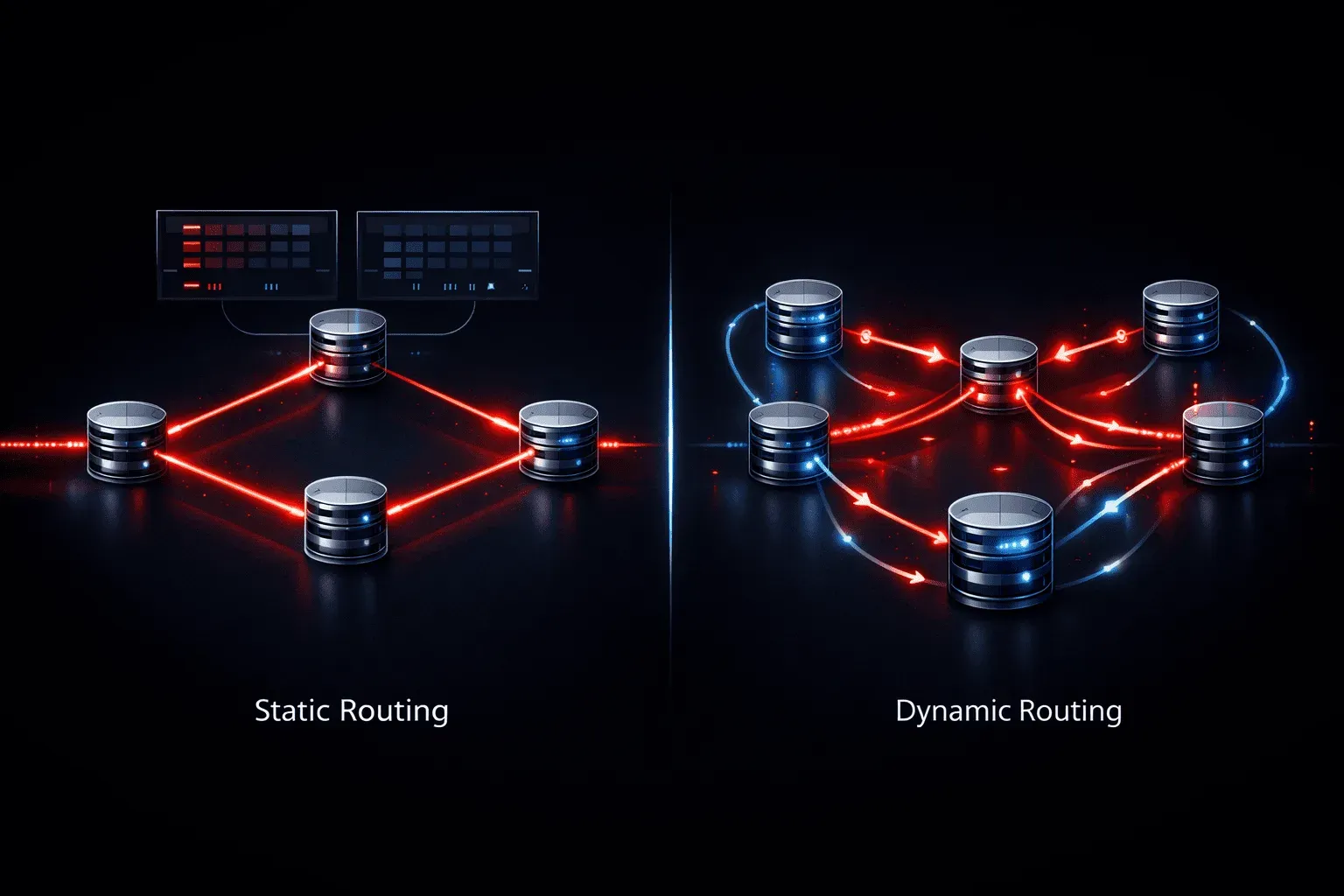
When it comes to routing in computer networks, you have two fundamental approaches: static and dynamic routing. Understanding the static vs dynamic routing differences is crucial for anyone studying networking or preparing for their Network+ certification. Let's explore how these routing types comparison works and when to use each approach.
What is Static Routing?
Static routing involves manually configuring network routes in a router's routing table. Network administrators must explicitly define the path packets should take to reach their destination networks. Once configured, these routes remain unchanged unless manually modified.
Here's a simple example of a static route configuration on a Cisco router:
Router(config)# ip route 192.168.2.0 255.255.255.0 10.0.0.2
Router(config)# ip route 0.0.0.0 0.0.0.0 203.0.113.1
The first command creates a route to the 192.168.2.0/24 network via the next-hop address 10.0.0.2. The second creates a default route (0.0.0.0/0) pointing to 203.0.113.1.
Advantages of Static Routing
- Predictable performance: No CPU overhead from routing protocol calculations
- Security: No routing information exchanged between routers
- Bandwidth conservation: No routing protocol traffic consuming network resources
- Complete control: Administrators decide exactly which paths packets take
Disadvantages of Static Routing
- Manual maintenance: Every route must be configured and updated manually
- No fault tolerance: If a link fails, traffic cannot automatically reroute
- Scalability issues: Becomes unmanageable in large networks
What is Dynamic Routing?
Dynamic routing uses routing protocols to automatically discover and maintain network routes. Routers exchange routing information with neighboring routers, building and updating their routing tables automatically as network conditions change.
Common dynamic routing protocols include:
- RIP (Routing Information Protocol): Distance-vector protocol, simple but limited
- OSPF (Open Shortest Path First): Link-state protocol, efficient and scalable
- EIGRP (Enhanced Interior Gateway Routing Protocol): Cisco proprietary, hybrid approach
- BGP (Border Gateway Protocol): Used for internet routing between autonomous systems
Here's how you might enable OSPF on a Cisco router:
Router(config)# router ospf 1
Router(config-router)# network 192.168.1.0 0.0.0.255 area 0
Router(config-router)# network 10.0.0.0 0.255.255.255 area 0
Advantages of Dynamic Routing
- Automatic updates: Routes adjust automatically to network changes
- Fault tolerance: Can find alternate paths when links fail
- Scalability: Works well in large, complex networks
- Load balancing: Can distribute traffic across multiple paths
Disadvantages of Dynamic Routing
- Resource consumption: Uses CPU cycles and network bandwidth
- Complexity: Requires understanding of routing protocols and their configuration
- Convergence time: Takes time to adapt to network changes
- Security considerations: Routing updates could potentially be exploited
Network Routing Differences: When to Use Each
The choice between static and dynamic routing depends on your specific network requirements:
Use Static Routing When:
- You have a small network with few routers
- Network topology rarely changes
- Maximum security is required
- You need predictable routing behavior
- Bandwidth and processing power are limited
Use Dynamic Routing When:
- You have a large, complex network
- Network topology changes frequently
- Fault tolerance and redundancy are important
- You need automatic load balancing
- Administrative overhead must be minimized
Hybrid Approach
Many real-world networks use a combination of both approaches. For example, you might use static routes for connecting to specific servers or internet gateways, while employing dynamic routing protocols for internal network communication. This hybrid approach leverages the benefits of both routing types.
What's Next
Now that you understand the fundamental differences between static and dynamic routing, the next step is diving deeper into specific dynamic routing protocols. In our upcoming posts, we'll explore distance-vector routing protocols like RIP and examine how they discover and maintain network routes automatically.
Network+ study resources
- CompTIA Network+ Study Guide — Full N10-009 exam coverage across all five domains. Essential exam preparation.