
What is Subnetting and Why is it Important?
Subnetting divides large networks into smaller, manageable segments, improving IP address efficiency, network management, security, and performance. This fundamental concept enables logical network organization and better traffic control.

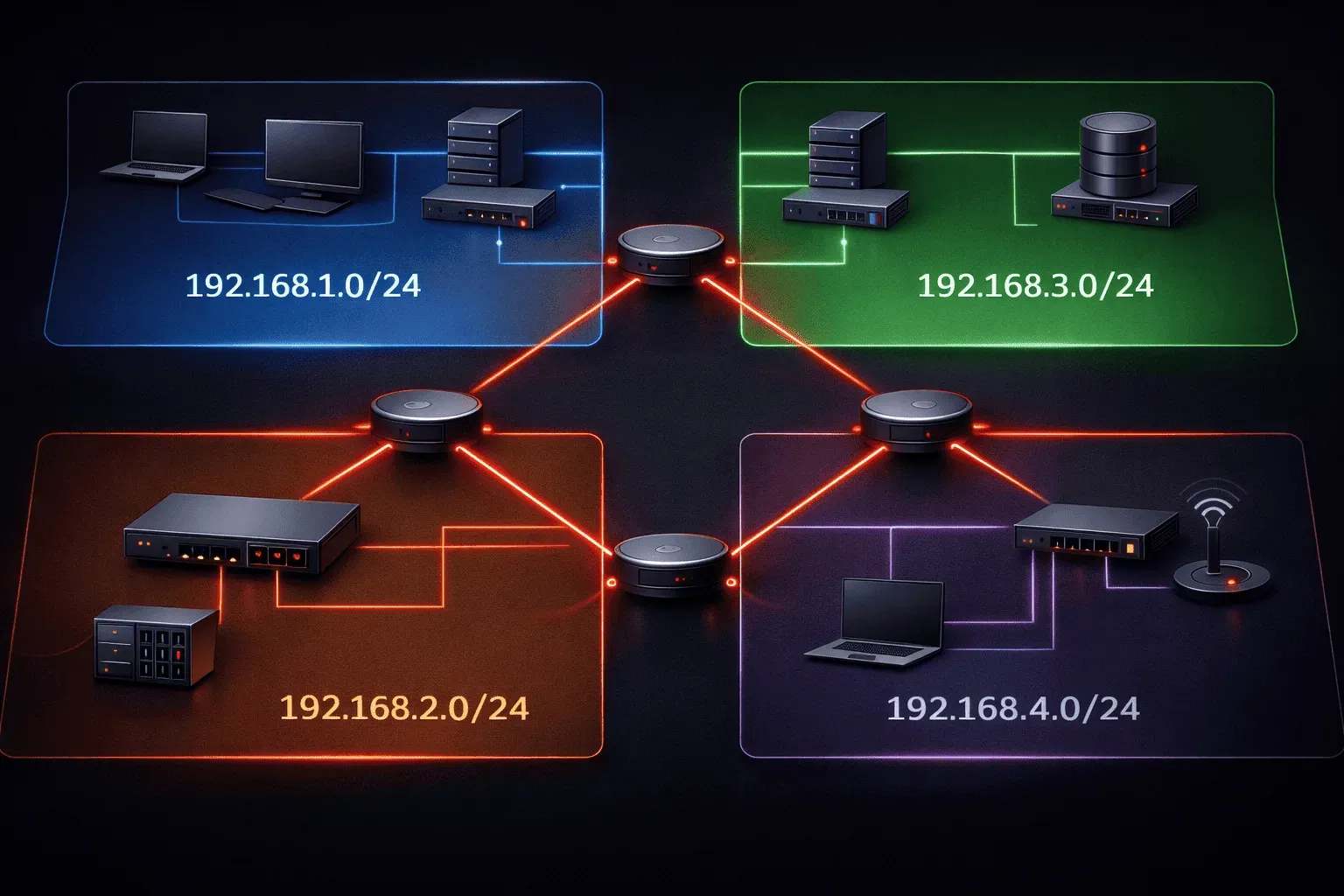
Subnetting is one of those networking concepts that seems intimidating at first but becomes incredibly logical once you understand why it exists. Think of subnetting as a way to take a large network and break it into smaller, more manageable pieces, much like how a large office building is divided into floors and departments.
What is Subnetting?
Subnetting is the process of dividing a single network into multiple smaller networks called subnets. When you subnet a network, you're essentially borrowing bits from the host portion of an IP address to create additional network identifiers. This allows you to create multiple logical networks within a single physical network infrastructure.
To understand how bits are borrowed, consider a /24 network like 192.168.1.0/24. In binary, the subnet mask for /24 is 24 ones followed by 8 zeros: 11111111.11111111.11111111.00000000. The 24 ones represent the network portion and the 8 zeros represent the host portion, giving you 254 usable host addresses. If you borrow 2 bits from the host portion, your mask becomes /26: 11111111.11111111.11111111.11000000. Those 2 borrowed bits allow you to create 4 subnets (2 to the power of 2), and the remaining 6 host bits give each subnet 62 usable addresses (2 to the power of 6, minus 2 for the network and broadcast addresses).
The subnet mask tells devices which part of an IP address identifies the network and which part identifies the host. When a device wants to communicate with another device, it compares its own IP address against the subnet mask to determine whether the destination is on the same subnet (send directly) or a different subnet (send to the router). This is why getting the subnet mask right is critical: a wrong mask means devices send traffic to the wrong place.
For example, instead of having one large network with the address 192.168.1.0/24 that can accommodate 254 hosts, you might divide it into four smaller /26 subnets, each capable of supporting 62 hosts. Each subnet becomes its own broadcast domain with its own unique network address.
Why is Subnetting Important?
Efficient IP Address Organisation
Without subnetting, IP address allocation would be incredibly wasteful. Imagine if every small office with 10 computers were assigned a Class C network that could support 254 devices. That's 244 wasted IP addresses per location! Subnetting allows network administrators to allocate exactly the right amount of IP addresses needed for each network segment.
Improved Network Management
Subnetting provides significant advantages for network management:
- Logical organisation: Different departments or functions can be placed on separate subnets (Sales, Engineering, Guest network)
- Easier troubleshooting: Network issues can be isolated to specific subnets
- Simplified administration: Policies and configurations can be applied per subnet rather than per individual device
Enhanced Security
Each subnet creates a natural boundary for implementing security policies. You can control traffic flow between subnets using access control lists (ACLs) or firewalls. For instance, you might allow the Accounting subnet to access the Server subnet but prevent the Guest subnet from reaching internal resources.
Broadcast Domain Control
Every subnet is its own broadcast domain, which means broadcast traffic is contained within each subnet. This reduces unnecessary network traffic and improves overall performance. In a flat network without subnets, every broadcast message reaches every device on the network.
Real-World Example
Consider a company with 200 employees across three departments. Instead of putting everyone on one large network, you might create:
- Sales Department: 192.168.1.0/26 (62 hosts)
- Engineering: 192.168.1.64/26 (62 hosts)
- Administration: 192.168.1.128/26 (62 hosts)
- Servers: 192.168.1.192/27 (30 hosts)
This design does more than just organise addresses. It directly improves routing efficiency and network performance. A router connecting these subnets maintains a routing table entry for each subnet and forwards traffic only where it needs to go. When a Sales employee sends a file to a colleague in the same subnet, that traffic never leaves the Sales subnet at all. When a Sales employee needs to reach the Servers subnet, the router forwards only that specific flow rather than exposing it to all devices on a flat network. This reduces the load on the router and keeps broadcast traffic contained, which is especially noticeable in environments with hundreds of devices where broadcast storms on a flat network can cause serious performance degradation.
Traffic Flow Benefits
With proper subnetting, traffic between devices in the same department stays local to their subnet. Only traffic destined for other departments needs to pass through a router, reducing congestion and improving performance. This is particularly important in environments with heavy local communication patterns.
Planning Considerations
Effective subnetting requires planning ahead. You need to consider:
- Current host requirements for each network segment
- Future growth expectations
- Network topology and physical constraints
- Administrative and security boundaries
The importance of subnetting becomes clear when you realise that poor initial planning can lead to network redesigns, IP address renumbering, and significant operational disruption later.
What's Next
Now that you understand why subnetting is crucial for network organisation and management, the next step is to learn how to calculate subnet masks and determine network boundaries. We'll dive into the binary math behind subnetting and walk through practical examples of dividing networks to meet specific requirements.
CCNA study resources
- CCNA Official Cert Guide Library (Wendell Odom) - Both volumes covering the full 200-301 exam blueprint. The definitive CCNA study resource.
- Wendell Odom CCNA Vol 1 - Networking fundamentals, switching, VLANs, STP, and IPv4 routing.