
Verifying Summarization Across Multiple Routing Protocols
This post covers comprehensive verification techniques for route summarization across EIGRP, OSPF, and BGP, including specific CLI commands and database queries to confirm proper summary route generation and propagation. Essential knowledge for maintaining optimal routing tables in enterprise netwo

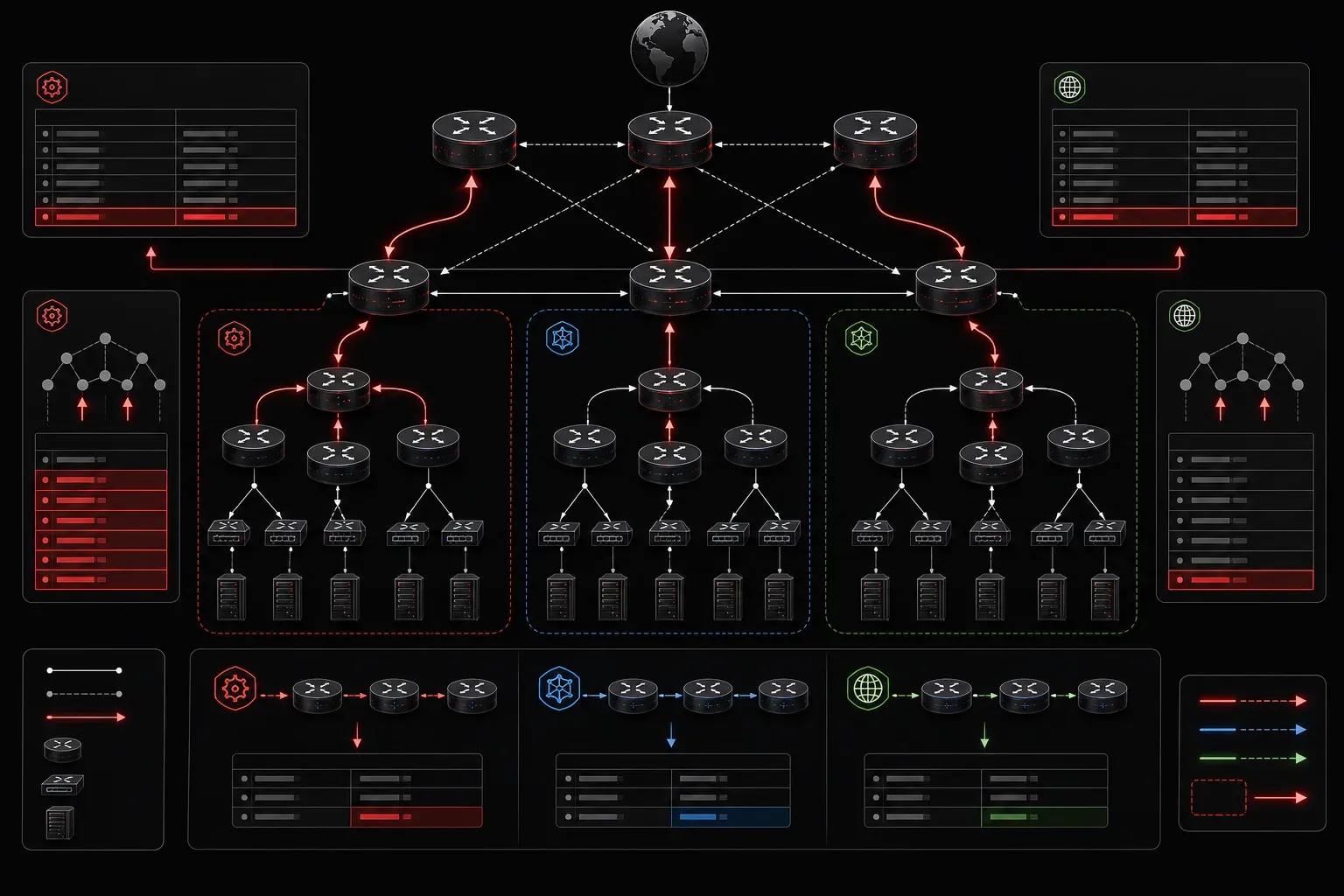
Route summarization verification requires protocol-specific approaches and understanding of how each routing protocol handles aggregated routes. As networks grow and summarization becomes critical for scalability, knowing how to verify that your summarization is working correctly across EIGRP, OSPF, and BGP becomes essential for maintaining optimal routing tables and preventing routing loops or suboptimal path selection.
EIGRP Summarization Verification
EIGRP supports both automatic and manual summarization. When verifying EIGRP summarization, start with the routing table and work backwards through the EIGRP topology table to understand the summarization behavior.
Manual Summarization Verification
For manual summarization configured with ip summary-address eigrp, verify the summary route appears in the routing table with the correct administrative distance and metric:
Router# show ip route eigrp
E    192.168.0.0/16 [90/409600] via 10.1.1.2, 00:05:23, GigabitEthernet0/1
     10.0.0.0/8 is variably subnetted, 5 subnets, 3 masks
E       10.1.0.0/16 [90/409600] via 10.1.1.2, 00:05:23, GigabitEthernet0/1
Examine the EIGRP topology table to confirm the summary route exists and verify which specific routes are being summarized:
Router# show ip eigrp topology 192.168.0.0/16
EIGRP-IPv4 Topology Entry for AS(100)/ID(1.1.1.1) for 192.168.0.0/16
  State is Passive, Query origin flag is 1, 1 Successor(s), FD is 281600
  Descriptor Blocks:
  0.0.0.0 (Null0), from 0.0.0.0, Send flag is 0x0
      Composite metric is (281600/0), route is Internal
      Vector metric:
        Minimum bandwidth is 10000000 Kbit
        Total delay is 1000 microseconds
The Null0 interface indicates this is a locally originated summary route. Use show ip eigrp topology all-links to see both successors and feasible successors for comprehensive verification.
Automatic Summarization Verification
When auto-summary is enabled, EIGRP automatically summarizes at classful network boundaries. Verify this behavior by checking for classful summaries in the routing table and confirming the summarization occurs only where expected:
Router# show ip protocols
*** IP Routing is NSF aware ***

Routing Protocol is "eigrp 100"
  Outgoing update filter list for all interfaces is not set
  Incoming update filter list for all interfaces is not set
  Default networks flagged in outgoing updates
  Default networks accepted from incoming updates
  EIGRP-IPv4 Protocol for AS(100)
    Metric weight K1=1, K2=0, K3=1, K4=0, K5=0
    Soft SIA disabled
    NSF-aware route hold timer is 240
    Router-ID: 1.1.1.1
    Automatic Summarization: enabled
OSPF Summarization Verification
OSPF summarization occurs at Area Border Routers (ABRs) and Autonomous System Boundary Routers (ASBRs). Verification requires understanding which device should be performing summarization and confirming the summary LSAs are properly generated and propagated.
Inter-Area Summarization
For ABR summarization configured with area range, verify the summary route appears in the OSPF database as a Type 3 LSA and in the routing table:
Router# show ip ospf database summary 192.168.0.0

            OSPF Router with ID (3.3.3.3) (Process ID 1)

                Summary Net Link States (Area 0)

  LS age: 312
  Options: (No TOS-capability, DC, Upward)
  LS Type: Summary Links(Network)
  Link State ID: 192.168.0.0 (summary Network Number)
  Advertising Router: 2.2.2.2
  LS Seq Number: 80000001
  Checksum: 0x7B5B
  Length: 28
  Network Mask: /16
        MTID: 0         Metric: 20
Confirm the ABR is not advertising the more specific routes that are being summarized by checking that individual subnet LSAs are not present in areas where the summary should be active.
External Route Summarization
For ASBR summarization using summary-address, verify the summary appears as a Type 5 LSA and that more specific external routes are suppressed:
Router# show ip ospf database external 10.0.0.0

            OSPF Router with ID (4.4.4.4) (Process ID 1)

                Type-5 AS External Link States

  LS age: 156
  Options: (No TOS-capability, DC)
  LS Type: AS External Link
  Link State ID: 10.0.0.0 (External Network Number )
  Advertising Router: 4.4.4.4
  LS Seq Number: 80000001
  Checksum: 0x9B3F
  Length: 36
  Network Mask: /16
        Metric Type: 2 (Larger than any link state path)
        MTID: 0
        Metric: 20
        Forward Address: 0.0.0.0
        External Route Tag: 0
BGP Summarization Verification
BGP summarization involves route aggregation and requires careful verification to ensure proper path selection and loop prevention. BGP summary routes are created using the aggregate-address command.
Aggregate Route Verification
Verify the aggregate route exists in the BGP table and confirm its attributes are set correctly:
Router# show ip bgp 172.16.0.0/16
BGP routing table entry for 172.16.0.0/16, version 5
Paths: (1 available, best #1, table default, aggregated/local)
  Not advertised to any peer
  Local, (aggregated by 65001 5.5.5.5)
    0.0.0.0 from 0.0.0.0 (5.5.5.5)
      Origin IGP, metric 0, localpref 100, weight 32768, valid, aggregated, local, best
      Originator: 5.5.5.5, Cluster list:
      rx pathid: 0, tx pathid: 0x0
The "aggregated/local" indicator confirms this is a locally generated summary route. Use show ip bgp neighbors [peer] advertised-routes to verify the aggregate is being advertised to appropriate peers.
Component Route Verification
When using aggregate-address with the summary-only keyword, verify that more specific routes are suppressed from advertisements:
Router# show ip bgp 172.16.1.0/24
BGP routing table entry for 172.16.1.0/24, version 3
Paths: (1 available, best #1, table default, not advertised to EBGP peer)
  Advertised to update-groups:
  Local
    0.0.0.0 from 0.0.0.0 (5.5.5.5)
      Origin IGP, metric 0, localpref 100, weight 32768, valid, sourced, local, best
      rx pathid: 0, tx pathid: 0x0
The "not advertised to EBGP peer" notation indicates successful suppression of the more specific route.
Cross-Protocol Verification
When summarization occurs at redistribution points between different routing protocols, verify that the summary routes are properly redistributed and that routing loops are prevented through appropriate administrative distance settings and route filtering.
Use show ip route summary to get an overview of route counts by protocol, which helps identify whether summarization is achieving the desired reduction in routing table size:
Router# show ip route summary
IP routing table name is default (0x0)
IP routing table maximum-paths is 32
Route Source    Networks    Subnets     Replicates  Overhead    Memory (bytes)
connected       3           8           0           704         1672
static          1           2           0           192         456
eigrp 100       5           15          0           1280        3040
ospf 1          2           8           0           640         1520
bgp 65001       10          25          0           2240        5320
Total           21          58          0           5056        12008
What's Next
With summarization verification mastered across multiple protocols, the next critical skill is understanding how route filtering works in conjunction with summarization. We'll explore advanced route filtering techniques including distribute lists, route maps, and prefix lists to control route advertisement and ensure your summarization strategy aligns with your network's routing policies and security requirements.
Tools and resources for this topic
- CCNP ENARSI 300-410 Official Cert Guide — The definitive ENARSI study resource by Raymond Lacoste. Covers advanced routing, services, and troubleshooting.