
Advanced VRF Configuration and Verification
This comprehensive guide covers advanced VRF configuration including route leaking, dynamic routing integration, and systematic verification methodology for enterprise network segmentation. Essential knowledge for CCNP ENCOR exam objective 2.2.a covering VRF virtualization concepts.

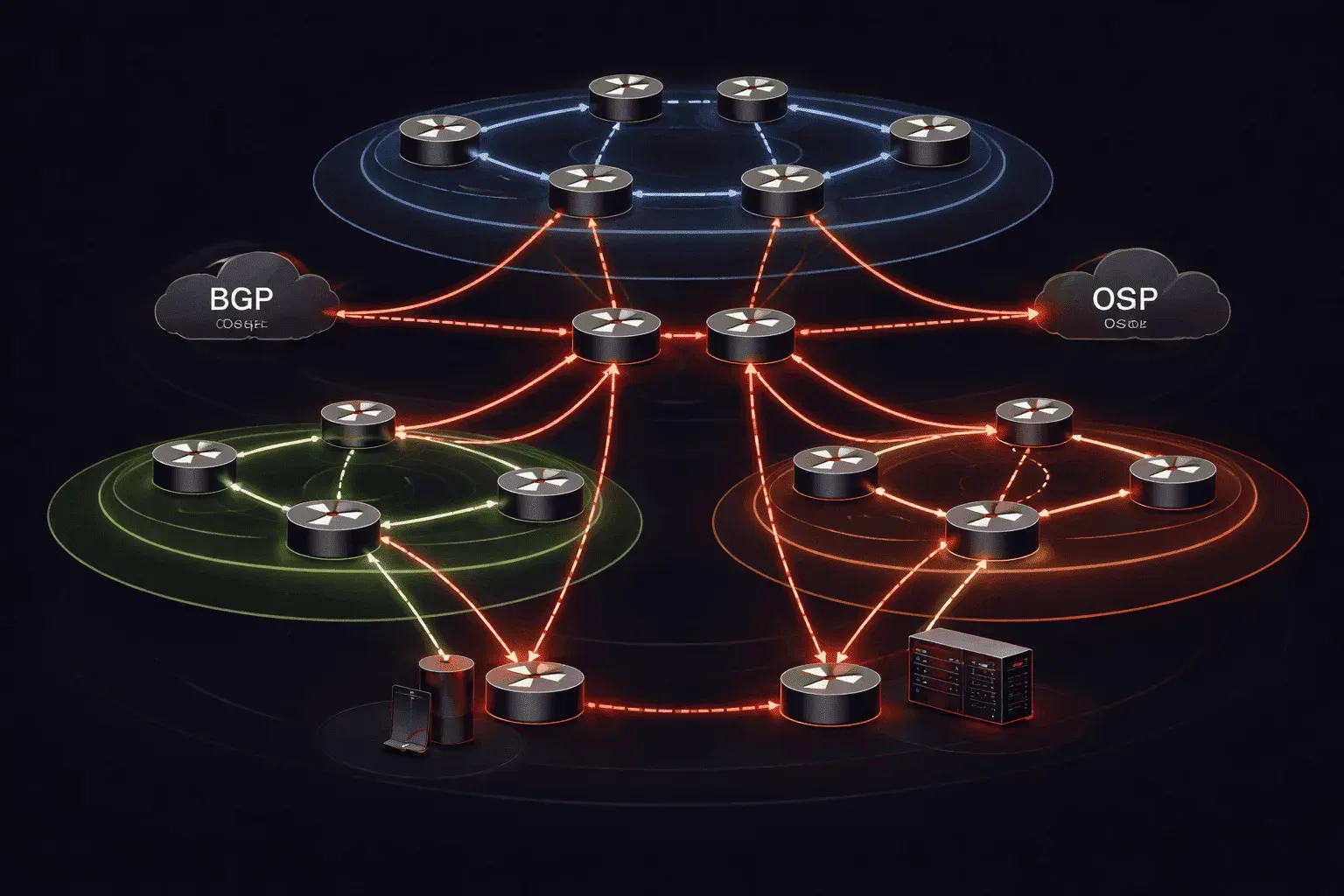
Virtual Routing and Forwarding (VRF) represents one of the most powerful segmentation technologies in enterprise networking, enabling multiple isolated routing tables within a single physical device. For CCNP ENCOR candidates, mastering advanced VRF configuration goes beyond basic implementation to include complex scenarios involving route leaking, import/export policies, and multi-protocol integration.
Advanced VRF Implementation Architecture
Advanced VRF configuration requires understanding the relationship between VRF instances, route distinguishers (RD), and route targets (RT). Unlike basic VRF implementations, enterprise deployments often require sophisticated routing segmentation with controlled inter-VRF communication.
Begin with the fundamental VRF structure that supports both IPv4 and IPv6 address families:
Router(config)# vrf definition CUSTOMER_A
Router(config-vrf)# rd 65001:100
Router(config-vrf)# route-target export 65001:100
Router(config-vrf)# route-target import 65001:100
Router(config-vrf)# address-family ipv4
Router(config-vrf-af)# exit-address-family
Router(config-vrf)# address-family ipv6
Router(config-vrf-af)# exit-address-family
The vrf definition command creates a VRF instance supporting both address families simultaneously, crucial for dual-stack environments. The route distinguisher ensures unique routing information across the MPLS backbone, while route targets control route distribution.
Interface Assignment and Advanced Parameters
Interface assignment to VRFs requires careful consideration of forwarding behavior and policy application:
Router(config)# interface GigabitEthernet0/1
Router(config-if)# vrf forwarding CUSTOMER_A
Router(config-if)# ip address 192.168.100.1 255.255.255.0
Router(config-if)# ipv6 address 2001:db8:100::1/64
Router(config-if)# ipv6 enable
Note that assigning an interface to a VRF removes all existing IP addressing. This behavior catches many engineers during implementation, requiring address reconfiguration after VRF assignment.
Advanced Route Leaking Configuration
Enterprise scenarios often require controlled communication between VRFs. Route leaking enables selective route sharing without compromising segmentation integrity:
Router(config)# vrf definition SHARED_SERVICES
Router(config-vrf)# rd 65001:999
Router(config-vrf)# route-target export 65001:999
Router(config-vrf)# route-target import 65001:999
Router(config-vrf)# route-target import 65001:100
Router(config-vrf)# route-target import 65001:200
This configuration allows the SHARED_SERVICES VRF to import routes from multiple customer VRFs while maintaining isolation between customer environments. The asymmetric route target configuration creates hub-and-spoke connectivity patterns.
Dynamic Routing Integration
Advanced VRF deployments integrate with dynamic routing protocols, requiring protocol-specific configuration within each VRF context:
Router(config)# router ospf 100 vrf CUSTOMER_A
Router(config-router)# router-id 10.1.1.1
Router(config-router)# network 192.168.100.0 0.0.0.255 area 0
Router(config-router)# redistribute bgp 65001 subnets
The VRF-aware OSPF process maintains separate topology databases per VRF, enabling independent routing decisions. Process IDs can be reused across VRFs without conflict, though unique router IDs prevent convergence issues.
BGP Integration with VRFs
BGP provides the most sophisticated VRF integration capabilities through address family configuration:
Router(config)# router bgp 65001
Router(config-router)# address-family ipv4 vrf CUSTOMER_A
Router(config-router-af)# neighbor 192.168.100.2 remote-as 65002
Router(config-router-af)# neighbor 192.168.100.2 activate
Router(config-router-af)# redistribute ospf 100
Router(config-router-af)# exit-address-family
Comprehensive VRF Verification Methodology
VRF verification requires systematic validation of forwarding tables, routing information, and interface assignments. The verification process begins with VRF instance confirmation:
Router# show vrf detail
  VRF CUSTOMER_A (VRF Id = 1); default RD 65001:100; default VPNID
  Old CLI format, supports both IPV4 and IPV6 address-families
  Interfaces:
    Gi0/1
  Address family ipv4 (Table ID = 1):
    Flags: 0x0
    Export VPN route-target communities
      RT:65001:100
    Import VPN route-target communities
      RT:65001:100
This output confirms VRF configuration accuracy, interface assignments, and route target policies. The table ID indicates the forwarding table identifier used by the forwarding engine.
Routing Table Verification
VRF-specific routing table verification uses context-aware commands:
Router# show ip route vrf CUSTOMER_A
Routing Table: CUSTOMER_A
Gateway of last resort is not set

     192.168.100.0/24 is variably subnetted, 2 subnets, 2 masks
C       192.168.100.0/24 is directly connected, GigabitEthernet0/1
L       192.168.100.1/32 is directly connected, GigabitEthernet0/1
O    192.168.200.0/24 [110/20] via 192.168.100.2, 00:05:23, GigabitEthernet0/1
The VRF-specific routing table displays only routes associated with the specified VRF instance. Verify that expected routes appear with correct next-hop addresses and administrative distances.
Advanced Verification Commands
Deep verification requires examining VRF forwarding structures and protocol-specific information:
Router# show ip cef vrf CUSTOMER_A detail
Router# show ip bgp vpnv4 vrf CUSTOMER_A
Router# show ip ospf database database-summary
CEF verification confirms hardware forwarding table population, while BGP VPNv4 examination reveals MPLS label allocation and route target attachment. OSPF database verification ensures proper LSA flooding within VRF boundaries.
Troubleshooting Advanced VRF Issues
Common advanced VRF issues include route target misconfiguration, interface assignment problems, and protocol redistribution failures. Systematic troubleshooting begins with VRF table verification:
Router# ping vrf CUSTOMER_A 192.168.200.1 source 192.168.100.1
Router# traceroute vrf CUSTOMER_A 192.168.200.1 source 192.168.100.1
VRF-aware connectivity testing isolates forwarding issues within specific routing contexts. Source specification ensures traffic originates from the correct VRF-assigned interface.
What's Next
With advanced VRF configuration mastered, the next logical progression involves implementing VRF-Lite for campus environments and examining MPLS L3VPN integration for service provider connectivity. These technologies extend VRF concepts into broader enterprise architectures requiring scalable segmentation solutions.
CCNP ENCOR study resources
- CCNP Enterprise Core ENCOR 350-401 and Advanced Routing ENARSI 300-410 Official Cert Guide Library — Both ENCOR and ENARSI books bundled together. The best value for CCNP Enterprise candidates.
- CCNP and CCIE Enterprise Core ENCOR 350-401 Official Cert Guide — The only Cisco-approved study guide for the ENCOR 350-401 exam. Essential for CCNP and CCIE candidates.