
What is the MCP Framework in Agentic AI?
This post introduces the Model Context Protocol (MCP) framework and its role in agentic AI. It covers the three core primitives: tools, resources, and prompts, explaining how each component works and how they combine to power real-world AI agent workflows.

If you've been exploring agentic AI, you've likely come across the term MCP. It stands for Model Context Protocol, an open standard introduced by Anthropic in late 2024 that is rapidly gaining adoption as a foundational framework for building AI agents that can take action in the real world. In this post, we'll break down what MCP is, why it matters, and what its core components look like in practice.
What Problem Does MCP Solve?
Large language models (LLMs) are powerful, but they have a significant limitation: they live in a box. By default, an LLM can only work with the text you give it in a prompt. It can't browse your files, query your database, call an API, or take action on your behalf unless something bridges that gap.
That's exactly what the MCP framework in agentic AI is designed to do. MCP gives AI models a structured, standardized way to interact with external systems, data sources, and capabilities. Think of it as a universal connector between an AI agent and the tools and information it needs to complete a task.
Instead of every developer building their own one-off integrations, MCP provides a consistent protocol that AI clients and servers can speak. This makes agentic AI tools more portable, composable, and easier to build.
The Three Core Primitives of MCP
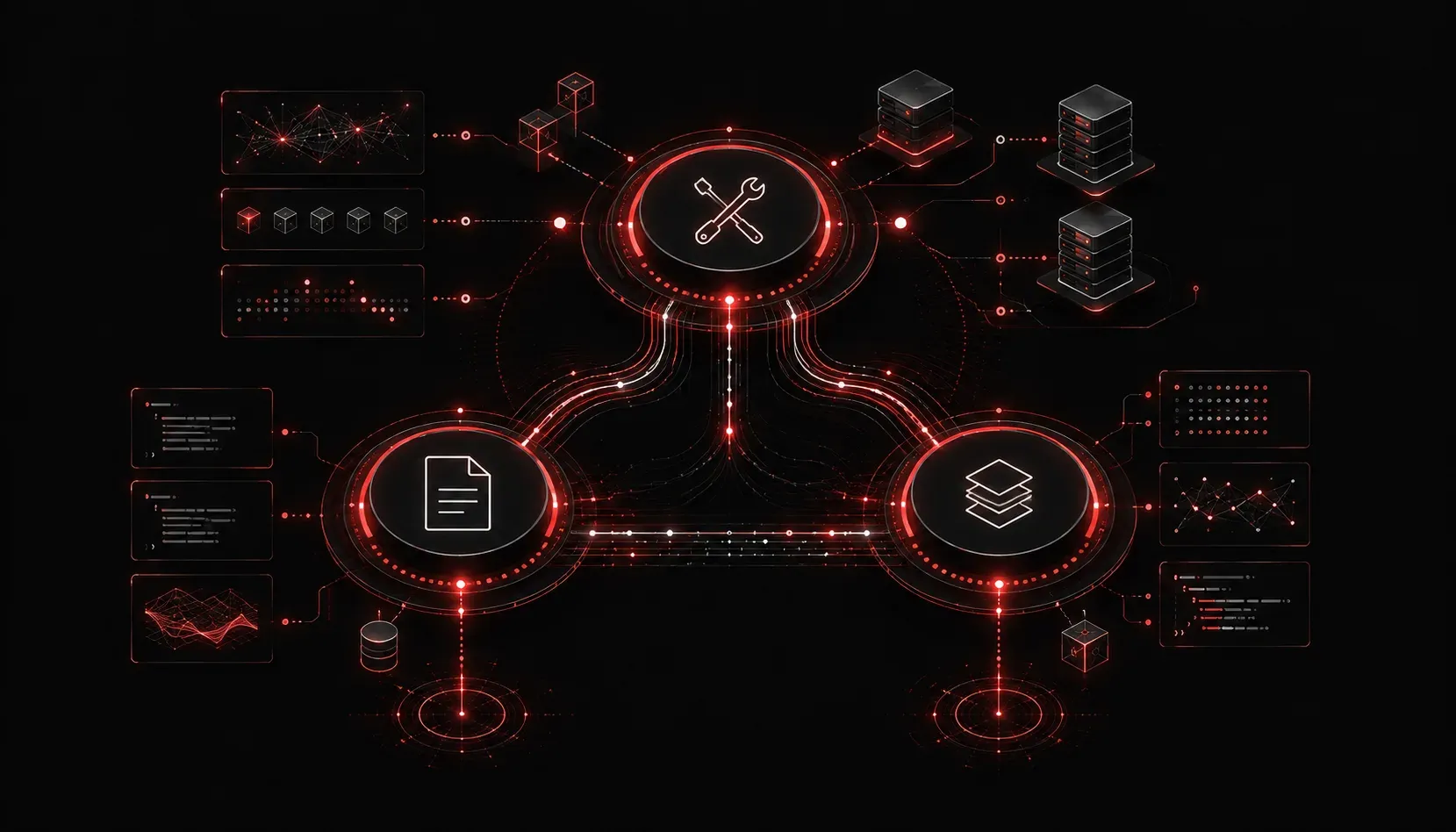
The MCP framework is organized around three fundamental building blocks, often called primitives. Understanding these three concepts gives you a solid mental model for how MCP works.
Tools
Tools are actions that an AI agent can invoke. These are executable functions that do something: run a shell command, query a database, send an HTTP request, or write a file. Agentic AI tools in MCP are defined by a name, a description, and an input schema so the model knows how to call them correctly.
A simple example: you might expose a tool called get_weather that accepts a city name and returns the current forecast. The model can decide when to call this tool based on the user's request, pass the right arguments, and use the result to form a response.
{
  "name": "get_weather",
  "description": "Returns the current weather for a given city.",
  "inputSchema": {
    "type": "object",
    "properties": {
      "city": {
        "type": "string",
        "description": "The name of the city"
      }
    },
    "required": ["city"]
  }
}
Resources
MCP resources represent data that an agent can read. Unlike tools, resources are not actions; they are content. This could be a file, a database record, a webpage, or any structured piece of information that the AI needs to reason about.
Resources in MCP are identified by a URI and have a defined MIME type. For example, a resource might point to a local file like file:///project/config.yaml or a remote endpoint. The model can request these resources to pull context into its reasoning without needing that data hardcoded into a prompt.
Prompts
AI prompts in MCP are pre-defined, reusable prompt templates that can be surfaced to users or invoked programmatically. These help standardize how a model is instructed to perform a particular task.
For instance, a prompt template might exist for "summarize this document" or "review this code for security issues." Rather than rewriting the instruction every time, MCP allows you to define it once and reuse it across sessions and tools. This is especially useful in multi-agent workflows where consistency matters.
How These Primitives Work Together
In a real agentic workflow, these three primitives combine fluidly. An agent might:
- Receive a user request
- Load relevant context using resources
- Follow a structured prompt template to frame its reasoning
- Execute one or more tools to take action or gather information
- Return a result to the user
This pattern is what makes agentic AI feel genuinely useful rather than just conversational. MCP provides the scaffolding that makes these steps reliable and repeatable.
Why MCP Matters for AI Practitioners
The MCP framework is gaining traction quickly. Major AI development environments and agent platforms are beginning to support it natively, which means understanding MCP now gives you a real advantage when building or integrating AI systems. It's not just an academic concept; it's becoming practical infrastructure for the next generation of AI-powered applications.
What's Next
Now that you understand the core primitives of MCP, the next step is looking at how MCP servers and clients are structured and how you actually deploy them. In the next post, we'll walk through the MCP server architecture and show you what a basic implementation looks like in practice.