
How to Choose the Right Transmission Media For Your Network
Learn how to select the right transmission media for network projects by evaluating distance, speed, and cost requirements. Covers copper, fiber, and wireless options with practical decision-making guidance.

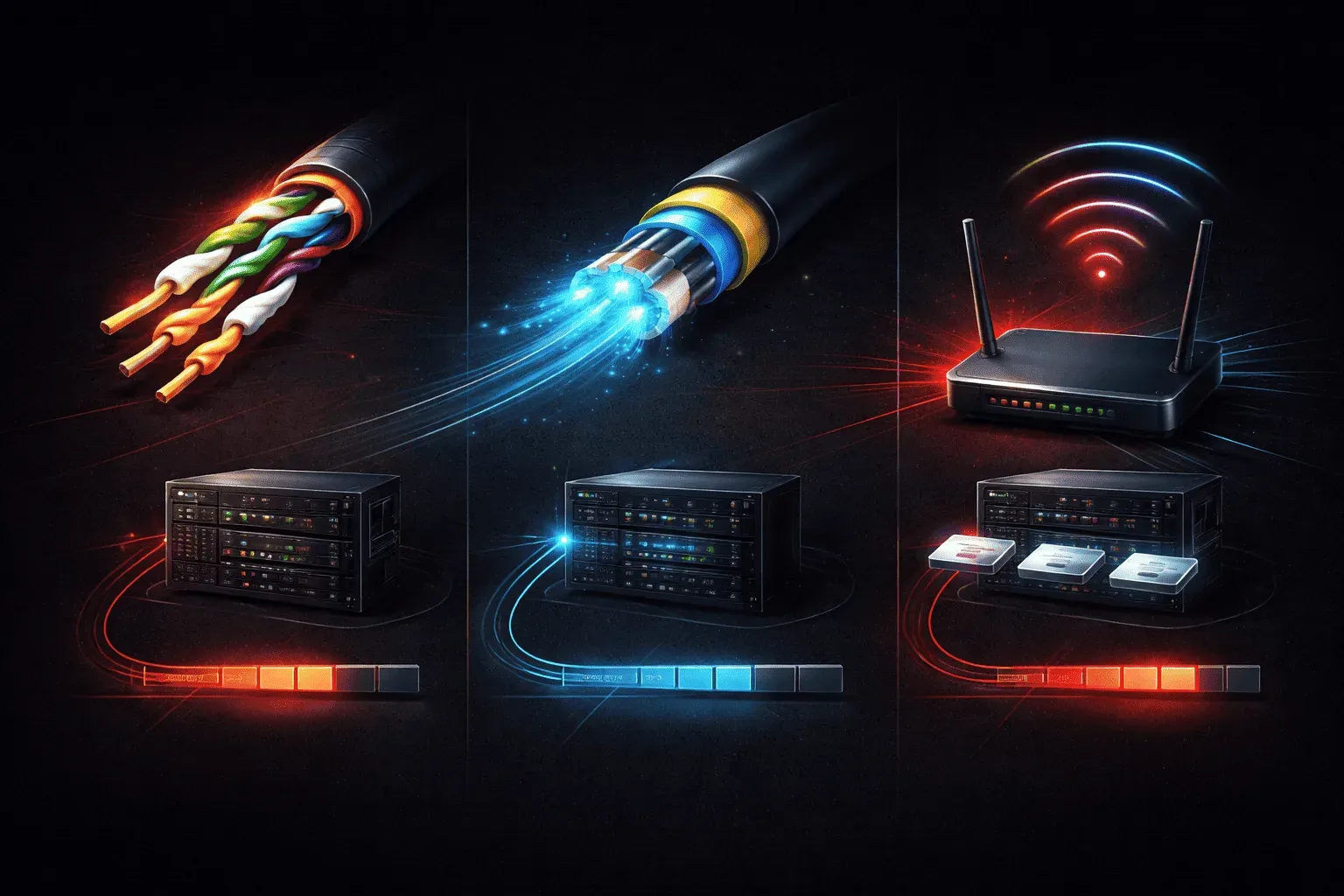
Choosing the right transmission media is one of the most critical decisions in network planning. Whether you're setting up a small office network or designing enterprise infrastructure, understanding how different media types perform under various conditions will save you time, money, and headaches down the road.
Let's walk through the key factors that should guide your media selection process and examine real-world scenarios where each type shines.
Understanding Your Network Requirements
Before diving into specific media types, you need to assess three fundamental requirements:
- Distance: How far does your signal need to travel?
- Bandwidth: What speeds do you need now and in the future?
- Budget: What are your installation and maintenance costs?
These factors work together. For example, you might want gigabit speeds, but if you're connecting buildings 500 meters apart, standard copper cable won't work regardless of your budget.
Copper Cable: The Workhorse
Twisted pair copper remains the go-to choice for most network setup scenarios. Here's when to choose it:
- Distance: Up to 100 meters for Ethernet
- Speed: Cat 5e supports 1 Gbps, Cat 6a handles 10 Gbps
- Cost: Lowest upfront investment
- Installation: Easiest to terminate and troubleshoot
Best for: Office networks, desktop connections, and anywhere you need reliable, cost-effective connectivity under 100 meters.
Avoid when: You need to span long distances, require immunity from electromagnetic interference, or need speeds above 10 Gbps consistently.
Fiber Optic: Speed and Distance Champion
When copper hits its limits, fiber takes over. Here's how to choose transmission media involving fiber:
Multimode Fiber
- Distance: 300-550 meters depending on speed
- Speed: Up to 100 Gbps
- Cost: Moderate cable cost, expensive transceivers
Single-mode Fiber
- Distance: Kilometers without repeaters
- Speed: Virtually unlimited with proper equipment
- Cost: Higher cable cost, very expensive transceivers
Best for: Building-to-building connections, high-speed backbone links, environments with electromagnetic interference, and future-proofing network infrastructure.
Wireless: Flexibility with Trade-offs
Wireless transmission offers mobility but comes with performance considerations:
- Distance: 50-100 meters indoors, varies significantly with obstacles
- Speed: Wi-Fi 6 theoretically reaches 9.6 Gbps, but real-world performance is much lower
- Cost: Moderate equipment cost, no cable installation
Best for: Mobile devices, temporary setups, areas where cable installation is impractical, and guest network access.
Consider carefully: Wireless is shared bandwidth, affected by interference, and has security considerations that wired networks don't face.
Real-World Decision Matrix
Here's how to approach common scenarios:
Small office (under 50 users): Cat 6 copper for workstation connections, single multimode fiber run for internet connection if needed.
Multi-building campus: Single-mode fiber for building interconnects, Cat 6a copper within buildings, enterprise wireless for mobility.
Industrial environment: Fiber optic for immunity to electromagnetic interference, with hardened switches and careful cable protection.
Home office: Cat 5e or Cat 6 for fixed connections, Wi-Fi 6 for mobile devices.
Planning for the Future
Your media selection should account for growth. Installing Cat 6a instead of Cat 5e costs little extra during initial installation but provides significant headroom for future speed increases. Similarly, running conduit for future fiber pulls is far cheaper than retrofitting later.
Consider your upgrade timeline. If you'll likely refresh network equipment in 3-5 years, don't over-engineer the cabling. But if you're planning for 10+ years, invest in higher-grade media now.
What's Next
Now that you understand how to choose transmission media, the next step is learning about cable standards and specifications. In our next post, we'll dive deep into cable categories, understanding what Cat 5e, Cat 6, and Cat 6a actually mean for your network performance.
Network+ study resources
- CompTIA Network+ Study Guide — Full N10-009 exam coverage across all five domains. Essential exam preparation.