
Choosing the Right Linux Server Architecture
A comprehensive comparison of Linux server architectures including x86, x86_64, AArch64, and RISC-V, helping beginners understand the differences and choose the right architecture for their server needs.

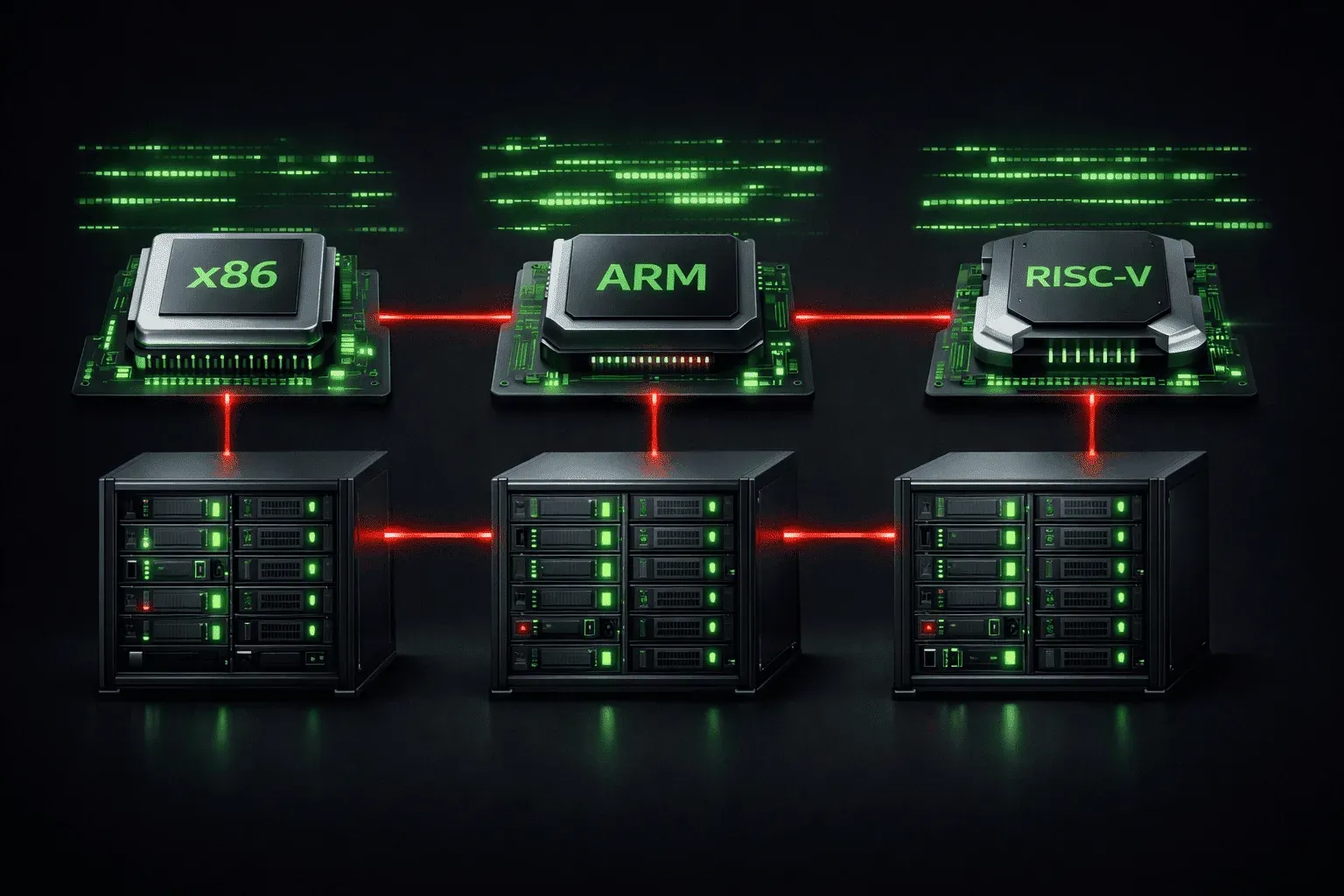
When setting up your first Linux server, one of the fundamental decisions you'll make is choosing the right processor architecture. This choice affects everything from performance to software compatibility, and understanding the differences between available architectures will help you make an informed decision for your specific needs.
Understanding Processor Architectures
A processor architecture defines the instruction set and design principles that determine how your CPU processes data. In the Linux server world, you'll encounter four main architectures, each with distinct characteristics and use cases.
x86: The Legacy Foundation
The x86 architecture, developed by Intel in the 1970s, represents the traditional 32-bit computing standard. While largely superseded by its 64-bit successor, you might still encounter x86 in specific scenarios:
- Legacy applications that require 32-bit compatibility
- Embedded systems with strict memory constraints
- Older hardware that doesn't support 64-bit processing
Most modern Linux distributions have dropped support for x86, making it less relevant for new server deployments. You can check your current architecture by running uname -m in your terminal.
x86_64: The Current Standard
Also known as AMD64, x86_64 is the 64-bit extension of the x86 architecture and currently dominates the server market. This Linux server architecture offers several advantages:
- Memory capacity: Supports more than 4GB of RAM, essential for modern applications
- Performance: 64-bit processing provides better computational efficiency
- Software compatibility: Extensive ecosystem with virtually all server software available
- Mature ecosystem: Decades of optimization and debugging
When you run lscpu on most modern servers, you'll see "x86_64" listed as the architecture. This remains the safest choice for general-purpose server deployments, especially for beginners.
AArch64: The Efficient Alternative
AArch64, also called ARM64, represents the 64-bit ARM architecture that's gaining significant traction in server environments. Originally designed for mobile devices, AArch64 brings unique benefits to server deployments:
- Power efficiency: Lower energy consumption, reducing operational costs
- Cost-effectiveness: Often less expensive than equivalent x86_64 processors
- Cloud adoption: Major cloud providers now offer ARM-based instances
- Performance per watt: Excellent for specific workloads like web servers and databases
Cloud provider support for AArch64 has expanded significantly. AWS offers Graviton-based instances (t4g, m7g, c7g families) at a meaningful discount over equivalent x86_64 instances. Google Cloud provides Tau T2A instances using Ampere Altra processors. Azure offers Cobalt 100-based VMs built on ARM. Oracle Cloud Infrastructure also offers Ampere A1 instances, which have a generous free tier useful for testing AArch64 workloads before committing.
Before migrating to AArch64, be aware of potential compatibility considerations. Most major open-source software runs natively on AArch64, but some older or proprietary software may only provide x86_64 binaries. Docker images need to be built for or support the arm64 platform, and some container images on Docker Hub only ship x86_64 variants. If your workload relies on specific commercial software or older compiled binaries, verify AArch64 support before choosing this architecture. You can verify ARM architecture support by checking /proc/cpuinfo for ARM-specific features.
RISC-V: The Open Future
RISC-V represents an open-source instruction set architecture that's rapidly evolving. While still emerging in the server space, it offers compelling advantages:
- Open standard: No licensing fees or vendor lock-in
- Customization: Organizations can modify the architecture for specific needs
- Growing ecosystem: Increasing Linux distribution and software support
- Future potential: Promising for specialized server applications
RISC-V server adoption is progressing but remains limited in scope. Most major Linux distributions including Ubuntu, Fedora, and Debian now provide RISC-V builds, and the upstream kernel has supported RISC-V for several years. Hardware options are expanding, with companies like SiFive, StarFive, and Alibaba's T-Head division producing server-grade RISC-V silicon. However, the software ecosystem is narrower than x86_64 or AArch64, and production-grade server hardware is still limited compared to the other architectures. RISC-V is currently best suited for experimental environments, edge computing research, or organizations with specific architectural requirements rather than general production deployments.
Making the Right Choice
For beginners selecting a Linux server architecture, consider these decision factors:
Choose x86_64 if: You need maximum software compatibility, are running traditional enterprise applications, or want the most straightforward deployment experience.
Choose AArch64 if: Power efficiency is crucial, you're deploying cloud-native applications, or cost optimization is a primary concern. Verify that all software your workload depends on supports arm64 before committing.
Choose RISC-V if: You're in a research environment, need complete architectural control, or are planning for long-term strategic independence.
You can always check your current system's architecture compatibility by examining /proc/cpuinfo and using commands like file /bin/bash to see what architecture your binaries support.
What's Next
Now that you understand the different Linux server architectures available, the next step is learning about Linux distributions and how they support these various architectures. We'll explore how to choose the right distribution for your selected architecture and specific use case requirements.