
Comparing Administrative Distance: EIGRP vs OSPF
Administrative distance differences between EIGRP (90) and OSPF (110) significantly impact routing decisions in enterprise networks. EIGRP routes are always preferred over OSPF routes for the same destination, creating important design and troubleshooting considerations for multi-protocol environme

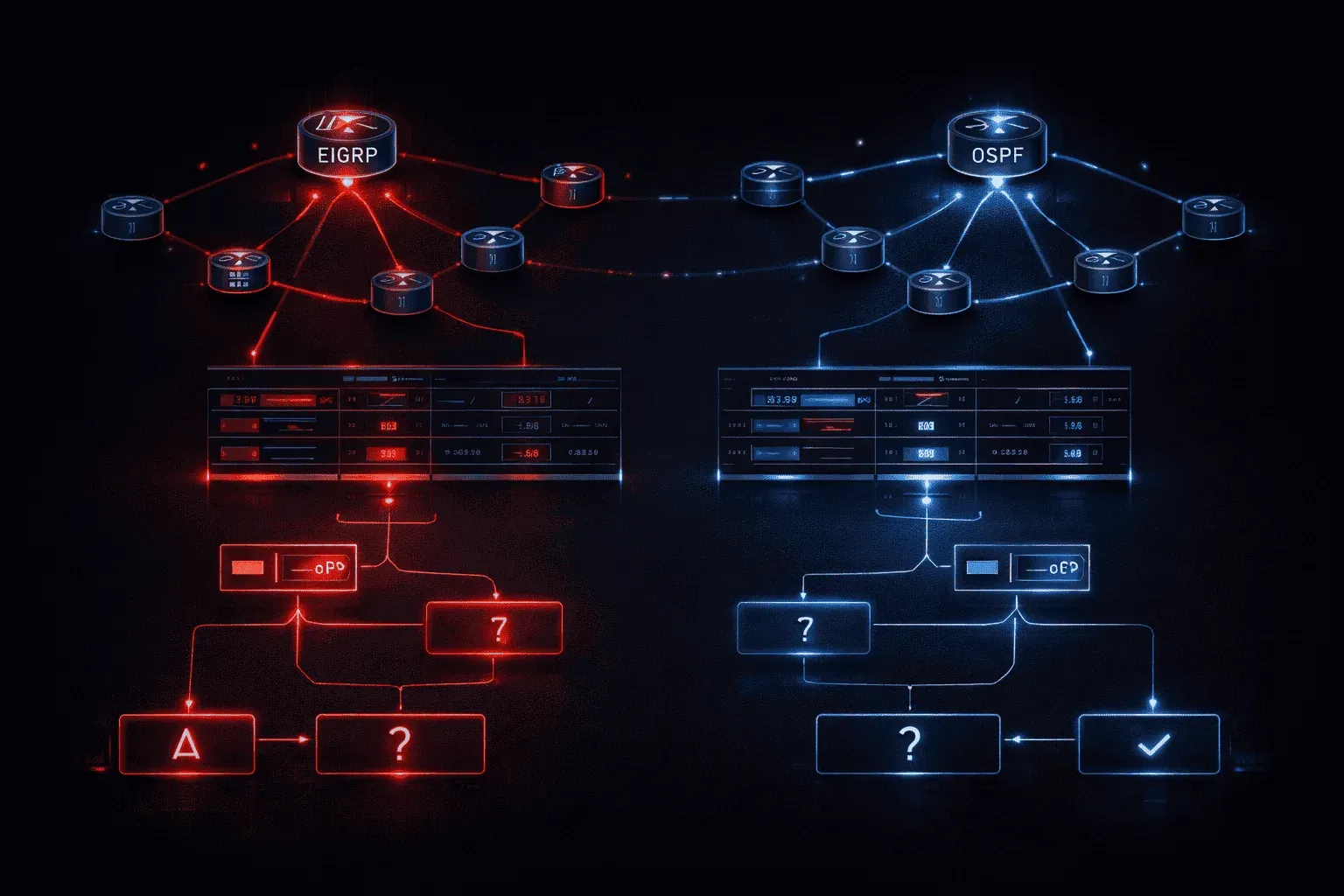
When designing enterprise networks with multiple routing protocols, understanding administrative distance becomes critical for predictable routing decisions. The administrative distance differences between EIGRP and OSPF can significantly impact your network's behavior, especially in redistribution scenarios or during migration projects.
Administrative Distance Fundamentals
Administrative distance (AD) serves as the trustworthiness metric for routing information sources. When multiple routing protocols advertise the same destination network, the router selects the route with the lowest administrative distance. This selection occurs before any metric comparison.
EIGRP uses an administrative distance of 90 for internal routes, while OSPF uses 110. This 20-point difference means EIGRP routes will always be preferred over OSPF routes for the same destination network, regardless of path quality or hop count.
Default Administrative Distance Values
Understanding the complete picture requires examining all route types:
EIGRP Internal Routes:           90
EIGRP External Routes:          170
OSPF Intra-area and Inter-area: 110
OSPF External Type 1:           110
OSPF External Type 2:           110
Static Routes:                    1
Connected Interfaces:             0
Notice that EIGRP external routes (170) have a higher administrative distance than OSPF routes (110), creating an interesting dynamic in networks with redistribution.
Routing Decision Impact
Consider a scenario where both EIGRP and OSPF advertise a route to the same network:
Router# show ip route 192.168.10.0
Routing entry for 192.168.10.0/24
  Known via "eigrp 100", distance 90, metric 2816
  Last update from 10.1.1.2 on GigabitEthernet0/1, 00:05:23 ago
  Routing Descriptor Blocks:
  * 10.1.1.2, from 10.1.1.2, 00:05:23 ago, via GigabitEthernet0/1
      Route metric is 2816, traffic share count is 1
      Total delay is 11000 microseconds, minimum bandwidth is 1000000 Kbit
Even if OSPF offers a superior path (fewer hops, higher bandwidth), EIGRP's lower administrative distance ensures its route remains in the routing table. The OSPF route exists in the topology database but never influences forwarding decisions.
Verification Commands
To see all routes including those not selected due to administrative distance:
Router# show ip route 192.168.10.0 longer-prefixes
Router# show ip ospf database
Router# show ip eigrp topology
Network Design Considerations
The administrative distance difference creates several design implications that network architects must address.
Protocol Migration Challenges
During OSPF-to-EIGRP or EIGRP-to-OSPF migrations, the administrative distance difference can cause unexpected routing behavior. If you're migrating from OSPF to EIGRP, routes will immediately shift to EIGRP as soon as EIGRP adjacencies form, potentially before EIGRP has converged fully.
For controlled migrations, consider modifying administrative distances:
router eigrp 100
 distance 120
This temporarily makes EIGRP less preferred than OSPF during the transition period.
Redistribution Scenarios
In networks requiring redistribution between EIGRP and OSPF, the administrative distance difference creates asymmetric routing risks. Routes learned via EIGRP internal (AD 90) will be preferred over the same routes redistributed into OSPF (AD 110), but routes redistributed from OSPF into EIGRP become EIGRP external routes (AD 170).
router eigrp 100
 redistribute ospf 1 metric 10000 100 255 1 1500

router ospf 1
 redistribute eigrp 100 subnets
Multi-Vendor Environment Considerations
EIGRP's Cisco-proprietary nature limits deployment options compared to OSPF's vendor-neutral standard. However, when Cisco devices interconnect with non-Cisco equipment, OSPF becomes necessary, and its higher administrative distance must be factored into the overall routing design.
Troubleshooting Administrative Distance Issues
When troubleshooting suboptimal routing, always verify which protocol is actually being used:
Router# show ip route 192.168.10.0
Router# show ip protocols
Router# show ip route summary
Look for scenarios where the routing table shows one protocol's route, but network performance suggests a better path exists via another protocol. This often indicates an administrative distance issue rather than a metric problem.
Selective Administrative Distance Modification
You can modify administrative distance for specific routes or route sources:
router eigrp 100
 distance 120 10.1.1.0 0.0.0.255

router ospf 1
 distance 90 10.2.1.0 0.0.0.255
This provides granular control over route selection without affecting the entire routing protocol.
Performance and Convergence Implications
While administrative distance affects route selection, it doesn't directly impact convergence speed. However, in dual-protocol environments, the preferred protocol's convergence characteristics become critical since backup routes from the secondary protocol won't be used until the primary protocol's routes are withdrawn.
EIGRP's sub-second convergence with feasible successors provides faster recovery than OSPF's SPF recalculation, making the lower administrative distance beneficial in most scenarios. However, this assumes proper EIGRP design with feasible successors available.
What's Next
Understanding administrative distance sets the foundation for advanced routing protocol interactions. Next, we'll explore EIGRP's metric calculation and how to manipulate EIGRP metrics for optimal path selection within the protocol itself, building on this administrative distance knowledge to create sophisticated routing policies.
CCNP ENARSI study resources
- CCNP Enterprise Core ENCOR 350-401 and Advanced Routing ENARSI 300-410 Official Cert Guide Library — Both ENCOR and ENARSI books bundled together. The best value for CCNP Enterprise candidates.
- CCNP Enterprise Advanced Routing ENARSI 300-410 Official Cert Guide — The only Cisco-approved study guide for the ENARSI 300-410 exam. Covers advanced routing, VPNs, and infrastructure security.