
Understanding High-Level Enterprise Network Designs
Comprehensive overview of enterprise network design patterns including 2-tier, 3-tier, fabric, and cloud architectures. Covers design selection criteria, configuration examples, and real-world applications for complex enterprise environments.

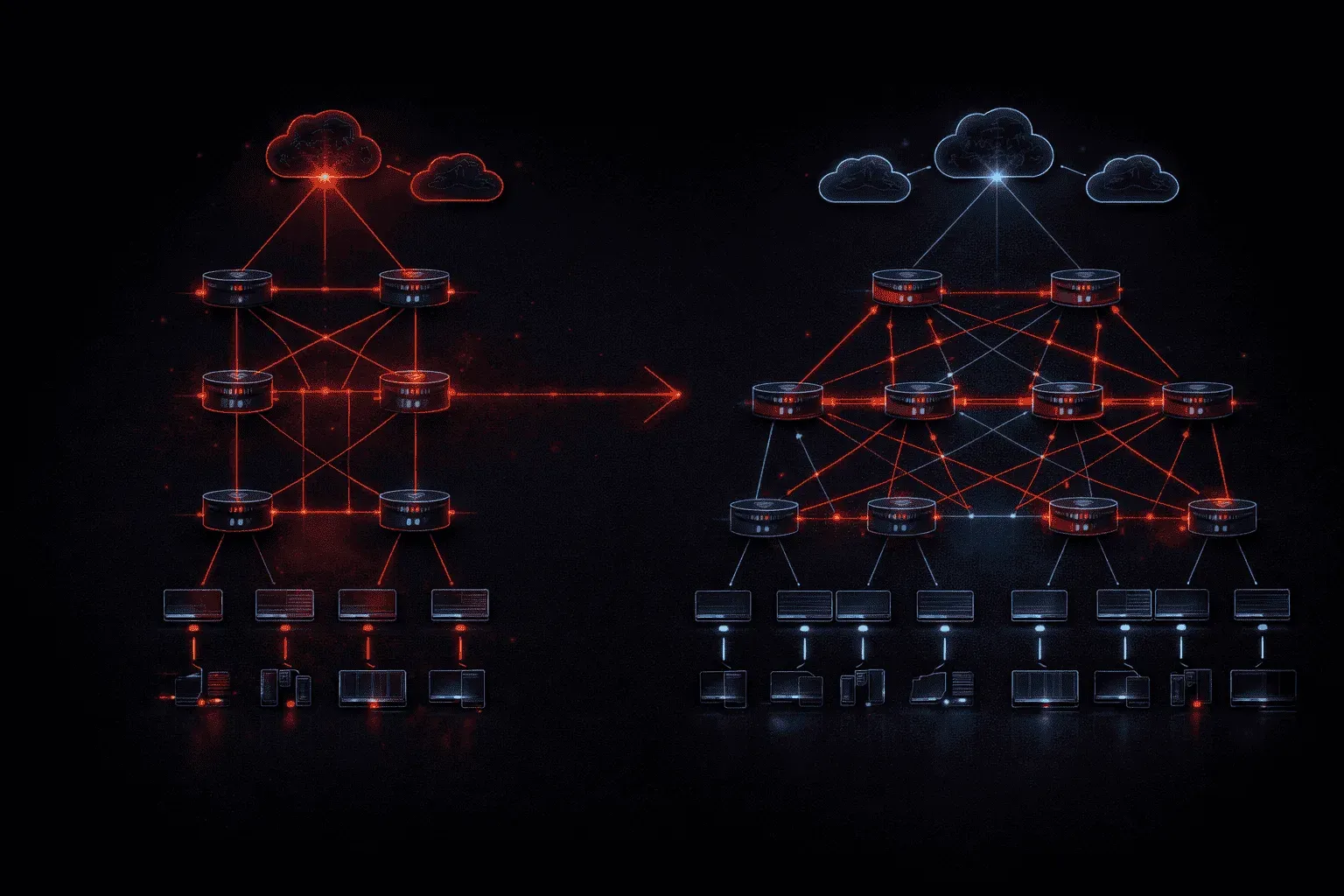
Enterprise network design has evolved significantly over the past decade, driven by cloud adoption, mobility requirements, and the need for agility in modern businesses. Understanding the fundamental architectural patterns is crucial for any network engineer designing or troubleshooting complex enterprise environments. Let's examine the core design models and their real-world applications.
2-Tier Architecture: Collapse Core Design
The 2-tier architecture, also known as collapsed core, eliminates the traditional distribution layer by combining core and distribution functions into a single tier. This design works particularly well for smaller enterprises or branch locations where the overhead of a full 3-tier model isn't justified.
In a typical 2-tier deployment, you'll configure distribution switches with both inter-VLAN routing capabilities and high-speed uplinks to the core. These switches handle local switching, VLAN termination, and provide the first hop for end devices while maintaining redundant paths to core services.
interface GigabitEthernet1/0/1
 description Uplink to Core-01
 switchport mode trunk
 switchport trunk allowed vlan 100,200,300
 channel-group 1 mode active

interface Vlan100
 description User_Data_VLAN
 ip address 10.1.100.1 255.255.255.0
 ip helper-address 10.1.10.100
 standby 100 ip 10.1.100.254
 standby 100 priority 110
 standby 100 preempt
The primary advantage of 2-tier architecture lies in reduced complexity and lower capital expenditure. You're eliminating an entire layer of switches, reducing configuration overhead, and simplifying troubleshooting paths. However, this comes at the cost of reduced scalability and potential performance bottlenecks as the network grows.
3-Tier Architecture: The Traditional Hierarchical Model
The 3-tier architecture remains the gold standard for large enterprise deployments, providing clear separation of functions across access, distribution, and core layers. Each layer has distinct responsibilities and failure domains, making the network more resilient and easier to troubleshoot.
The access layer connects end devices and applies initial policy enforcement. Distribution switches aggregate access layer connections and provide inter-VLAN routing, policy application, and services integration. The core layer focuses purely on high-speed packet forwarding between distribution blocks.
! Distribution Layer Configuration Example
ip routing
spanning-tree mode rapid-pvst
spanning-tree extend system-id

vlan 100
 name Users
vlan 200
 name Servers
vlan 999
 name Native_VLAN

interface range GigabitEthernet1/0/1-24
 description Access Layer Uplinks
 switchport mode trunk
 switchport trunk native vlan 999
 spanning-tree portfast trunk

interface range TenGigabitEthernet1/0/1-2
 description Core Layer Uplinks
 switchport mode trunk
 channel-group 1 mode active
This separation allows for optimization at each layer. Access switches can focus on port density and basic security features, distribution switches handle complex routing protocols and service insertion, while core switches maximize throughput and minimize latency.
Distribution Block Design Considerations
When designing distribution blocks in a 3-tier architecture, consider the 20:1 oversubscription ratio as a starting point. Each distribution block should serve approximately 1,000-5,000 users, depending on bandwidth requirements and application profiles. Implement redundant distribution switches with technologies like HSRP or VRRP for first-hop redundancy.
Network Fabric Architecture: The Modern Approach
Network fabric represents a fundamental shift from traditional hierarchical designs to a more flexible, scalable architecture. Unlike legacy spanning tree-based designs, fabric architectures leverage protocols like VXLAN, EVPN, or Cisco's FabricPath to create loop-free topologies with multiple active paths.
The key advantage of network fabric is the elimination of spanning tree's inherent limitations. Every link in the fabric can carry traffic, maximizing bandwidth utilization and providing predictable performance characteristics.
! VXLAN EVPN Fabric Configuration Example
feature bgp
feature pim
feature interface-vlan
feature vn-segment-vlan-based
feature nv overlay

fabric forwarding anycast-gateway-mac 0001.0001.0001

vlan 100
  vn-segment 10100

interface nve1
  no shutdown
  source-interface loopback1
  member vni 10100
    ingress-replication protocol bgp
Fabric designs excel in data center environments where east-west traffic patterns dominate. The mesh connectivity provides optimal paths for server-to-server communication while maintaining the ability to scale horizontally by adding leaf switches without redesigning the entire network.
Spine-Leaf Topology Benefits
The spine-leaf topology, common in fabric designs, ensures consistent latency and bandwidth between any two endpoints. Each leaf switch connects to every spine switch, creating a non-blocking architecture where adding capacity is as simple as adding spine switches. This predictability is crucial for virtualized environments and microservices architectures.
Cloud Network Design: Hybrid and Multi-Cloud Considerations
Cloud network design extends traditional enterprise architectures into public and private cloud environments. This requires careful consideration of connectivity options, security boundaries, and traffic engineering across hybrid environments.
Modern cloud network design typically involves SD-WAN technologies for branch connectivity, direct cloud connections like AWS Direct Connect or Azure ExpressRoute for predictable performance, and careful IP address planning to avoid conflicts across environments.
! SD-WAN Policy Configuration Example
policy-map shape_internet
 class class-default
  shape average 100000000

interface Tunnel1
 description DMVPN_to_DC
 bandwidth 1000000
 ip address 192.168.1.10 255.255.255.0
 ip nhrp network-id 100
 ip nhrp holdtime 300
 tunnel source GigabitEthernet0/0/0
 tunnel mode gre multipoint
Cloud network design must also account for the dynamic nature of cloud resources. Traditional static routing and access control lists give way to API-driven network automation and policy-based segmentation that can adapt to rapidly changing application requirements.
Design Selection Criteria
Choosing the appropriate architecture depends on several factors: organization size, traffic patterns, performance requirements, and operational complexity tolerance. Small to medium enterprises often benefit from 2-tier designs, while large enterprises with multiple locations typically require 3-tier architectures.
Fabric designs make sense when you need predictable performance, high bandwidth utilization, and plan to implement network virtualization technologies. Cloud-first organizations should prioritize designs that integrate seamlessly with public cloud services and support hybrid connectivity models.
Consider also the operational expertise available. Fabric architectures require deeper understanding of overlay protocols and may necessitate additional training for network operations teams.
What's Next
Understanding these high-level design patterns sets the foundation for diving deeper into specific implementation technologies. Next, we'll explore virtualization concepts and how overlay networks like VXLAN enable network segmentation across these architectural models, particularly in modern data center and cloud environments.
CCNP ENCOR study resources
- CCNP Enterprise Core ENCOR 350-401 and Advanced Routing ENARSI 300-410 Official Cert Guide Library — Both ENCOR and ENARSI books bundled together. The best value for CCNP Enterprise candidates.
- CCNP and CCIE Enterprise Core ENCOR 350-401 Official Cert Guide — The only Cisco-approved study guide for the ENCOR 350-401 exam. Essential for CCNP and CCIE candidates.