
Comparing Network Topologies: Star vs Mesh vs Bus
A comprehensive comparison of star, mesh, and bus network topologies, covering their advantages, disadvantages, and practical use cases. Essential knowledge for Network+ certification and network design decisions.

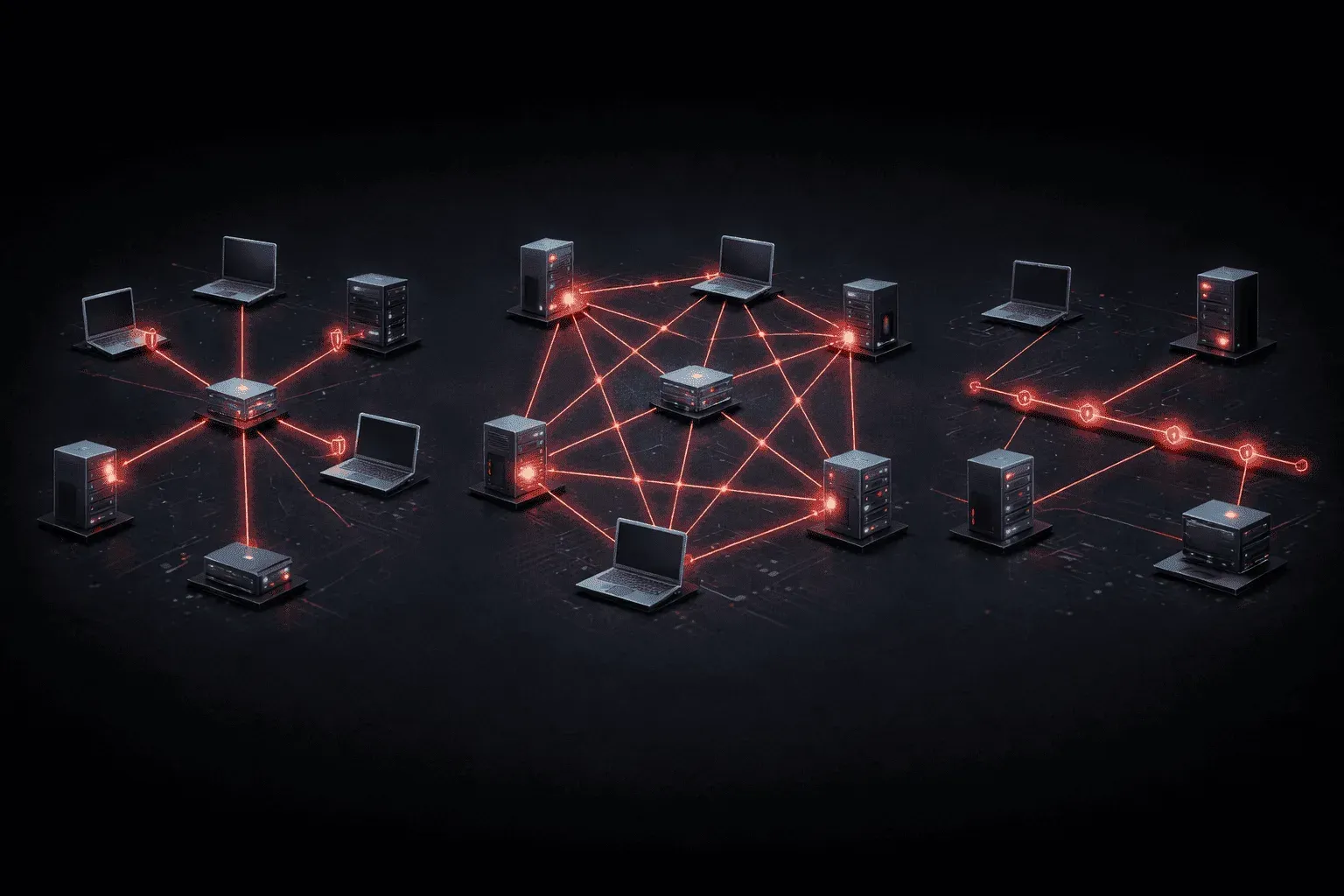
Network topology is the physical or logical layout of devices in a network. For Network+ candidates, understanding the fundamental differences between star, mesh, and bus topologies is crucial for network design decisions. Let's break down each topology and compare their strengths and weaknesses.
Star Topology: The Central Hub Approach
In a star topology, all devices connect to a central hub, switch, or access point. This creates a hub-and-spoke pattern where all communication flows through the central device.
Advantages of Star Topology
- Easy troubleshooting: If one connection fails, only that device is affected
- Centralized management: All traffic flows through one point, making monitoring simple
- Scalable: Adding new devices requires only one additional cable
- Performance isolation: Each device has dedicated bandwidth to the central hub
Disadvantages of Star Topology
- Single point of failure: If the central device fails, the entire network goes down
- Cable intensive: Requires more cable than bus topology
- Cost: Central switching equipment can be expensive
Star topology is the most common design in modern LANs, particularly in office environments where Ethernet switches serve as the central connection point.
Mesh Topology: Maximum Redundancy
Mesh topology connects devices with multiple paths between nodes. In a full mesh, every device connects directly to every other device. Partial mesh provides multiple paths but not necessarily direct connections between all devices.
Advantages of Mesh Topology
- High reliability: Multiple paths provide redundancy if one link fails
- Excellent performance: Multiple paths can share traffic load
- Self-healing: Network can automatically route around failed connections
- Security: Multiple paths make traffic interception more difficult
Disadvantages of Mesh Topology
- Expensive: Requires many cables and network interfaces
- Complex configuration: Routing protocols must manage multiple paths
- Difficult installation: Cable management becomes challenging with many connections
- Maintenance overhead: More connections mean more potential failure points to monitor
You'll typically see mesh topologies in WANs, data center interconnections, and wireless networks where redundancy is critical.
Bus Topology: The Shared Highway
Bus topology uses a single cable backbone where all devices connect. Data travels along the shared medium, and devices listen for transmissions intended for them.
Advantages of Bus Topology
- Simple and inexpensive: Uses minimal cable and hardware
- Easy to extend: Adding devices requires tapping into the main cable
- No central device needed: Eliminates single point of failure from hubs
Disadvantages of Bus Topology
- Collision domain issues: All devices share bandwidth and compete for transmission
- Difficult troubleshooting: Cable breaks can affect multiple devices
- Limited distance: Signal degradation limits network span
- Poor performance: Bandwidth decreases as more devices are added
- Obsolete technology: Largely replaced by switched networks
Bus topology was common in early Ethernet networks using coaxial cable but is rarely used in modern installations.
Network Topology Comparison Summary
When comparing these topologies for network design, consider these key factors:
- Reliability needs: Mesh offers highest reliability, star provides moderate reliability, bus has poor fault tolerance
- Budget constraints: Bus is cheapest, star is moderate cost, mesh is most expensive
- Performance requirements: Star and mesh provide better performance than bus topology
- Scalability: Star scales well, mesh becomes complex, bus performance degrades with growth
For most modern networks, star topology dominates LAN designs due to its balance of performance, manageability, and cost. Mesh topology appears in critical infrastructure and WAN connections where redundancy justifies the cost. Bus topology remains primarily of historical interest and in specialized industrial applications.
What's Next
Now that you understand basic physical topologies, we'll explore logical topologies and how protocols like Ethernet and Token Ring operate differently regardless of the underlying physical layout. This distinction becomes important when designing networks that must support specific traffic patterns and performance requirements.
Network+ study resources
- CompTIA Network+ Study Guide — Full N10-009 exam coverage across all five domains. Essential exam preparation.