
EIGRP vs OSPF: Advanced Routing Protocol Comparisons
Comprehensive comparison of EIGRP and OSPF focusing on operational characteristics, path selection algorithms, convergence behavior, and protocol selection guidelines for enterprise network design.

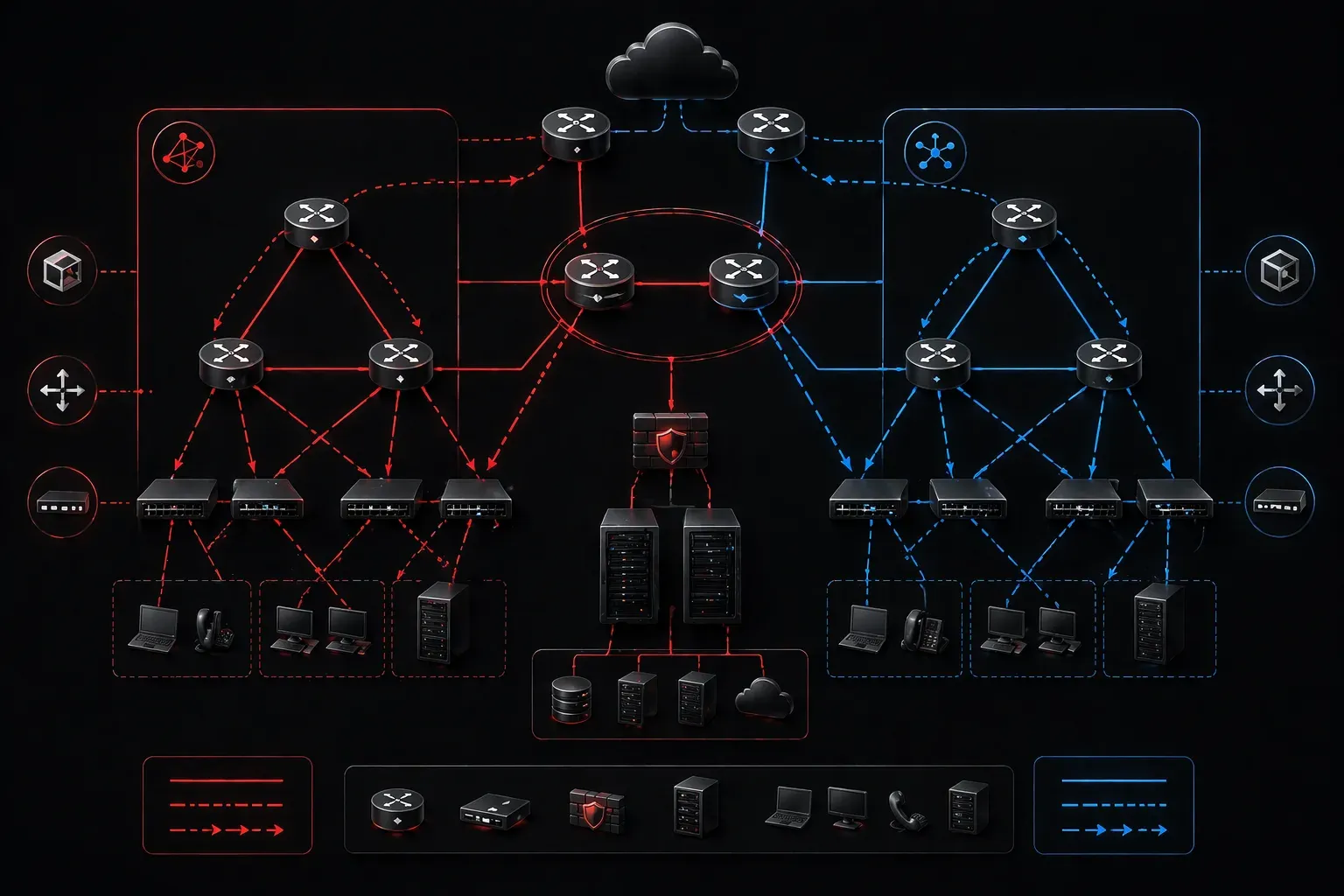
Understanding the operational differences between EIGRP and OSPF becomes critical when designing enterprise networks where protocol choice directly impacts convergence, scalability, and administrative overhead. While both protocols serve the same fundamental purpose, their architectural approaches create distinct operational characteristics that influence network behavior in production environments.
Protocol Architecture and State Management
EIGRP operates as a distance vector protocol with link-state characteristics, maintaining three tables: the neighbor table, topology table, and routing table. This hybrid approach allows EIGRP to store backup routes in its topology table, enabling sub-second convergence when a primary path fails. The protocol uses the Diffusing Update Algorithm (DUAL) to ensure loop-free topology calculations.
OSPF functions as a pure link-state protocol, maintaining a link-state database (LSDB) that contains complete topology information within each area. Every router within an area maintains an identical LSDB, requiring more memory but providing complete network visibility for optimal path calculations using the Shortest Path First (SPF) algorithm.
! EIGRP topology table showing feasible successors
Router# show ip eigrp topology 10.1.1.0/24
EIGRP-IPv4 Topology Entry for AS(100)/ID(1.1.1.1) for 10.1.1.0/24
  State is Passive, Query origin flag is 1, 1 Successor(s), FD is 281600
  Descriptor Blocks:
  10.0.12.2 (GigabitEthernet0/0), from 10.0.12.2, Send flag is 0x0
      Composite metric is (281600/256000), route is Internal
      Vector metric:
        Minimum bandwidth is 1000000 Kbit
        Total delay is 1100 microseconds
  10.0.13.3 (GigabitEthernet0/1), from 10.0.13.3, Send flag is 0x0
      Composite metric is (307200/281600), route is Internal
      Vector metric:
        Minimum bandwidth is 1000000 Kbit
        Total delay is 1200 microseconds
Path Selection and Metric Calculations
EIGRP's composite metric calculation provides granular control over path selection through bandwidth, delay, reliability, load, and MTU components. By default, only bandwidth and delay influence the metric, but administrators can fine-tune path selection through K-values or interface-specific delay modifications.
OSPF uses cost as its single metric, typically derived from reference bandwidth divided by interface bandwidth. While simpler, this approach requires careful reference bandwidth configuration in modern high-speed networks to prevent suboptimal routing decisions.
! EIGRP metric tuning example
interface GigabitEthernet0/0
 delay 200
 bandwidth 100000

! OSPF cost configuration
interface GigabitEthernet0/0
 ip ospf cost 10
The path selection differences become apparent in networks with multiple equal-cost paths. EIGRP performs unequal-cost load balancing through variance configuration, distributing traffic proportionally based on metric ratios. OSPF supports equal-cost multipath (ECMP) only, limiting load distribution options in asymmetric topologies.
Scalability and Hierarchical Design
OSPF's area-based hierarchy provides superior scalability in large networks through LSA type restrictions and area border router (ABR) summarization. Type 1 and Type 2 LSAs remain within areas, while Type 3 summary LSAs provide inter-area connectivity. This segmentation reduces LSDB size and SPF calculation frequency.
EIGRP's flat autonomous system structure relies on query scoping and summarization for scalability. While effective, large EIGRP networks can experience convergence delays during network instability as queries propagate across the topology searching for alternate paths.
! OSPF area summarization at ABR
router ospf 1
 area 1 range 10.1.0.0 255.255.0.0

! EIGRP summarization at interface level
interface GigabitEthernet0/0
 ip summary-address eigrp 100 10.1.0.0 255.255.0.0
Convergence Characteristics
EIGRP achieves faster convergence through its topology table maintaining feasible successors. When a primary path fails, DUAL immediately installs the backup route without requiring complex calculations. This mechanism provides sub-second convergence in well-designed networks.
OSPF convergence depends on LSA flooding, SPF recalculation, and routing table updates. While modern implementations include incremental SPF and other optimizations, convergence typically requires several seconds, especially in networks with frequent topology changes.
! EIGRP fast convergence verification
Router# show ip eigrp events
Event information for AS 100:
1    00:00:02.123 Change: DUAL 10.1.1.0/24 Metric set M:281600 S:256000
2    00:00:02.124 Change: DUAL 10.1.1.0/24 Route installed P
Administrative Considerations
EIGRP's simplicity extends to authentication configuration, supporting MD5 and SHA authentication through key chains. Named EIGRP configurations provide additional flexibility with address family support for IPv4 and IPv6 within single process configurations.
OSPF authentication operates per area or per interface, supporting simple password, MD5, and cryptographic authentication. The protocol's standards-based nature ensures vendor interoperability but requires careful LSA type and area configuration planning.
! EIGRP named configuration with authentication
router eigrp ENTERPRISE
 address-family ipv4 unicast autonomous-system 100
  af-interface GigabitEthernet0/0
   authentication mode md5
   authentication key-chain EIGRP_KEYS
Protocol Selection Guidelines
Choose EIGRP for networks requiring fast convergence with minimal administrative overhead, particularly in Cisco-only environments where advanced features like unequal-cost load balancing provide value. EIGRP excels in branch office deployments where simplicity and rapid failover capabilities are priorities.
Select OSPF for large enterprise networks requiring vendor interoperability, hierarchical design, or external route control. OSPF's area structure provides better scalability in complex topologies, while its standards-based nature ensures compatibility across multi-vendor environments.
What's Next
Now that you understand the operational differences between EIGRP and OSPF, the next logical step is examining BGP's role in enterprise networks. We'll explore how BGP handles path selection in multi-homed environments and its integration with IGP protocols for optimal traffic engineering and redundancy planning.
Tools and resources for this topic
- CCNP ENCOR 350-401 Official Cert Guide — The definitive ENCOR study resource by Brad Edgeworth. Covers enterprise infrastructure, virtualisation, and automation.