
Common Issues in Routing Protocol Redistribution and How to Solve Them
Explores common routing protocol redistribution issues including administrative distance conflicts, metric incompatibility, routing loops, and convergence problems. Provides systematic troubleshooting techniques and prevention strategies for complex enterprise redistribution scenarios.

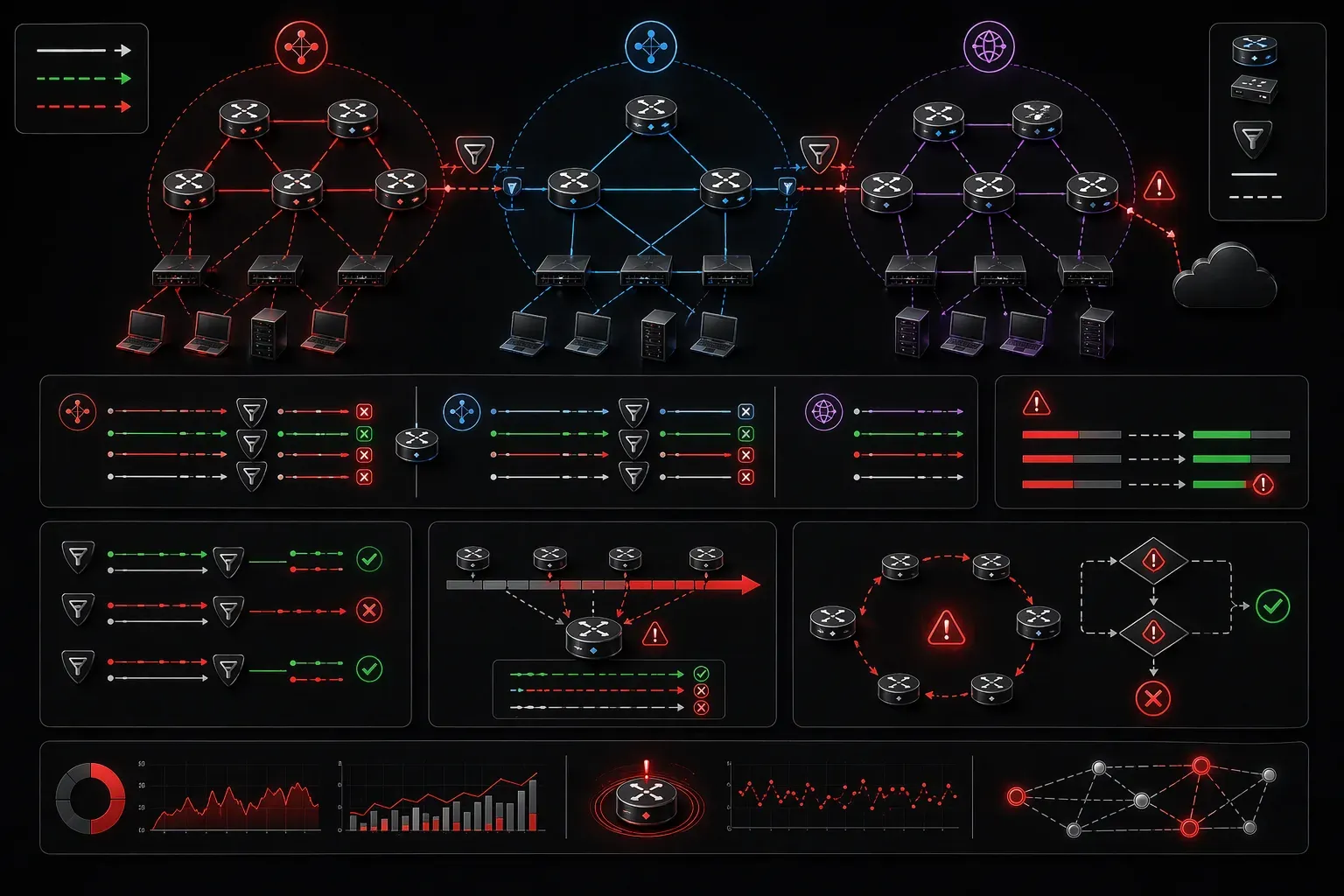
Routing protocol redistribution creates some of the most complex troubleshooting scenarios you'll encounter in enterprise networks. When multiple routing protocols coexist, the redistribution boundary becomes a critical failure point that can generate routing loops, suboptimal paths, and complete connectivity failures. Understanding these failure modes and their systematic resolution is essential for ENARSI success.
Administrative Distance Conflicts and Route Preference Issues
The most fundamental issue in redistribution stems from administrative distance mismatches. When redistributing between protocols with different AD values, you can create scenarios where the redistributed route has a better AD than the original source, leading to routing loops.
Consider EIGRP (AD 90) redistributing into OSPF (AD 110), then back into EIGRP. The EIGRP router receives its own routes back through OSPF with AD 170 (external EIGRP), which normally prevents loops. However, if you modify the AD values incorrectly:
router eigrp 100
 distance eigrp 85 180
 redistribute ospf 1 metric 1000 1 255 1 1500

router ospf 1
 redistribute eigrp 100 subnets
This configuration can create preference inversions. Use show ip route to identify when redistributed routes appear with unexpected AD values. The solution involves careful AD planning and implementing route filtering to prevent route feedback.
Metric Incompatibility and Infinite Metrics
Each routing protocol uses different metric calculations, creating translation challenges during redistribution. EIGRP's composite metric cannot directly translate to OSPF's cost or RIP's hop count without explicit configuration.
When you redistribute without specifying metrics, protocols often assign infinite or unusable values:
router ospf 1
 redistribute eigrp 100 subnets
 ! Missing metric - routes may not propagate

router eigrp 100
 redistribute ospf 1
 ! Missing metric - EIGRP assigns infinite metric
Troubleshoot metric issues by examining the routing table entries and checking if redistributed routes appear at all. Use show ip eigrp topology or show ip ospf database to verify route acceptance:
R1#show ip eigrp topology
P 10.1.1.0/24, 1 successors, FD is Inaccessible
        via Redistributed (Inaccessible/0)
The "Inaccessible" status indicates infinite metric assignment. Resolve this by configuring appropriate seed metrics using the default-metric command or specifying metrics in redistribution statements.
Subnet Boundary and Classful Routing Conflicts
Protocol mismatch issues frequently occur at subnet boundaries, especially when redistributing between classful and classless protocols. EIGRP and OSPF handle VLSM differently than RIPv1 or IGRP, creating summarization conflicts.
When redistributing OSPF into RIP, classful summarization can eliminate crucial subnet information:
router rip
 version 1
 redistribute ospf 1
 no auto-summary
Even with no auto-summary, RIPv1 cannot advertise subnet information across major network boundaries. Verify redistribution behavior using debug ip rip and examine whether expected subnets appear in RIP updates.
For OSPF redistribution, the subnets keyword is critical. Without it, only classful networks redistribute:
router ospf 1
 redistribute eigrp 100 subnets metric 20
Routing Loop Detection and Prevention
Routing loops represent the most dangerous redistribution failure mode. Two-point mutual redistribution creates the highest risk, where routes bounce between protocols indefinitely.
Identify potential loops by tracing route advertisements through the network. Use show ip route to examine route sources and traceroute to detect circular paths:
R1#traceroute 192.168.1.1
Type escape sequence to abort.
Tracing the route to 192.168.1.1
  1 10.1.1.2 4 msec 4 msec 4 msec
  2 10.1.1.1 8 msec 8 msec 8 msec
  3 10.1.1.2 12 msec 12 msec *
This output shows a routing loop between .1 and .2. Prevent loops using route tags and distribute lists:
route-map EIGRP-to-OSPF permit 10
 set tag 100

route-map OSPF-to-EIGRP deny 10
 match tag 100
route-map OSPF-to-EIGRP permit 20

router ospf 1
 redistribute eigrp 100 route-map EIGRP-to-OSPF subnets

router eigrp 100
 redistribute ospf 1 route-map OSPF-to-EIGRP
This configuration tags routes from EIGRP when redistributed into OSPF, then filters those tagged routes when redistributing back into EIGRP.
Convergence Issues and Black Hole Scenarios
Redistribution points create convergence dependencies that can generate temporary or permanent black holes. When the redistributing router fails or loses connectivity, alternate paths through other redistribution points may not exist or may have significantly different metrics.
Monitor convergence behavior using show ip route summary and timing analysis during topology changes. Configure multiple redistribution points with consistent routing policies to ensure redundancy:
router ospf 1
 redistribute eigrp 100 subnets metric 100
 distance ospf external 115
Adjust external route preferences to influence failover behavior and ensure predictable backup path selection.
Systematic Troubleshooting Methodology
When troubleshooting redistribution issues, follow this systematic approach:
- Verify source protocol operation using protocol-specific commands
- Check redistribution configuration syntax and metric assignments
- Examine routing tables on redistribution boundary routers
- Trace route advertisements through the network using debug commands
- Validate route filtering and route-map operations
- Test failover scenarios and convergence timing
Use show route-map to verify route-map hit counters and ensure policies are processing traffic as expected. The show ip protocols command provides a comprehensive view of redistribution relationships and metric configurations.
What's Next
Now that you understand common redistribution failure modes and their resolution techniques, the next critical step is mastering advanced route filtering and path control mechanisms. These tools provide precise control over route advertisement and selection in complex redistribution scenarios, enabling you to implement sophisticated routing policies that prevent the issues covered here while maintaining optimal traffic engineering.
Tools and resources for this topic
- CCNP ENARSI 300-410 Official Cert Guide — The definitive ENARSI study resource by Raymond Lacoste. Covers advanced routing, services, and troubleshooting.