
Understanding OSPF Area Types and Router Roles
Deep dive into OSPF area types (backbone, stub, NSSA) and router roles (ABR, ASBR) covering hierarchical design, LSA filtering behavior, and configuration requirements for enterprise networks.

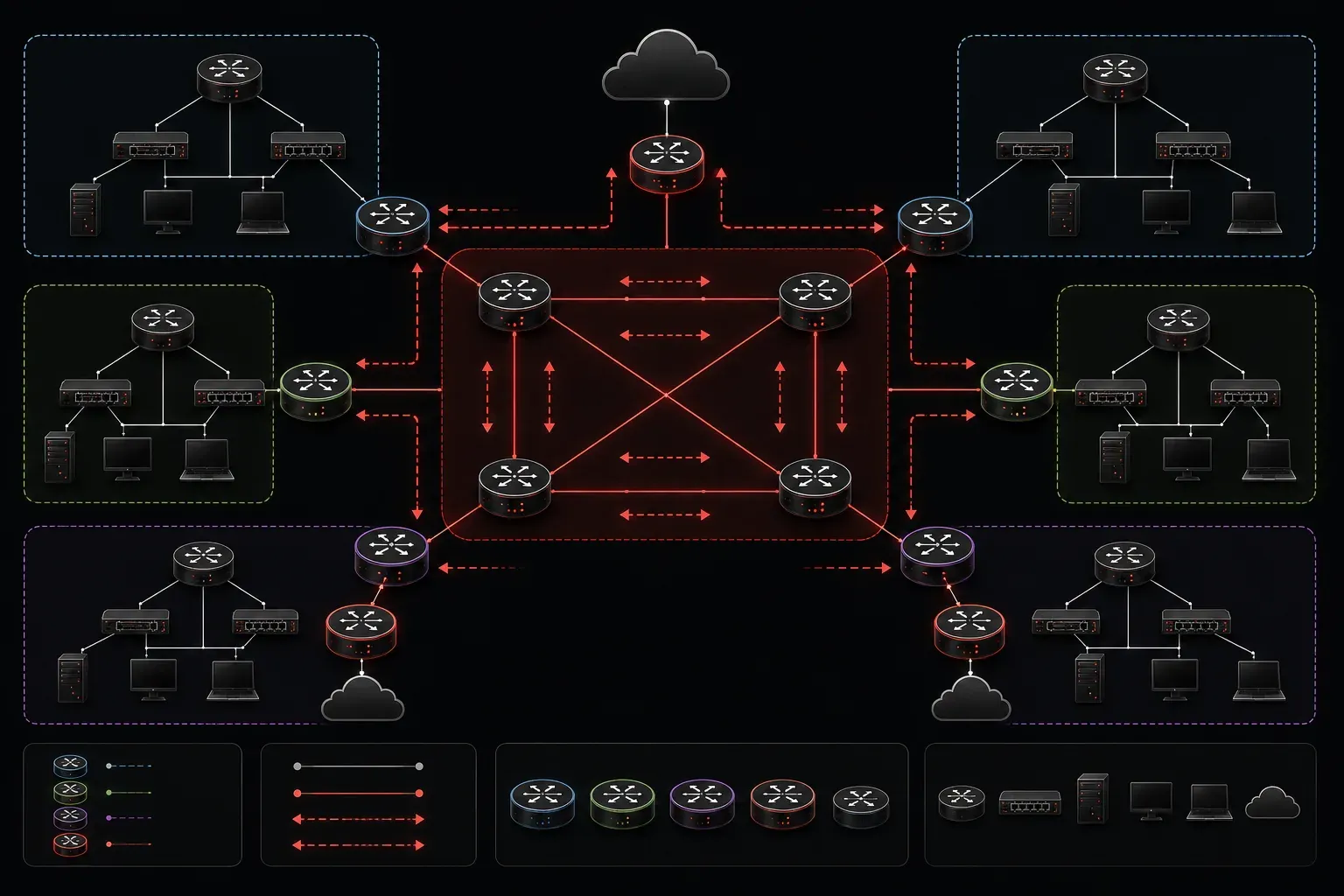
OSPF's hierarchical design centers around areas and specialized router roles that control routing information flow and optimize network performance. Understanding these relationships is critical for implementing scalable enterprise networks and passing the ENARSI exam's advanced routing scenarios.
OSPF Area Types
OSPF uses areas to create routing hierarchy and reduce LSA flooding. Each area type serves specific design purposes and implements different LSA filtering rules.
Backbone Area (Area 0)
The OSPF backbone area serves as the central hub for inter-area routing. All other areas must connect directly to Area 0, either physically or through virtual links. The backbone maintains complete topology information and handles inter-area route summarization.
router ospf 1
 network 10.0.0.0 0.0.0.255 area 0
 area 1 range 192.168.1.0 255.255.255.0
 area 2 range 192.168.2.0 255.255.255.0
The backbone area typically does not filter LSA types 1, 2, or 3, ensuring full reachability between all areas in the OSPF domain. However, specific configurations such as filtering with distribute-lists or route-maps can modify this default behavior.
Standard Areas
Standard areas accept all LSA types (1-7) and maintain complete OSPF topology tables. These areas support ASBRs and allow external route advertisements throughout the area.
Stub Areas
Stub areas filter LSA types 4 and 5 (external routes) while accepting types 1, 2, and 3. ABRs inject a default route to provide external connectivity.
router ospf 1
 area 10 stub

! Verification
show ip ospf database
All routers in a stub area must be configured with the area X stub command. The area cannot contain ASBRs since external route advertisements are prohibited.
Totally Stubby Areas
Cisco's proprietary totally stubby areas filter LSA types 3, 4, and 5. Only intra-area routes and the ABR-generated default route exist in the area's topology table.
! ABR configuration
router ospf 1
 area 20 stub no-summary

! Internal router configuration
router ospf 1
 area 20 stub
Not-So-Stubby Areas (NSSA)
NSSA areas filter LSA types 4 and 5 but allow type 7 LSAs for external route redistribution within the area. The ABR converts type 7 LSAs to type 5 when advertising into other areas.
router ospf 1
 area 30 nssa
 redistribute static subnets

! Verify NSSA LSAs
show ip ospf database nssa-external
NSSA areas solve the limitation of stub areas by allowing controlled external route injection through type 7 LSAs.
Totally NSSA Areas
Totally NSSA areas combine NSSA functionality with inter-area route filtering, accepting only type 1, 2, and 7 LSAs plus the ABR's default route.
router ospf 1
 area 40 nssa no-summary
OSPF Router Roles
Router roles define functional responsibilities within the OSPF hierarchy and determine LSA processing behavior.
Area Border Router (ABR)
OSPF ABR routers connect multiple areas and control inter-area routing. ABRs maintain separate topology databases for each connected area and generate type 3 summary LSAs.
router ospf 1
 network 10.1.1.0 0.0.0.255 area 0
 network 10.2.2.0 0.0.0.255 area 1
 area 1 range 10.2.0.0 255.255.0.0

! Verify ABR status
show ip ospf
show ip ospf border-routers
ABRs perform critical functions including route summarization, LSA type conversion for special area types, and SPF calculation coordination between areas.
Autonomous System Boundary Router (ASBR)
OSPF ASBR routers inject external routes into the OSPF domain through redistribution. ASBRs generate type 5 (or type 7 in NSSA areas) external LSAs and cannot exist in stub areas.
router ospf 1
 redistribute bgp 65001 subnets
 redistribute connected subnets
 default-information originate

! Verify ASBR status and external routes
show ip ospf
show ip ospf database external
The ASBR role activates automatically when redistribution occurs. When an ASBR exists in a non-backbone area, ABRs generate type 4 ASBR summary LSAs to inform other areas about the ASBR's presence, enabling other routers to calculate paths to external destinations.
Internal Router
Internal routers operate entirely within a single area, maintaining only that area's topology database. These routers process LSA types 1 and 2 for intra-area routing calculations.
Backbone Router
Backbone routers connect to Area 0 and may include ABRs, ASBRs, or internal routers. All backbone routers maintain the complete Area 0 topology for inter-area path calculations.
LSA Filtering and Router Role Interactions
Router roles and area types create specific LSA filtering behaviors that optimize routing table size and convergence performance.
! Example: ABR connecting standard area to stub area
router ospf 1
 area 0 range 172.16.0.0 255.255.0.0
 area 10 stub
 area 10 range 192.168.10.0 255.255.255.0
 area 10 default-cost 50
ABRs automatically filter inappropriate LSA types based on connected area configurations. Understanding these filtering rules prevents connectivity issues during network design and troubleshooting.
Verification and Troubleshooting
Systematic verification confirms proper area configuration and router role assignment:
show ip ospf
show ip ospf interface brief
show ip ospf database
show ip ospf border-routers
show ip route ospf
Common issues include area type mismatches, missing backbone connectivity, and incorrect ASBR placement in stub areas. The show ip ospf database command reveals LSA types present in each area, confirming proper filtering behavior.
What's Next
With area types and router roles mastered, the next critical OSPF topic covers LSA types in detail. Understanding how each LSA type functions within different area configurations builds on this foundation and prepares you for complex redistribution scenarios and advanced OSPF troubleshooting.
Tools and resources for this topic
- CCNP ENARSI 300-410 Official Cert Guide — The definitive ENARSI study resource by Raymond Lacoste. Covers advanced routing, services, and troubleshooting.