
Real-World Examples of APIs in Networking
Explore real-world API applications in networking, from device configuration management to SDN controllers. Learn practical examples of how APIs automate network tasks, improve scalability, and enable infrastructure as code in modern network environments.

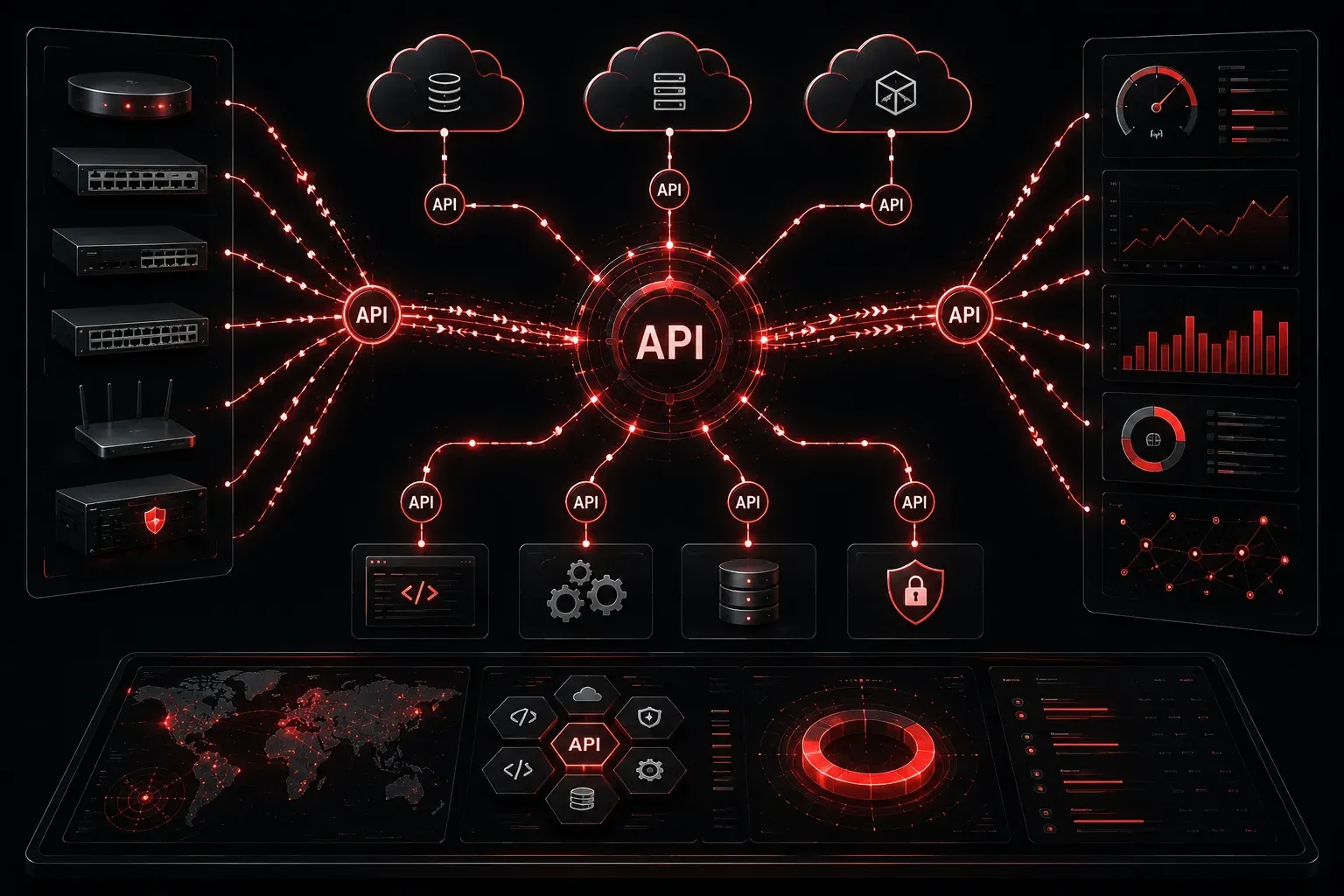
When you're learning about APIs in networking, understanding real-world applications makes all the difference. Let's explore how APIs are actually used in modern network environments and why they've become essential tools for network engineers.
Network Device Configuration Management
One of the most common API applications in networking involves managing device configurations across large infrastructures. Instead of logging into each switch or router individually, network engineers use APIs to push configuration changes to hundreds of devices simultaneously.
For example, Cisco's RESTCONF API allows you to configure an interface using a simple HTTP POST request. RESTCONF is a protocol that provides a programmatic interface for accessing data defined in YANG models, enabling network automation through standard HTTP operations:
POST /restconf/data/ietf-interfaces:interfaces/interface=GigabitEthernet1%2F0%2F1
Content-Type: application/yang-data+json

{
  "ietf-interfaces:interface": {
    "name": "GigabitEthernet1/0/1",
    "description": "Configured via API",
    "enabled": true,
    "type": "iana-if-type:ethernetCsmacd"
  }
}
This approach eliminates human error and ensures consistent configurations across your network infrastructure. Note: Always verify API endpoints and payload structures with the latest vendor documentation, as these may change between software versions.
Network Monitoring and Analytics
Modern monitoring platforms rely heavily on APIs to collect network data. Tools like SolarWinds, PRTG, and Nagios use various APIs to gather real-time network statistics. While SNMP (Simple Network Management Protocol) is a network monitoring protocol, many modern tools provide REST APIs that can complement or replace traditional SNMP monitoring, offering more flexible data access and integration capabilities.
A practical example involves using Cisco's DNA Center API to retrieve network health information:
GET /dna/intent/api/v1/network-health
Authorization: Bearer {token}
Accept: application/json
This single API call returns comprehensive health metrics for your entire network, including device status, interface utilization, and performance trends. The API benefits here are clear: automated data collection, real-time insights, and the ability to integrate network health into broader IT dashboards.
Software-Defined Networking (SDN)
SDN controllers like OpenDaylight and Cisco ACI rely entirely on APIs for network programmability. These platforms expose northbound APIs that allow applications to request network services dynamically.
Consider this example of creating a network policy through an ACI API:
POST /api/node/mo/uni/tn-production.json
Content-Type: application/json

{
  "fvTenant": {
    "attributes": {
      "name": "production",
      "descr": "Production tenant created via API"
    }
  }
}
This demonstrates how APIs enable infrastructure as code, where network configurations become programmable and version-controlled.
Cloud Network Integration
Cloud platforms extensively use APIs for network provisioning. AWS VPC API, Azure Virtual Network API, and Google Cloud VPC API are prime examples of networking API use cases in cloud environments.
When you create a virtual network in AWS using their API, you might use:
aws ec2 create-vpc --cidr-block 10.0.0.0/16 --tag-specifications 'ResourceType=vpc,Tags=[{Key=Name,Value=MyVPC}]'This programmatic approach allows network architects to deploy complex multi-tier network architectures through automation scripts.
Network Security Automation
Security appliances like Palo Alto firewalls and Cisco ASA devices provide APIs for security policy management. Instead of manually configuring firewall rules through a GUI, security teams use APIs to implement consistent security policies.
For instance, adding a security rule to a Palo Alto firewall via API:
POST /restapi/9.0/Policies/SecurityRules
Content-Type: application/json

{
  "entry": {
    "@name": "Allow-Web-Traffic",
    "from": ["trust"],
    "to": ["untrust"],
    "source": ["192.168.1.0/24"],
    "destination": ["any"],
    "service": ["service-http"]
  }
}
Why APIs Matter in Modern Networking
These API examples in networking highlight several key advantages:
- Scalability: Configure thousands of devices with a single script
- Consistency: Eliminate configuration drift across your infrastructure
- Integration: Connect network tools with broader IT systems
- Automation: Reduce manual tasks and human errors
Understanding these real-world applications helps you see why API skills are becoming essential for network engineers. Whether you're managing a small office network or a large enterprise infrastructure, APIs provide the programmability that modern networks demand.
What's Next
Now that you've seen how APIs are used in networking, the next step is understanding different types of APIs and their specific characteristics. We'll explore REST, SOAP, and GraphQL APIs, helping you choose the right API type for your networking automation projects.