
Single-Mode vs Multimode Fiber: What's the Difference?
Learn the key differences between single-mode and multimode fiber optics, including distance limitations, cost considerations, and practical applications for network design. Essential knowledge for CCNA candidates.

When you're studying for your CCNA or Network+ or working on network design, understanding single-mode vs. multimode fiber is crucial. These two types of fiber-optic cables serve different purposes in modern networks, and knowing when to use each can make or break your network infrastructure decisions.
Let's break down the key differences and help you understand which fiber type fits which scenario.
What Makes Them Different?
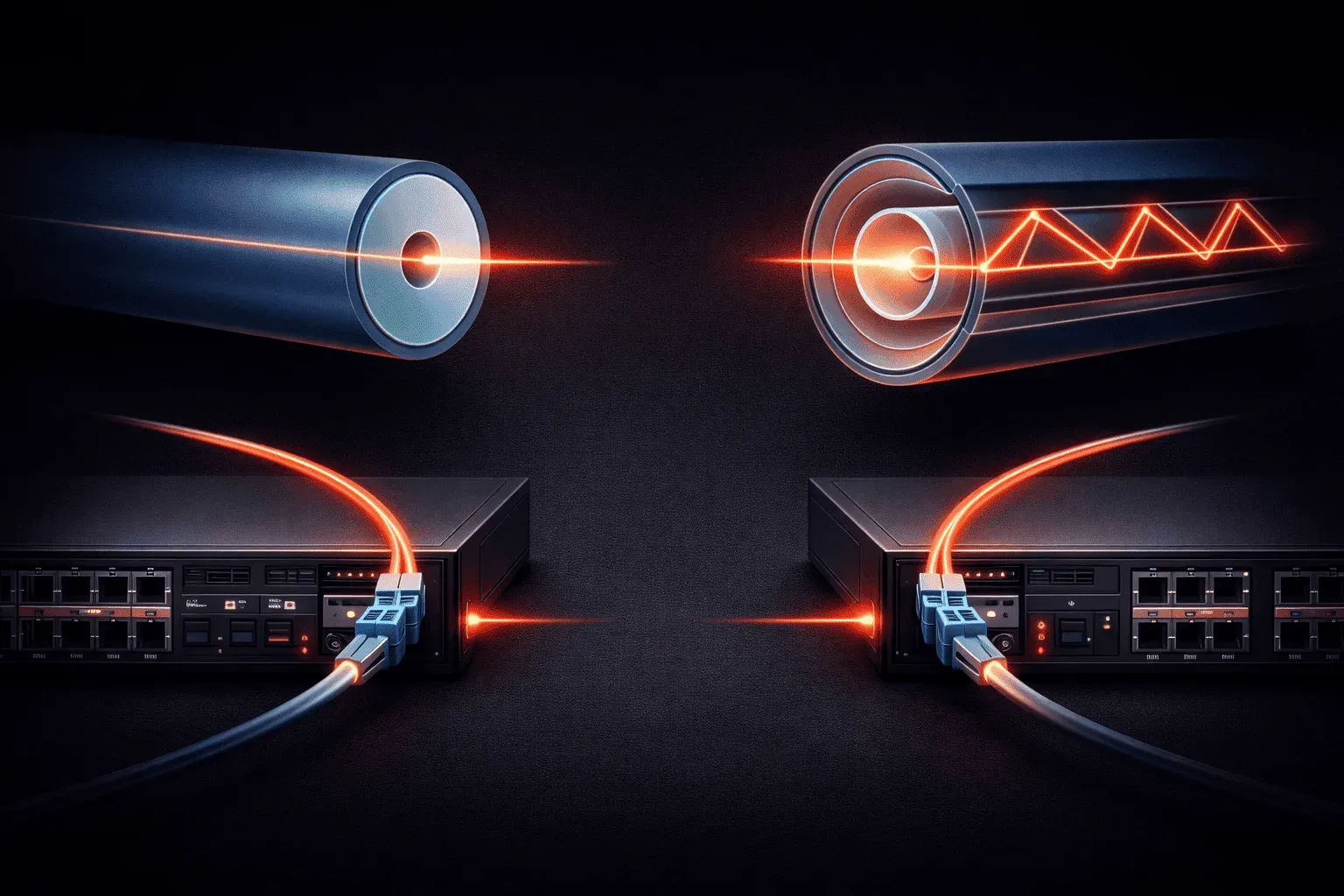
The fundamental difference between single-mode and multimode fiber lies in their core diameter and how light travels through them.
Single-mode fiber has a much smaller core diameter (typically 9 micrometers) compared to multimode fiber (50 or 62.5 micrometers). This size difference dramatically affects how light signals propagate through the cable.
In single-mode fiber, light travels in essentially one path (or "mode") straight down the center of the core. Think of it like a laser pointer beam traveling through a very narrow tube. In multimode fiber, light bounces around inside the larger core, taking multiple paths to reach the destination.
Distance and Performance Comparison
Here's where the differences become practically important for your network cabling decisions:
Single-Mode Fiber
- Distance: Can transmit data over very long distances (40+ kilometers)
- Bandwidth: Higher bandwidth capacity
- Applications: Long-haul networks, ISP backbones, campus backbone connections
- Light source: Uses laser diodes (more expensive)
- Color coding: Typically yellow jacket
Multimode Fiber
- Distance: Limited to shorter distances (typically 300-500 meters)
- Bandwidth: Lower bandwidth than single-mode
- Applications: Building networks, data centers, LAN connections
- Light source: Uses LED or VCSEL (less expensive)
- Color coding: Orange jacket (OM1/OM2) or aqua jacket (OM3/OM4/OM5)
Why the Distance Limitation?
The distance limitation in multimode fiber comes from something called modal dispersion. Since light takes multiple paths through the larger core, some light rays arrive at the destination slightly later than others. Over long distances, this causes the signal to become distorted and unclear.
Single-mode fiber eliminates this problem because light travels in essentially one path, so all the light arrives at the same time, maintaining signal integrity over much longer distances.
Cost Considerations
While multimode fiber cable itself is slightly more expensive due to its more complex manufacturing, the overall system cost tells a different story:
Multimode systems are generally less expensive because:
- LED light sources cost less than lasers
- Transceivers are cheaper
- Installation is more forgiving due to the larger core
Single-mode systems cost more upfront but:
- Provide much longer transmission distances
- Offer higher bandwidth potential
- Future-proof your network better
Practical CCNA Examples
For your CCNA fiber studies, remember these common scenarios:
Use multimode fiber when:
- Connecting switches within a building
- Linking floors in a multi-story office
- Data center server connections
- Budget is a primary concern for shorter runs
Use single-mode fiber when:
- Connecting buildings across a campus
- ISP or service provider networks
- Any connection over 500 meters
- Maximum bandwidth is required
What's Next
Now that you understand the core differences between single-mode and multimode fiber, the next logical step is learning about fiber optic connectors and transceivers. We'll explore SC, LC, and ST connectors, plus how SFP and SFP+ modules work with different fiber types to complete your fiber optic knowledge for the CCNA.
CCNA study resources
- CCNA Official Cert Guide Library (Wendell Odom) — Both volumes covering the full 200-301 exam blueprint. The definitive CCNA study resource.
- Wendell Odom CCNA Vol 1 — Networking fundamentals, switching, VLANs, STP, and IPv4 routing.