
Token Usage vs Context-Window: Which Matters More?
Compares token usage and context-window management for AI applications, explaining when to prioritize each factor based on cost, quality, and latency requirements. Provides practical guidance for balancing these competing concerns.

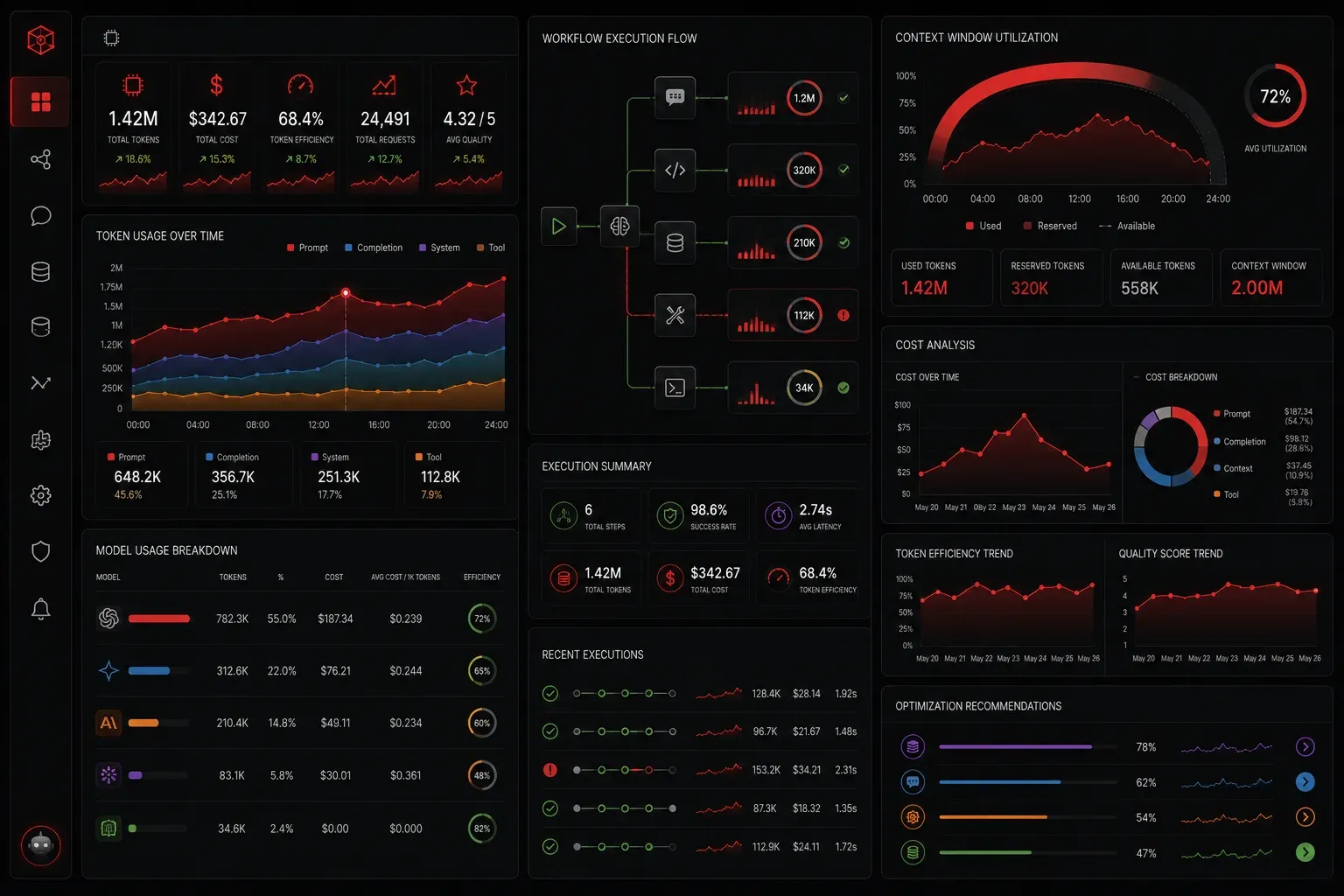
Understanding the Fundamentals
When working with AI models, two critical metrics often compete for your attention: token usage and context-window size. Understanding the difference between these concepts is essential for making informed decisions about AI performance comparison and optimizing your workflows.
Token usage refers to the actual number of tokens consumed in a conversation or API call, including both input (prompt) and output (completion) tokens. Context-window represents the maximum number of tokens an AI model can process in a single interaction, essentially its "memory capacity" for a conversation.
Think of it this way: if the context window is your car's fuel tank capacity, token usage is how much fuel you actually consume on each trip.
The Cost vs Quality Trade-off
Token usage directly impacts your costs. Every token processed costs money, whether it's in your prompt or the AI's response. A 1,000-token conversation costs less than a 10,000-token conversation, regardless of context-window size.
Context window size affects your ability to maintain context across interactions. A larger context window allows the AI to:
- Maintain coherent conversations across longer exchanges
- Reference earlier parts of complex documentation
- Process larger code files or datasets in a single operation
- Access more information when generating responses
However, response quality depends primarily on the model's architecture, training data, and fine-tuning, rather than on context window size alone. A well-trained model with a smaller context window may outperform a poorly trained model with a larger window.
Here's the key insight: a larger context window doesn't automatically mean higher costs. You're charged for tokens used, not for the available window size.
Practical Example: Network Security Analysis
Consider analyzing network security logs for a Cisco environment:
# Scenario 1: Small context-window (4K tokens)
# Must analyze logs in chunks, losing patterns between segments
# Result: 3 separate API calls, potential security insights missed

# Scenario 2: Large context-window (128K tokens)
# Process complete log sequence at once
# Result: 1 API call, comprehensive threat pattern analysis
Scenario 2 might require fewer API calls and could identify security patterns that span the entire log sequence, though total token usage will depend on the actual log content processed and the AI's response length.
Latency Impact Considerations
The latency impact creates another dimension to this comparison. Token usage affects processing time more directly than context-window size. A prompt with 10,000 tokens takes longer to process than one with 1,000 tokens, regardless of whether you're using a 32K or 128K context-window model.
However, context-window size affects latency indirectly through workflow efficiency:
- Smaller windows: Multiple API calls, network overhead, but faster individual responses
- Larger windows: Single API call, reduced overhead, but potentially slower individual processing
Model-Specific Considerations
Different AI models handle context-window and token usage differently:
- GPT-4 Turbo (128K context): Optimized for large document processing, suitable for comprehensive code reviews
- Claude 3 (200K context): Excellent for analyzing entire technical documentation sets
- Gemini Pro (32K context): Balanced approach for most enterprise applications
For Cisco AI Technical Practitioner scenarios, consider that network device configurations, security policies, and troubleshooting logs often benefit from larger context-windows to maintain relationships between different configuration sections.
When to Prioritize Each Factor
Prioritize Token Usage Optimization When:
- Working with high-volume, automated workflows
- Budget constraints are primary concern
- Processing simple, independent queries
- Real-time applications require minimal latency
Prioritize Context-Window Management When:
- Analyzing large documents or codebases
- Maintaining conversation coherence is critical
- Quality and accuracy outweigh cost concerns
- Complex reasoning requires extensive context (e.g., multi-device network troubleshooting)
Finding the Sweet Spot
The most effective approach combines both strategies. Start by selecting a model with an appropriate context-window for your use case, then optimize token usage within that window:
# Efficient prompt structure for Cisco device analysis
system_prompt = "You are a network security analyst. Focus on identifying misconfigurations and security vulnerabilities."
user_input = f"Analyze this router configuration for security issues:\n{config_text}"
# Clear, concise prompts reduce token waste while utilizing available context
Monitor your total_tokens usage in API responses and adjust your approach based on the balance of cost, quality, and speed that matters most for your specific workflow.
What's Next
Now that you understand the token usage vs context-window trade-offs, the next step is learning practical techniques for prompt engineering optimization. We'll explore how to craft efficient prompts that maximize output quality while minimizing token consumption.