
Undersea Internet Cables: The Real Backbone of the Web
Explores how submarine fiber optic cables carry 99% of international internet traffic, including landing stations, redundancy systems, and what happens when cables break. Covers the invisible physical infrastructure that powers global internet connectivity.

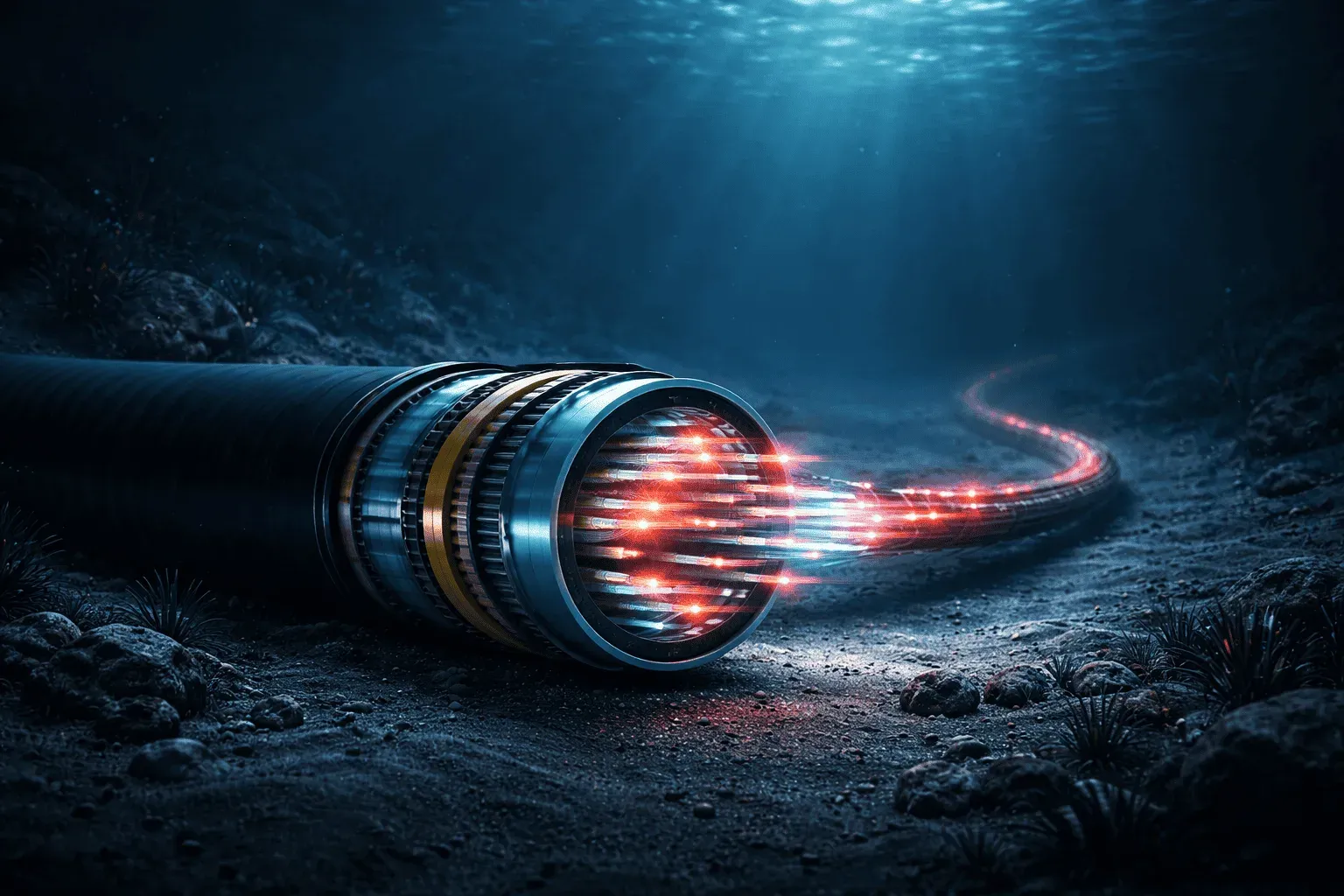
When you send a message to someone on another continent, that data doesn't magically beam through satellites (okay, sometimes it does ;-) ). Instead, it travels through massive fiber optic cables lying on the ocean floor, carrying over 99% of all international internet traffic. These undersea cables are the true internet backbone connecting our digital world.
What Are Submarine Cables?
Submarine cables are thick fiber optic cables designed to withstand the crushing pressure and corrosive environment of the ocean depths. A typical cable contains multiple fiber pairs wrapped in protective layers of steel wire, copper tubing, and waterproof polymer coatings. These cables can stretch thousands of miles across ocean basins, carrying terabits of data per second.
The largest cables today can transmit over 20 terabits per second per fiber pair. To put that in perspective, that's enough bandwidth to stream millions of HD videos simultaneously. Modern submarine fibre systems use wavelength division multiplexing (WDM) technology, allowing dozens of different light wavelengths to carry separate data streams through a single fiber strand.
Landing Stations: Where Ocean Meets Internet
At each end of a submarine cable sits a landing station - a specialized facility where the undersea cable connects to terrestrial networks. These stations house critical equipment, including:
- Optical amplifiers to boost signals after their long ocean journey
- Repeaters that regenerate the optical signals
- Power feeding equipment that sends electricity down the cable to power underwater repeaters
- Monitoring systems that constantly check cable health and performance
Landing stations are often located in remote coastal areas for security and to minimize interference. From these stations, the traffic flows into national and regional fiber networks, eventually reaching your internet service provider and then your home.
Redundancy: Multiple Paths Across the Ocean
No single cable carries all traffic between continents. The global submarine cable network includes hundreds of systems providing multiple redundant paths. For example, traffic between the US and Europe can travel via several different cable routes:
- Northern routes through Greenland and Iceland
- Mid-Atlantic routes connecting directly to Ireland and the UK
- Southern routes through the Azores or Mediterranean
This redundancy is crucial because cable failures are surprisingly common. Ships drag anchors across cables, earthquakes damage them, and occasionally sharks actually do bite them (though this is rarer than internet folklore suggests).
When Cables Break: The Reality of Internet Disruption
When a submarine cable is cut, internet traffic automatically reroutes through other available cables. However, this can cause several noticeable effects:
Increased Latency
Traffic may take longer paths, adding milliseconds or even hundreds of milliseconds to connection times. Online gaming and video calls become noticeably slower.
Reduced Bandwidth
With fewer cables available, the remaining systems become congested. Internet speeds slow down, especially for international connections.
Regional Isolation
Countries or regions served by only a few cables can experience severe internet disruptions. Island nations are particularly vulnerable.
Cable Repair: A Specialized Operation
When a cable breaks, specialized cable repair ships rush to the scene. These vessels can locate the break using time-domain reflectometry, essentially sending light pulses down the cable and measuring how long they take to bounce back from the break point.
The repair process involves hauling up the broken cable from depths that can exceed 8,000 meters, splicing in new cable sections, and carefully lowering everything back to the seafloor. This process can take days or weeks, depending on weather conditions and the location of the break.
The Invisible Infrastructure
Most internet users never think about the physical infrastructure carrying their data across oceans. Yet every video call with family overseas, every international business transaction, and every global social media interaction depends on these underwater fiber highways.
Major technology companies like Google, Facebook, and Amazon now invest billions in their own private submarine cables, recognizing that controlling this infrastructure is crucial for reliable global services. These investments ensure faster, more reliable connections for their users while reducing dependence on traditional telecommunications carriers.
What's Next
Understanding submarine cables gives us an appreciation for the physical reality behind our connected world. In our next post, we'll explore how internet traffic actually routes between these cable systems and what happens inside the routers that make global connectivity decisions.