
Understanding Route Redistribution: OSPF, EIGRP, and BGP Interactions
Explores the complex interactions between OSPF, EIGRP, and BGP during route redistribution, covering metric conversion challenges, loop prevention strategies, and protocol-specific considerations for enterprise routing environments.

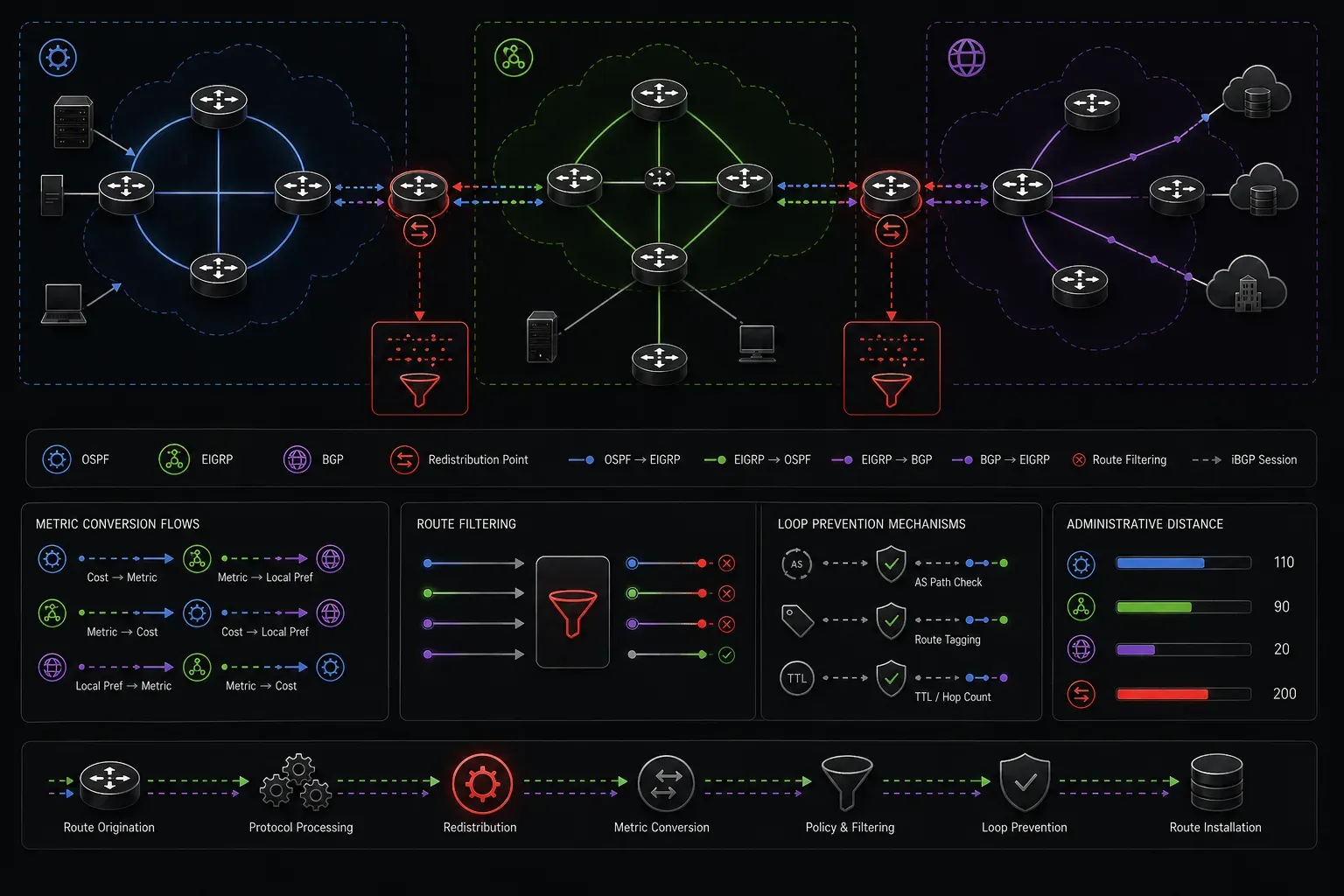
Route redistribution between OSPF, EIGRP, and BGP represents one of the most complex challenges in enterprise routing design. Each protocol's unique characteristics create specific interaction patterns that can dramatically impact network convergence, path selection, and overall stability. Understanding these protocol interactions is essential for developing effective redistribution strategies in multi-protocol environments.
Protocol Metric and Administrative Distance Interactions
The fundamental challenge in redistribution ospf eigrp bgp scenarios lies in how each protocol handles foreign routes. When redistributing between these protocols, metric conversion becomes critical because each uses incompatible metric calculations.
OSPF uses a simple cost metric based on bandwidth, while EIGRP employs a composite metric incorporating bandwidth, delay, reliability, and load. BGP uses a complex path attribute system with local preference, AS path length, and MED values. This disparity requires careful planning to prevent suboptimal routing decisions.
router ospf 1
 redistribute eigrp 100 metric 20 subnets
 redistribute bgp 65001 metric 50 subnets
!
router eigrp 100
 redistribute ospf 1 metric 1000 100 255 1 1500
 redistribute bgp 65001 metric 1000 100 255 1 1500
!
router bgp 65001
 redistribute ospf 1 metric 100
 redistribute eigrp 100 metric 200
Administrative distance (AD) plays a crucial role in these protocol interactions. eBGP has the lowest AD at 20, making it preferred over internal protocols like EIGRP (AD 90) and OSPF (AD 110). However, iBGP's high AD of 200 loses to both internal protocols. This hierarchy creates predictable path selection patterns: eBGP routes are preferred first, followed by internal protocol routes (EIGRP over OSPF), and finally iBGP routes. Understanding this hierarchy is essential for strategic AD manipulation in complex topologies.
Loop Prevention and Path Selection Challenges
Multi-protocol redistribution introduces significant loop prevention challenges. Unlike single-protocol environments where loop prevention mechanisms are built-in, redistribution scenarios require external safeguards to prevent routing loops and suboptimal path selection.
The most effective redistribution strategy involves implementing route filtering and tagging at redistribution points. Route tags act as markers that identify the original source protocol, allowing downstream routers to make informed filtering decisions:
route-map OSPF-TO-EIGRP deny 10
 match tag 120
 ! Deny routes originally from EIGRP
route-map OSPF-TO-EIGRP permit 20
 set tag 110
 ! Tag routes as originating from OSPF
!
route-map EIGRP-TO-OSPF deny 10
 match tag 110
 ! Deny routes originally from OSPF
route-map EIGRP-TO-OSPF permit 20
 set tag 120
 ! Tag routes as originating from EIGRP
!
router ospf 1
 redistribute eigrp 100 metric 20 subnets route-map EIGRP-TO-OSPF
!
router eigrp 100
 redistribute ospf 1 metric 1000 100 255 1 1500 route-map OSPF-TO-EIGRP
BGP introduces additional complexity through its path attribute manipulation capabilities. When redistributing IGP routes into BGP, proper community tagging and local preference settings become essential for maintaining routing policy consistency across the autonomous system boundary.
EIGRP-OSPF Redistribution Specifics
EIGRP and OSPF redistribution require particular attention to subnet boundaries and summarization. OSPF's subnets keyword is critical; without it, only classful networks are redistributed, causing subnet information to be lost in modern classless environments. This keyword ensures all subnet routes are properly transferred between protocols.
EIGRP's automatic summarization behavior has evolved significantly. In newer IOS versions (15.0(1)M and later), automatic summarization is disabled by default, but in older versions it was enabled by default and could create unexpected routing behavior:
router ospf 1
 area 0 range 192.168.0.0 255.255.0.0
 redistribute eigrp 100 metric 30 subnets
!
router eigrp 100
 no auto-summary  ! Explicitly disable if enabled
 redistribute ospf 1 metric 10000 100 255 1 1500
The interaction between EIGRP's topology table and OSPF's link-state database creates interesting convergence characteristics. EIGRP's faster convergence can temporarily create routing inconsistencies until OSPF recalculates its shortest path tree.
BGP Integration Considerations
Integrating BGP with IGP redistribution adds another layer of complexity to ospf eigrp bgp interactions. BGP's policy-driven nature requires careful consideration of route propagation and path manipulation.
When redistributing IGP routes into BGP, establishing proper route origin codes and community values ensures appropriate treatment by downstream BGP speakers. The following example demonstrates comprehensive route-map configuration with detailed attribute setting:
! Define which networks can be redistributed
ip prefix-list INTERNAL-NETWORKS permit 10.0.0.0/8 le 24
ip prefix-list INTERNAL-NETWORKS permit 172.16.0.0/12 le 24
ip prefix-list INTERNAL-NETWORKS permit 192.168.0.0/16 le 24
!
route-map IGP-TO-BGP permit 10
 match ip address prefix-list INTERNAL-NETWORKS
 set origin igp               ! Mark as IGP-originated
 set community 65001:100      ! Tag with community for policy
 set local-preference 150     ! Higher than default for preference
 set med 50                   ! Set Multi-Exit Discriminator
!
router bgp 65001
 redistribute ospf 1 route-map IGP-TO-BGP
 redistribute eigrp 100 route-map IGP-TO-BGP
The reverse direction (redistributing BGP routes into IGPs) requires extreme caution. Full BGP tables contain hundreds of thousands of routes that can overwhelm IGP databases and control planes. Selective redistribution with aggressive filtering becomes mandatory:
ip prefix-list BGP-TO-IGP permit 10.0.0.0/8 le 24
ip prefix-list BGP-TO-IGP permit 172.16.0.0/12 le 24
ip prefix-list BGP-TO-IGP permit 192.168.0.0/16 le 24
!
route-map BGP-TO-IGP permit 10
 match ip address prefix-list BGP-TO-IGP
 match origin igp             ! Only redistribute IGP-originated routes
 set tag 200                  ! Tag for identification
 set metric 100               ! Set consistent metric
Verification and Troubleshooting Multi-Protocol Redistribution
Effective troubleshooting of redistribution scenarios requires understanding each protocol's route advertisement and selection process. Key verification commands include protocol-specific route table examination and redistribution status monitoring.
show ip route ospf
show ip route eigrp
show ip route bgp
show ip protocols
show route-map
show ip bgp summary
show ip ospf database external
show ip eigrp topology
Pay particular attention to route tags, administrative distances, and metric values in the routing table. Unexpected path selection often indicates redistribution configuration errors or incomplete loop prevention measures.
What's Next
With a solid understanding of multi-protocol redistribution interactions, the next logical step involves exploring advanced redistribution filtering techniques and route map applications. These tools provide the granular control necessary to implement robust redistribution policies in complex enterprise environments while maintaining optimal routing behavior and loop prevention.
Tools and resources for this topic
- CCNP ENARSI 300-410 Official Cert Guide — The definitive ENARSI study resource by Raymond Lacoste. Covers advanced routing, services, and troubleshooting.