
VXLAN: Enhancing Network Scalability and Segmentation
VXLAN enhances network scalability beyond VLAN limitations with 24-bit VNIDs supporting over 16 million logical networks. This technology enables micro-segmentation, multi-tenancy, and workload mobility in modern data centers through overlay networking.

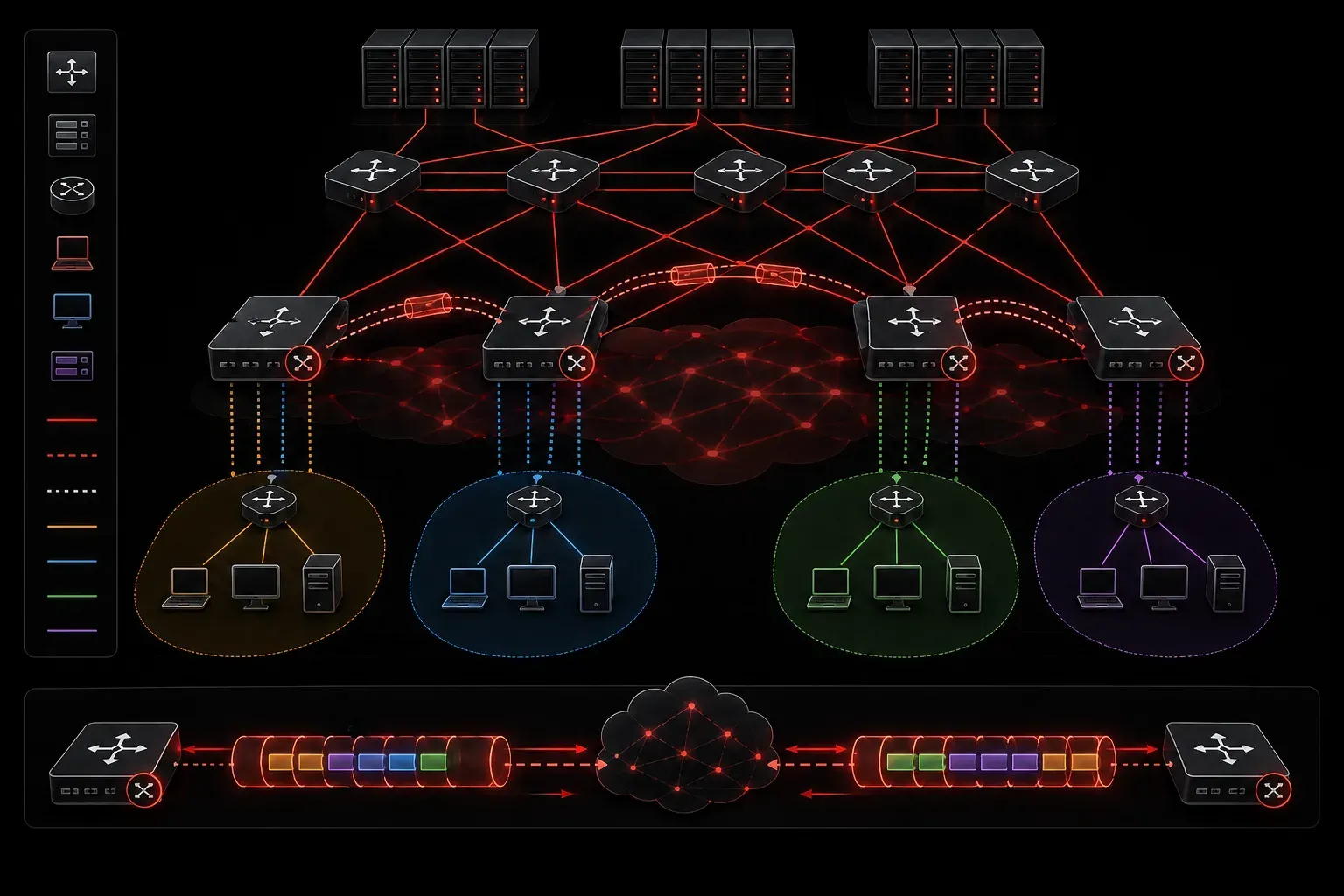
VXLAN (Virtual Extensible LAN) transforms traditional Layer 2 networks by encapsulating Ethernet frames within UDP packets, creating overlay networks that scale far beyond VLAN limitations. For data center networking professionals, understanding VXLAN scalability segmentation principles is essential as enterprises migrate to cloud-first architectures and implement multi-tenant environments.
VXLAN Architecture and Scalability Fundamentals
Traditional VLANs are constrained by the 4,094 VLAN ID limit (12-bit field), creating significant challenges in large-scale data centers. VXLAN addresses this limitation with a 24-bit VNID (VXLAN Network Identifier), supporting over 16 million logical networks. This exponential increase in available identifiers enables massive multi-tenant environments where each tenant can have thousands of isolated network segments.
The VXLAN header structure includes the VNID, flags, and reserved fields, totaling 8 bytes. When combined with the outer IP/UDP headers (28 bytes for IPv4), VXLAN adds 36 bytes of overhead per packet. This overhead consideration is crucial for MTU planning in VXLAN deployments.
interface Vlan100
 description VXLAN-mapped VLAN
 ip address 192.168.100.1 255.255.255.0

interface nve1
 no shutdown
 source-interface loopback1
 member vni 10100
  suppress-arp
  ingress-replication protocol bgp
Enhanced Network Segmentation Capabilities
VXLAN benefits extend beyond simple VLAN expansion. The technology enables micro-segmentation at unprecedented scale, allowing granular traffic isolation between workloads, applications, and tenants. Each VNID creates a completely isolated Layer 2 domain, with traffic forwarding decisions made based on the outer IP header routing.
The decoupling of overlay and underlay networks provides operational flexibility. Physical network infrastructure can be simplified to pure Layer 3 IP fabric, while overlay networks handle tenant-specific requirements. This separation allows network operators to optimize underlay networks for performance and reliability without impacting tenant configurations.
evpn
 vni 10100 l2
  rd auto
  route-target import auto
  route-target export auto
 vni 10200 l2
  rd auto
  route-target import auto
  route-target export auto
Multi-Tenancy and Isolation
VXLAN's segmentation capabilities enable true multi-tenancy in shared infrastructure. Each tenant receives isolated network segments with overlapping IP address spaces when needed. The VNID ensures complete traffic isolation, while BGP EVPN control plane distributes tenant-specific routing information without cross-contamination.
Advanced segmentation policies can be implemented using VNID-based access control lists and distributed firewalling. This approach enables centralized policy definition with distributed enforcement at each VTEP (VXLAN Tunnel Endpoint).
VXLAN in Modern Data Center Networking
Contemporary data center networking architectures leverage VXLAN for workload mobility, disaster recovery, and hybrid cloud connectivity. Virtual machines and containers can migrate between physical hosts and even data centers while maintaining their network identity through consistent VNID assignments.
The technology integrates seamlessly with SDN controllers and orchestration platforms. VMware NSX, Cisco ACI, and cloud platforms like AWS use VXLAN extensively for network virtualization. This integration enables automated provisioning of network segments as applications deploy and scale.
interface nve1
 no shutdown
 source-interface loopback1
 host-reachability protocol bgp
 member vni 10100
  suppress-arp
  ingress-replication protocol bgp
 member vni 10200
  suppress-arp
  ingress-replication protocol bgp
BGP EVPN Control Plane Integration
BGP EVPN serves as the control plane for VXLAN deployments, providing MAC and IP address learning without flooding. This combination eliminates the need for multicast in the underlay network while providing efficient host mobility and optimal traffic forwarding.
EVPN route types handle different aspects of VXLAN operations: Type 2 routes advertise MAC/IP bindings, Type 3 routes handle multicast group membership, and Type 5 routes enable inter-VNID routing. This comprehensive control plane ensures loop-free forwarding and rapid convergence during topology changes.
Performance and Design Considerations
VXLAN deployments require careful consideration of VTEP placement, replication mechanisms, and traffic patterns. Hardware VTEP implementations in modern switches provide line-rate encapsulation and decapsulation, while software VTEPs in hypervisors may introduce performance considerations for high-throughput applications.
Ingress replication and multicast-based BUM (Broadcast, Unknown unicast, Multicast) traffic handling represent key design decisions. Ingress replication scales well for smaller deployments but can create bandwidth multiplication in large-scale environments. Multicast-based solutions require underlay PIM configuration but offer more efficient bandwidth utilization.
show nve peers
show nve vni
show bgp l2vpn evpn summary
show bgp l2vpn evpn route-type 2
Troubleshooting and Verification
VXLAN troubleshooting focuses on overlay-underlay interaction, VTEP reachability, and control plane synchronization. Key verification points include NVE interface status, BGP EVPN neighbor relationships, and MAC address table population across VTEPs.
Packet capture and analysis must account for the encapsulation layer. Tools like Wireshark can decode VXLAN headers, but network operators need visibility into both overlay and underlay packet flows for comprehensive troubleshooting.
What's Next
Understanding VXLAN's scalability and segmentation benefits provides the foundation for implementing modern data center networks. The next critical topic in your ENCOR journey is exploring VXLAN deployment models and configuration specifics, including BGP EVPN integration and multi-site connectivity patterns that enable enterprise-scale network virtualization.
Tools and resources for this topic
- CCNP ENCOR 350-401 Official Cert Guide — The definitive ENCOR study resource by Brad Edgeworth. Covers enterprise infrastructure, virtualisation, and automation.