
A Brief History of Linux
Linux began in 1991 as Finnish student Linus Torvalds' hobby project to create a free Unix-like operating system. Combined with GNU tools and released under an open-source license, it evolved from a solo project to the collaborative foundation powering billions of devices today.

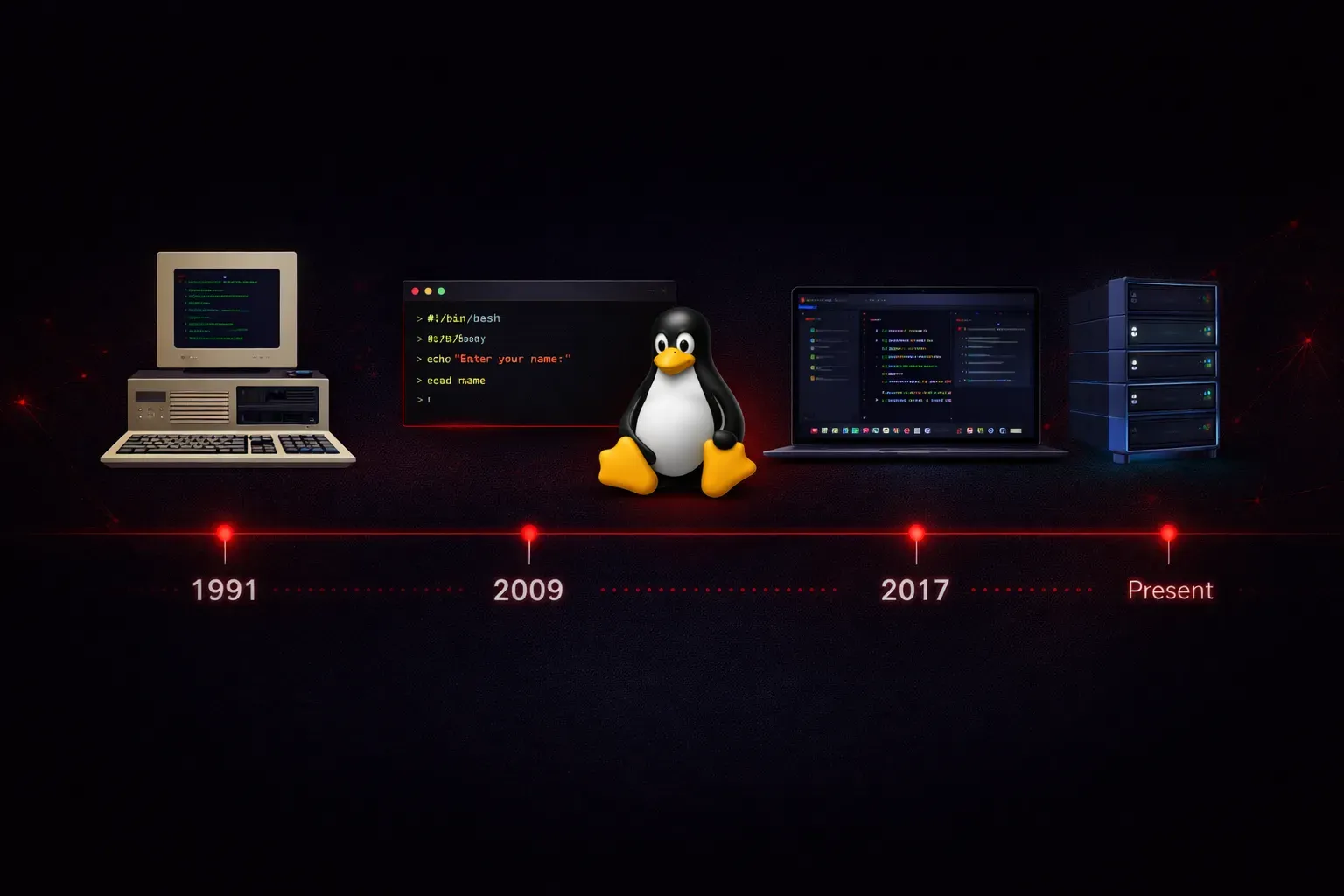
Understanding Linux's history isn't just academic curiosity; it reveals why this operating system has become the backbone of everything from smartphones to supercomputers. Let's explore how a Finnish student's hobby project evolved into one of the most influential technologies of our time.
The Unix Foundation
Before Linux existed, there was Unix. Developed at Bell Labs in 1969 by Ken Thompson and Dennis Ritchie, Unix introduced revolutionary concepts like hierarchical file systems and the philosophy that programs should "do one thing and do it well." However, Unix was proprietary and expensive, limiting its accessibility to universities and large corporations.
This created a gap in the market for a free, Unix-like operating system that students and developers could use without licensing fees.
Enter Linus Torvalds
In 1991, 21-year-old Linus Torvalds was a computer science student at the University of Helsinki. Frustrated with the limitations of MINIX (a Unix-like system used for teaching), he decided to create his own operating system kernel as a hobby project.
A kernel is the core component of an operating system; it manages hardware resources like memory and processors, and allows other programs to run on top of it. Think of it as the foundation that everything else is built upon.
On August 25, 1991, Torvalds posted this famous message to the comp.os.minix newsgroup:
Hello everybody out there using minix -

I'm doing a (free) operating system (just a hobby, won't be big and
professional like gnu) for 386(486) AT clones.
Little did he know this "hobby" would change the world.
The GNU Connection
Torvalds' kernel filled a crucial gap in the GNU Project, started by Richard Stallman in 1983. GNU (which recursively stands for "GNU's Not Unix") aimed to create a completely free Unix-like operating system. By 1991, GNU had developed most components (compilers, text editors, shell) but lacked a working kernel.
When Torvalds combined his Linux kernel with GNU tools, the result was a complete, functional operating system. This is why you'll sometimes hear it called "GNU/Linux," though most people simply say "Linux."
The Open Source Revolution
Torvalds made a pivotal decision: he released Linux under the GNU General Public License (GPL). The GPL is a special type of software license that ensures the software remains free and open; it's sometimes called a "copyleft" license because it flips traditional copyright on its head. This meant anyone could:
- Use the software for any purpose
- Study and modify the source code
- Distribute copies
- Distribute modified versions (but they must also be released under the GPL)
This open-source model attracted developers worldwide. By 1992, the Linux kernel had grown from Torvalds' solo project to a collaborative effort involving hundreds of contributors.
Commercial Success and Distributions
The mid-1990s saw the emergence of Linux distributions, complete operating systems built around the Linux kernel. Companies like Red Hat (1994) and SUSE (1994) began offering commercial support, proving that open-source software could be a viable business model.
Ubuntu's launch in 2004 marked another milestone, bringing Linux to desktop users with its focus on ease of use and regular release cycles. The tagline "Linux for Human Beings" captured Ubuntu's mission to make Linux accessible to everyone.
Linux Today
Today, Linux's influence is everywhere. The Linux kernel powers Android devices (though Android itself is quite different from traditional Linux distributions), runs over 96% of the world's top supercomputers, and dominates cloud computing platforms like AWS and Google Cloud. Major tech companies, including Google, Facebook, and Netflix, rely heavily on Linux infrastructure.
While Android uses the Linux kernel at its core, it's important to understand that Android devices aren't the same as traditional Linux computers. Android has its own user interface, application framework, and development model built on top of the Linux kernel.
The kernel that started as one student's hobby now includes contributions from thousands of developers across hundreds of companies. Linux has proven that collaborative development can create software that's both technically superior and economically sustainable.
What's Next
Now that you understand Linux's remarkable journey from university project to global phenomenon, you're ready to dive into the technical fundamentals. In our next post, we'll explore Linux distributions and help you choose the right one for your learning journey.