
Advanced Filtering Techniques for Loop Prevention
Advanced filtering techniques using ACLs and route maps provide granular loop prevention control in enterprise networks. This post covers tag-based filtering, administrative distance manipulation, and multi-protocol loop prevention strategies for complex routing environments.

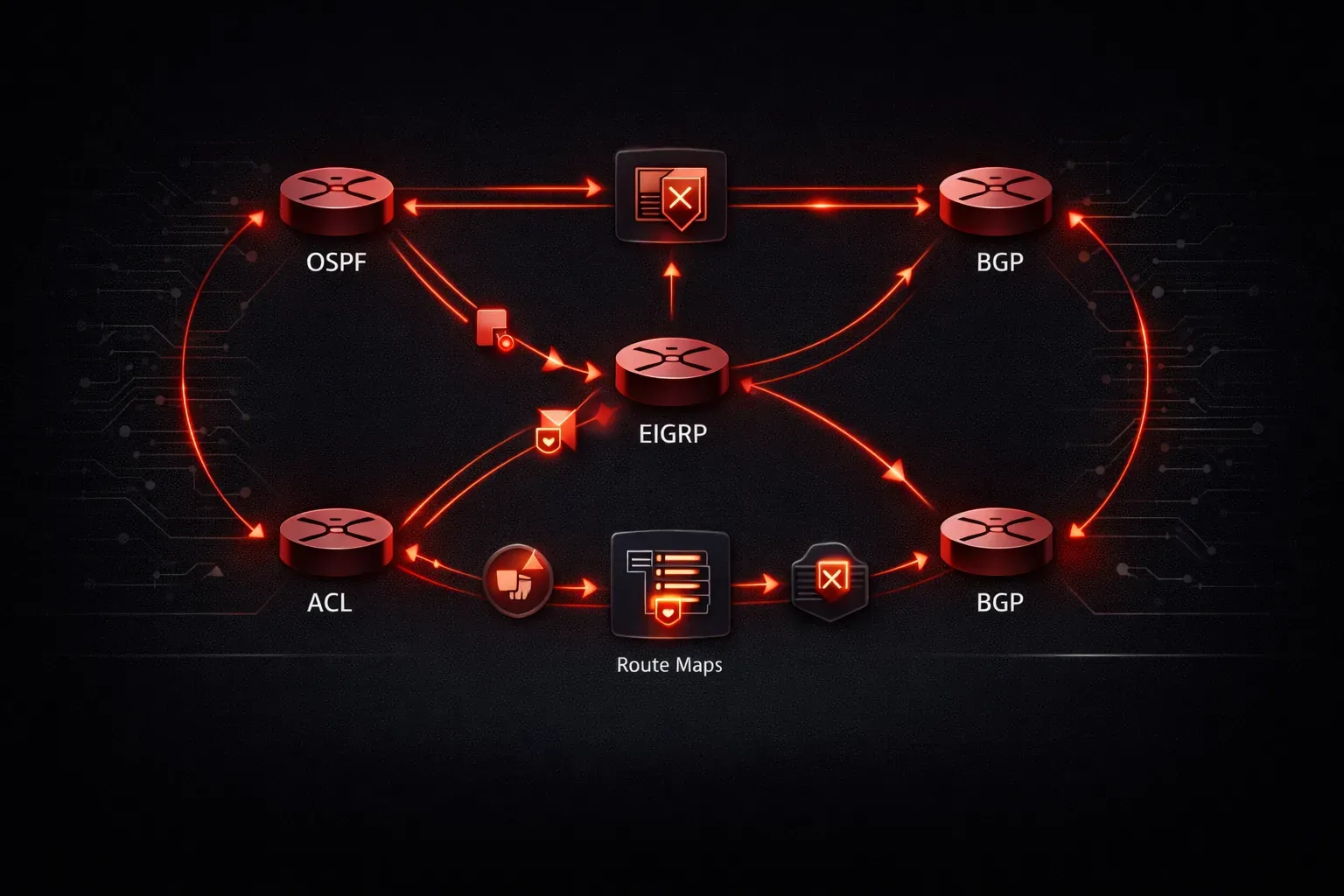
Loop prevention filtering represents one of the most critical yet often overlooked aspects of enterprise network design. While basic loop prevention mechanisms like Spanning Tree Protocol handle Layer 2 loops, advanced filtering techniques using ACLs and route maps provide granular control over routing policies and path selection issues that can create suboptimal forwarding or policy-induced loops in complex enterprise networks.
Understanding Advanced Filtering for Loop Prevention
Traditional loop prevention focuses on blocking physical loops through protocols like STP, OSPF, and EIGRP with their built-in mechanisms. However, advanced filtering techniques target policy-induced loops and routing inconsistencies that emerge through complex routing policies, redistribution scenarios, and multi-homed connections. These techniques work by selectively filtering routes, advertisements, or traffic flows based on sophisticated matching criteria.
The key difference lies in preventing policy conflicts and suboptimal routing decisions that can lead to forwarding loops. While routing protocols handle basic loop prevention, they don't account for loops created through route redistribution conflicts, BGP path manipulation errors, or misconfigured administrative distance settings.
ACL-Based Traffic and Route Filtering
While Access Control Lists are primarily designed for traffic filtering and security, they play a supporting role in loop prevention by controlling route advertisements and filtering traffic that could exacerbate routing instabilities. When used strategically, ACLs can prevent problematic routing scenarios before they create forwarding loops.
Route Advertisement Filtering
ACLs can filter route advertisements at redistribution points to prevent routing feedback loops. Consider a network with multiple OSPF areas connected through EIGRP, where routes learned from Area 1 should never be redistributed back into Area 1:
ip access-list standard PREVENT_AREA1_FEEDBACK
 deny 172.16.10.0 0.0.0.255
 deny 172.16.11.0 0.0.0.255
 permit any

router ospf 100
 area 1 range 172.16.10.0 255.255.254.0
 redistribute eigrp 100 subnets route-map EIGRP_TO_OSPF

route-map EIGRP_TO_OSPF permit 10
 match ip address PREVENT_AREA1_FEEDBACK
 set metric 1000
 set metric-type 2
This configuration prevents routes originating from Area 1 from being redistributed back through EIGRP and potentially re-entering Area 1 through another ABR, which could cause routing instabilities.
Interface-Level Traffic Filtering
Strategic placement of ACLs on specific interfaces can filter traffic during network convergence events in hub-and-spoke topologies where backup paths might temporarily create forwarding inconsistencies:
interface Serial0/1/0
 description Backup link to remote site
 ip access-group BACKUP_TRAFFIC_FILTER in

ip access-list extended BACKUP_TRAFFIC_FILTER
 deny ip 192.168.100.0 0.0.0.255 any log
 deny ip 192.168.101.0 0.0.0.255 any log
 permit ip any any
Route Map Advanced Filtering Techniques
Route maps provide sophisticated filtering capabilities for loop prevention through conditional matching and selective modification of routing attributes. They excel in complex redistribution scenarios and BGP policy implementations where precise control over route selection is critical.
Tag-Based Route Tracking
Route tags offer a powerful mechanism for tracking route origins and preventing redistribution feedback loops in multi-point redistribution scenarios:
route-map EIGRP_TO_OSPF permit 10
 match ip address prefix-list EIGRP_ROUTES
 set tag 100
 set metric 1000

route-map OSPF_TO_EIGRP deny 10
 match tag 100

route-map OSPF_TO_EIGRP permit 20
 match ip address prefix-list OSPF_ROUTES
 set tag 200
 set metric 1000000 100 255 1 1500

router ospf 100
 redistribute eigrp 100 subnets route-map EIGRP_TO_OSPF

router eigrp 100
 redistribute ospf 100 route-map OSPF_TO_EIGRP
This configuration ensures routes redistributed from EIGRP into OSPF (tagged with 100) are never redistributed back into EIGRP, preventing redistribution feedback loops while maintaining necessary connectivity.
Path Selection Control
Route maps can influence path selection to create consistent, loop-free forwarding paths by modifying BGP attributes. Note that while administrative distance affects route selection between different routing protocols, it doesn't directly prevent loops, instead, it influences which routes are installed in the routing table:
route-map BACKUP_PATH_CONTROL permit 10
 match ip address prefix-list CRITICAL_NETWORKS
 set local-preference 50
 set weight 100

route-map PRIMARY_PATH_CONTROL permit 10
 match ip address prefix-list CRITICAL_NETWORKS
 set local-preference 200
 set weight 300

router bgp 65001
 neighbor 10.1.1.2 route-map PRIMARY_PATH_CONTROL in
 neighbor 10.1.1.3 route-map BACKUP_PATH_CONTROL in
Multi-Protocol Filtering Strategies
Enterprise networks running multiple routing protocols require sophisticated filtering strategies that work alongside each protocol's built-in loop prevention mechanisms to prevent policy-induced routing issues.
BGP and IGP Integration Filtering
When BGP provides external connectivity while OSPF handles internal routing, careful filtering prevents redistribution conflicts and maintains consistent routing policies:
ip prefix-list INTERNAL_NETWORKS seq 5 permit 10.0.0.0/8 le 24
ip prefix-list EXTERNAL_NETWORKS seq 5 permit 0.0.0.0/0 le 32

route-map BGP_TO_OSPF deny 5
 match ip address prefix-list INTERNAL_NETWORKS

route-map BGP_TO_OSPF permit 10
 match ip address prefix-list EXTERNAL_NETWORKS
 set metric 100
 set metric-type 1

route-map OSPF_TO_BGP permit 10
 match ip address prefix-list INTERNAL_NETWORKS
 set community 65001:100
Advanced Scenarios Requiring Filtering
Advanced filtering becomes essential in scenarios such as:
- Multi-homed sites with diverse routing protocols where standard protocol mechanisms aren't sufficient
- Network mergers requiring temporary routing policy coordination
- Disaster recovery scenarios where backup paths must be carefully controlled
- Service provider handoffs where route leaking must be precisely managed
- MPLS VPN environments with complex import/export policies
Verification and Troubleshooting
Effective loop prevention filtering requires continuous monitoring and verification. Key commands for validating your configurations include:
show ip route summary
show ip protocols
show route-map
show ip access-lists
show ip prefix-list
show ip bgp summary
show ip eigrp topology
show ip ospf database
Monitor routing table stability using show ip route with periodic sampling to identify routes that appear and disappear repeatedly, indicating potential routing instabilities that your filters haven't addressed. Use debug ip routing sparingly to trace routing decisions during troubleshooting.
Best Practices for Production Implementation
Successful loop prevention filtering in production networks requires careful planning and phased implementation. Always implement filters during maintenance windows and verify convergence behavior under various failure scenarios.
Document your filtering logic extensively, as complex route maps and ACLs become difficult to troubleshoot months after implementation. Use descriptive names for your access lists and route maps that clearly indicate their specific purpose.
Test your filtering configuration in lab environments that mirror your production topology, particularly focusing on failure and recovery scenarios where routing instabilities are most likely to occur. Validate that your filters work correctly with the underlying protocol loop prevention mechanisms rather than conflicting with them.
What's Next
With advanced loop prevention filtering techniques mastered, the next logical step is exploring Path Control and Manipulation strategies. These techniques build upon the filtering foundation to provide precise control over traffic paths while maintaining the stable routing topology you've established through advanced filtering.
Tools and resources for this topic
- CCNP ENARSI 300-410 Official Cert Guide — The definitive ENARSI study resource by Raymond Lacoste. Covers advanced routing, services, and troubleshooting.