
Designing Redundant Networks: Best Practices
Learn essential best practices for designing redundant networks that maximize uptime and reliability. Covers physical layer redundancy, protocol optimization, and real-world design patterns with practical Cisco examples.

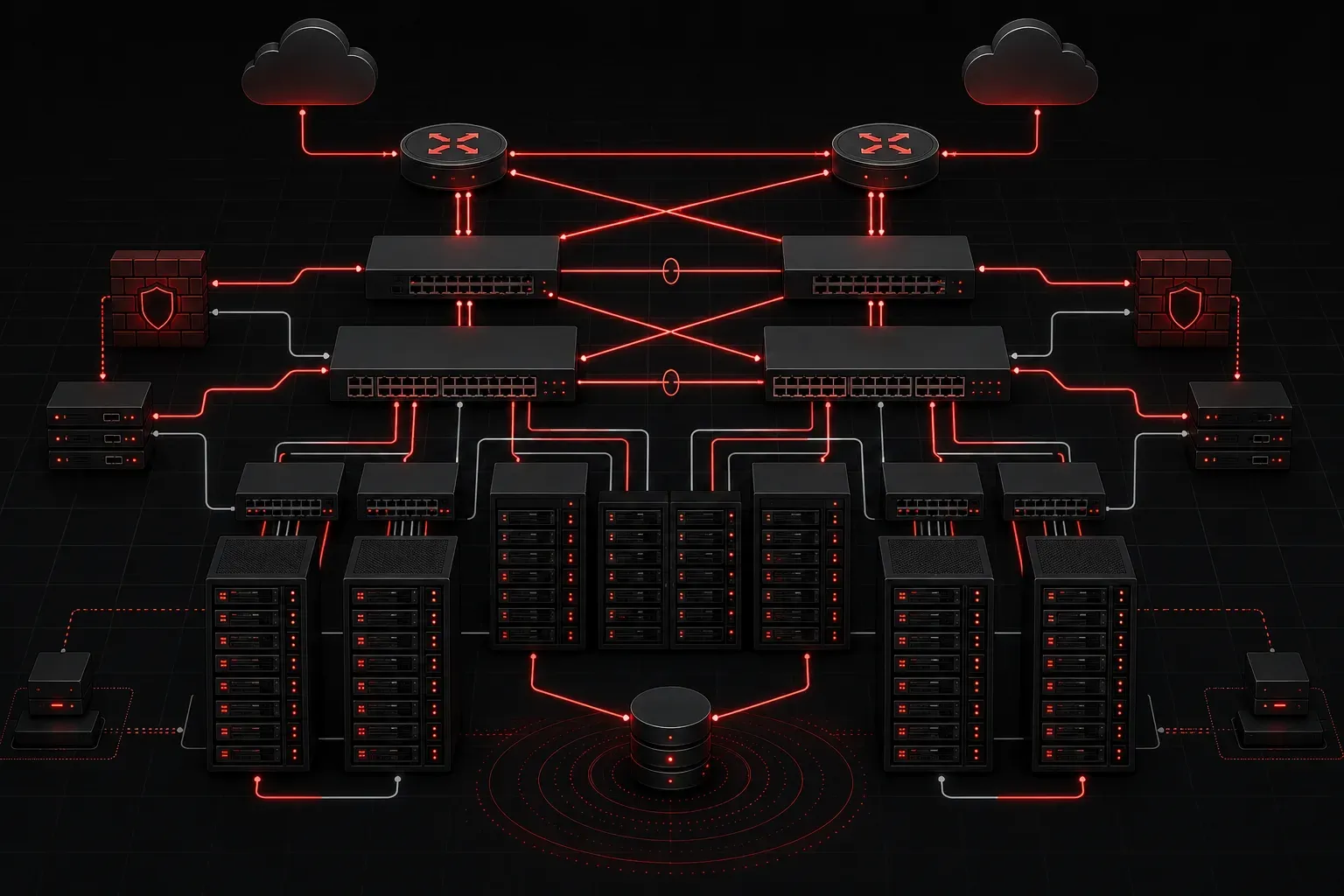
Network downtime costs can range from thousands to hundreds of thousands of dollars per minute, depending on your industry and organization size. When your network fails, everything stops: emails bounce, transactions halt, and productivity vanishes. This is why designing redundant networks isn't just a technical exercise; it's business insurance.
This article targets network engineers and IT professionals with intermediate to advanced technical knowledge of networking protocols and Cisco technologies.
Redundancy means having backup systems ready to take over when primary systems fail. But throwing extra hardware at the problem isn't enough. Effective redundant network design requires strategic planning, proper implementation, and ongoing maintenance.
The Redundancy Hierarchy
Start your design by identifying single points of failure from the ground up:
Physical Layer Redundancy
Your foundation begins with physical diversity. Run cables through separate conduits, use different fiber paths, and ensure your redundant links don't share the same physical infrastructure. A single backhoe can eliminate both your primary and backup connections if they share the same trench.
Device-Level Redundancy
Deploy redundant hardware at every critical layer. This means dual core switches, multiple distribution switches, and redundant edge devices. Configure your Cisco switches with stackwise or vss technologies to present multiple physical devices as a single logical unit:
switch 1 priority 15
switch 2 priority 14
switch stack-member-number 1 provision ws-c3850-48t
switch stack-member-number 2 provision ws-c3850-48t
Link Redundancy
Implement protocols that automatically handle link failures. LACP (Link Aggregation Control Protocol) bundles multiple physical links into a single logical connection, providing both redundancy and increased bandwidth:
interface port-channel 1
 switchport mode trunk
 switchport trunk allowed vlan 10,20,30

interface range GigabitEthernet1/0/1-2
 channel-group 1 mode active
 switchport mode trunk
Protocol-Level Best Practices
Your redundancy design must account for how protocols behave during failures:
Spanning Tree Optimization
While Spanning Tree Protocol (STP) prevents loops, it can also create single points of failure. Implement Rapid PVST+ or MST to reduce convergence times. Configure portfast on access ports and optimize convergence with modern spanning-tree enhancements:
spanning-tree mode rapid-pvst
spanning-tree portfast default
spanning-tree vlan 1-4094 priority 4096
First Hop Redundancy
Never rely on a single default gateway. Implement HSRP, VRRP, or GLBP to provide automatic failover for client devices. Configure preemption to ensure the preferred router resumes active duty when it recovers:
interface vlan 10
 ip address 192.168.10.2 255.255.255.0
 standby 1 ip 192.168.10.1
 standby 1 priority 110
 standby 1 preempt
Design Patterns That Work
The Three-Tier Model
Implement redundancy at each tier: access, distribution, and core. Each access switch connects to two distribution switches, and each distribution switch connects to two core switches. This creates multiple paths while maintaining a hierarchical structure that's easy to troubleshoot.
Geographic Redundancy
For critical operations, implement redundant data centers or sites. Use technologies like OTV (Overlay Transport Virtualization, Cisco's technology for extending Layer 2 networks across data centers) or VPLS (Virtual Private LAN Service, a way to provide Ethernet-based multipoint services over MPLS networks) to extend your Layer 2 domains across geographic boundaries while maintaining isolation and redundancy.
Monitoring and Testing
Reliability depends on knowing when redundant systems fail before you need them. Implement comprehensive monitoring using SNMP, syslog, and network management systems. Create automated best practices that include regular failover testing; schedule maintenance windows to deliberately fail primary systems and verify secondary systems activate correctly.
Documentation and Change Control
Maintain current network diagrams showing all redundant paths. Document failure scenarios and recovery procedures. Implement change control processes that consider redundancy implications; adding a single device shouldn't create a new single point of failure.
What's Next
With these redundancy fundamentals in place, you're ready to explore advanced high availability concepts, including network automation for faster recovery, disaster recovery planning, and integrating redundancy with cloud architectures.