
GitHub Copilot vs Tabnine: Which AI is Better for Network Automation?
A comprehensive comparison of GitHub Copilot and Tabnine for network automation tasks, covering their strengths in Python scripting, Ansible playbooks, and API integration. Includes practical guidance for choosing the right AI coding assistant based on security requirements and workflow preferences

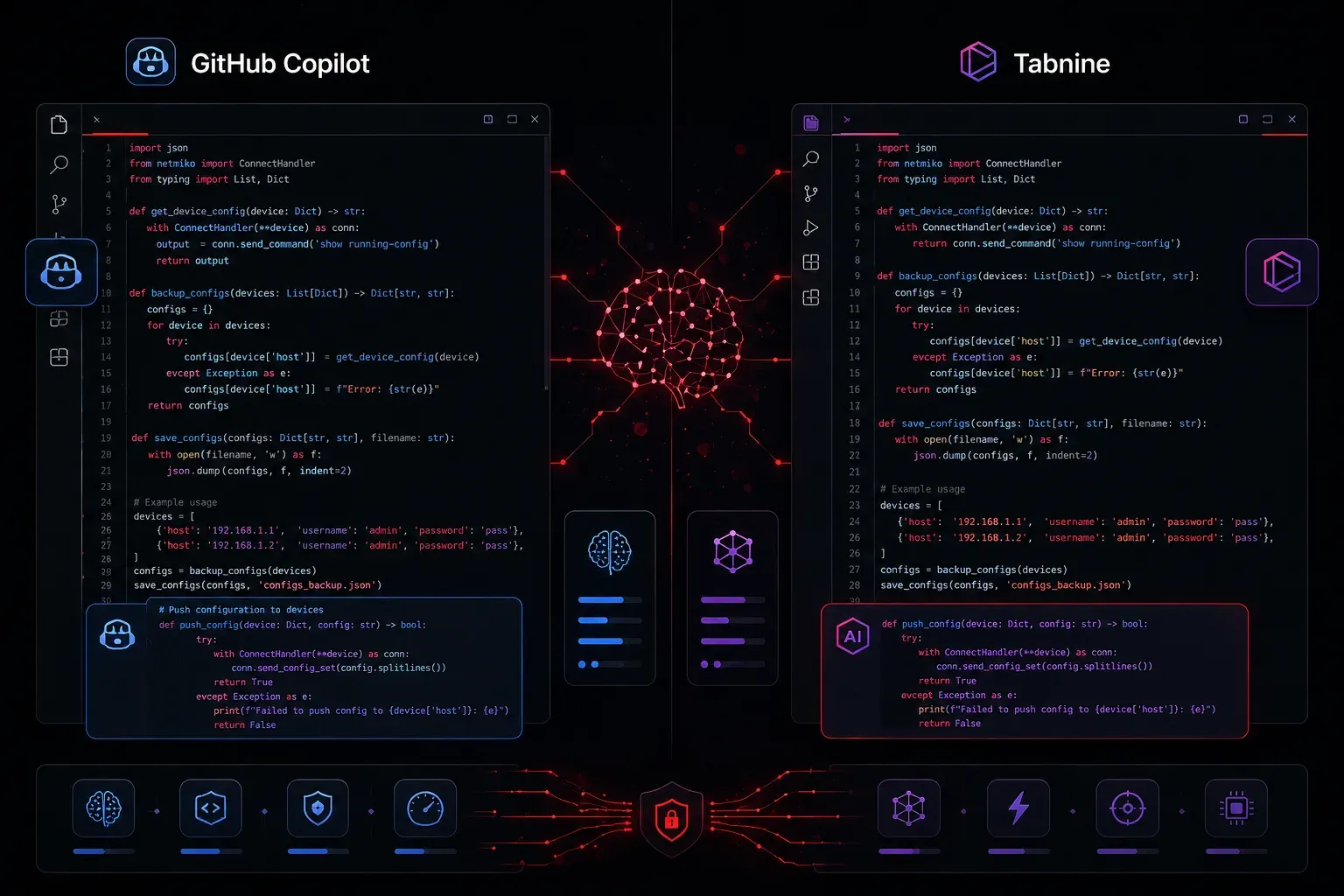
When it comes to automating network tasks with Python scripts, Ansible playbooks, or custom tooling, AI coding assistants have become game-changers for network engineers. Two popular options stand out: GitHub Copilot and Tabnine. Both promise to accelerate your coding workflow, but which one delivers better results for network automation tasks?
Understanding the Contenders
GitHub Copilot is Microsoft's AI pair programmer, trained on billions of lines of public code from GitHub repositories. It integrates directly into popular IDEs like VS Code, PyCharm, JetBrains IDEs, and Neovim (through extensions), suggesting entire functions or code blocks based on your comments and context.
Tabnine takes a different approach, offering both cloud-based and on-premises AI models. It focuses on code completion and can be trained on your organization's private codebase, making it attractive for enterprises with strict security requirements.
Network Automation Performance Comparison
Python Network Scripts
For network automation with Python libraries like netmiko, napalm, or paramiko, GitHub Copilot shows impressive results. When you type a comment like:
# Connect to Cisco router and get interface statusCopilot often generates complete, working code blocks that include proper error handling and connection management. For example, it might suggest a complete function that establishes an SSH connection, executes the command, parses the output, and handles potential exceptions like authentication failures or timeout errors. It understands common networking patterns and can suggest entire functions for tasks like configuration backups, VLAN management, or device inventory collection.
Tabnine excels at incremental code completion with intelligent context awareness. As you type connection.send_command("show int, it intelligently completes with erfaces") or suggests variations like erface brief based on your previous code patterns. While it typically provides shorter suggestions compared to Copilot's full function generations, these completions are often more precise and aligned with your existing code style.
Ansible Playbook Development
GitHub Copilot demonstrates strong understanding of Ansible syntax and network modules. It can generate complete tasks for configuring network devices, including proper module usage, variable handling, and conditional logic:
- name: Configure OSPF on Cisco routers
  cisco.ios.ios_ospf_interfaces:
    config:
      - name: "{{ item.interface }}"
        address_family:
          - afi: ipv4
            processes:
              - process_id: "{{ ospf_process_id }}"
                area:
                  area_id: "{{ item.area }}"
  loop: "{{ router_interfaces }}"
  when: ospf_enabled is defined and ospf_enabled
Tabnine provides more conservative but accurate suggestions in YAML files, focusing on completing module parameters, variable names, and Jinja2 templating syntax. It's particularly effective at suggesting the correct indentation and structure for complex nested configurations.
API Integration and REST Calls
Both AI coding assistants handle REST API integration well, but with different strengths. Copilot often suggests complete functions for interacting with network device APIs, including proper authentication headers, request/response handling, and comprehensive error handling for common HTTP status codes. For instance, when working with Cisco's DNA Center API, it might generate a complete function that handles token refresh, pagination, and rate limiting.
Tabnine shines in completing API endpoints, parameter names, and JSON payload structures, especially when working with vendor-specific APIs like Cisco's DNA Center, Meraki Dashboard, or Arista's CloudVision. Its strength lies in learning your organization's specific API usage patterns and suggesting completions that match your established conventions.
Key Differences for Network Engineers
Context Awareness: GitHub Copilot better understands the broader context of your network automation projects. It can suggest relevant imports, error handling patterns, logging statements, and even documentation comments that align with networking best practices and industry standards.
Security and Privacy: This is a critical consideration for network automation. Tabnine offers on-premises deployment options and can run completely offline, making it crucial for organizations that cannot send potentially sensitive network configuration code to external AI services. GitHub Copilot requires cloud connectivity for its primary functionality, though it can cache some suggestions for brief offline periods. However, when offline, Copilot's capabilities are significantly limited, providing only basic IntelliSense-style completions rather than its signature AI-powered suggestions. Organizations handling sensitive network infrastructure code should carefully evaluate their data governance policies when choosing between these tools.
Learning Curve: Copilot requires learning to write effective comments and prompts to get the best suggestions, essentially developing "prompt engineering" skills. Tabnine works more transparently, providing completions as you type without requiring specific prompt engineering techniques, making it more accessible to engineers who prefer immediate, context-aware assistance.
Cost Considerations: GitHub Copilot charges per user monthly ($10 for individuals, $19 for business), while Tabnine offers both free and paid tiers ($12-$39 per user monthly for pro features) with different feature sets. For teams, this pricing difference and feature distribution can significantly impact budget decisions.
Making the Right Choice
Choose GitHub Copilot if you want comprehensive code generation capabilities and can work with cloud-based AI processing. It's particularly effective for network engineers who are comfortable writing descriptive comments and want full function suggestions for complex automation tasks.
Choose Tabnine if you need on-premises AI processing, prefer incremental code completion, work with sensitive network infrastructure, or want to train the AI on your organization's specific network automation patterns and coding standards.
Many network engineers find that trying both tools with their specific workflows provides the best insight into which AI coding assistant fits their automation needs and security requirements.
What's Next
Now that you understand how these AI coding assistants compare for network automation, the next step is learning how to write effective prompts and comments that maximize their effectiveness. Our next post will cover prompt engineering techniques specifically designed for network automation tasks.