
GRE vs IPsec Tunneling: Choosing the Right Technology
This comprehensive comparison examines GRE and IPsec tunneling technologies, analyzing their security capabilities, performance characteristics, and optimal use cases to help enterprise network engineers make informed architectural decisions.

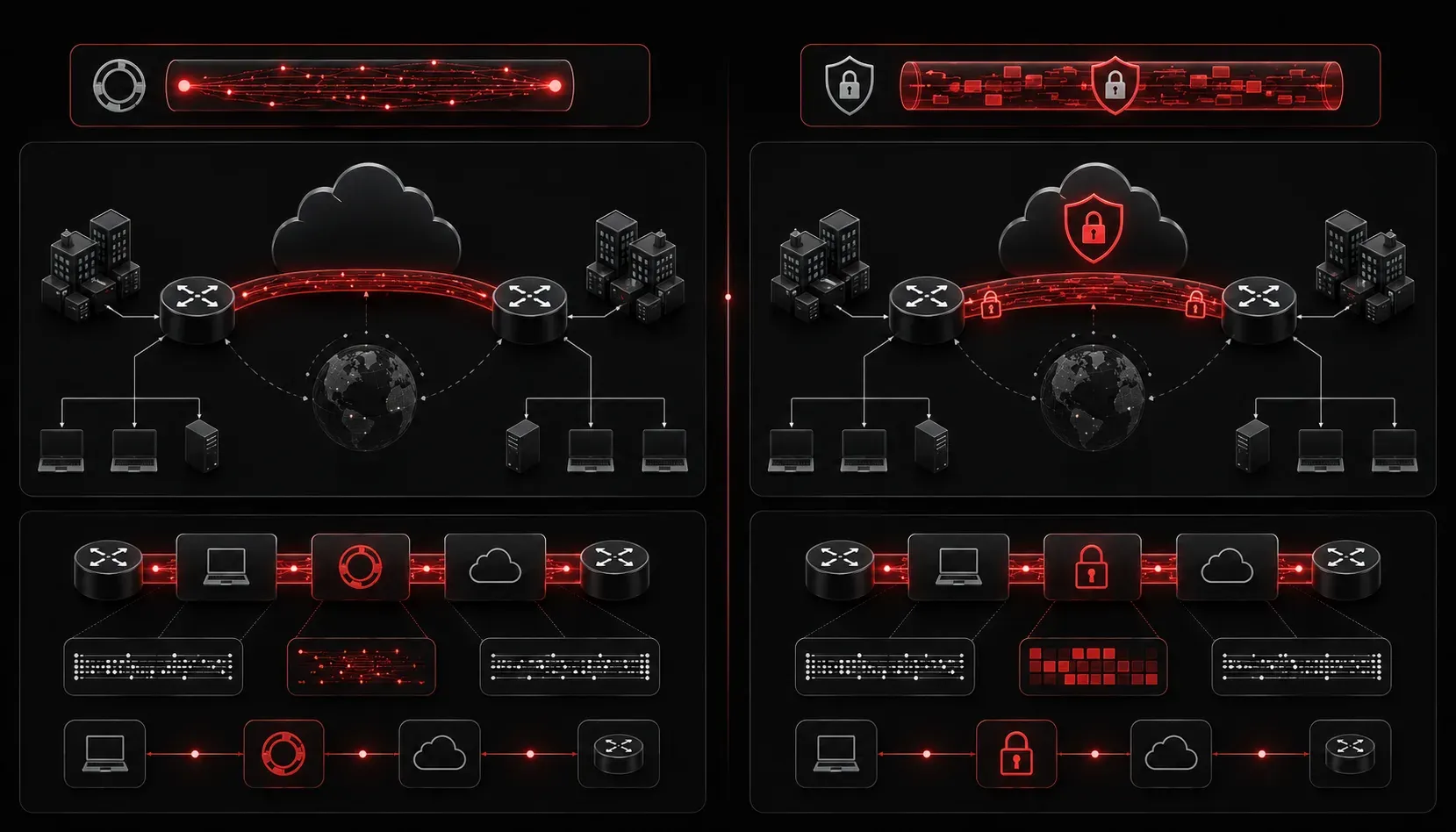
When designing enterprise networks, the choice between GRE and IPsec tunneling technologies often determines the success of your overlay network implementation. Both protocols serve distinct purposes in the modern enterprise toolkit, and understanding their fundamental differences is crucial for making informed architectural decisions.
Protocol Fundamentals and Operation
GRE (Generic Routing Encapsulation) operates as a simple tunneling protocol that encapsulates network layer packets inside IP packets. Originally defined in RFC 1701 and updated in RFC 2784, GRE creates point-to-point or point-to-multipoint tunnels without built-in security mechanisms. The protocol adds a 4-byte GRE header to encapsulated packets. When considering the complete overhead, the standard 20-byte IP header brings the total additional header size to 24 bytes for basic GRE over IPv4.
IPsec operates at the network layer (Layer 3) and provides both tunneling capabilities and comprehensive security services through the Encapsulating Security Payload (ESP) and Authentication Header (AH) protocols. Unlike GRE which primarily focuses on encapsulation, IPsec can function in tunnel mode (encrypting and encapsulating the entire IP packet) or transport mode (encrypting only the payload). This fundamental difference in operational scope makes IPsec suitable for scenarios requiring built-in security, while GRE excels in trusted environments where routing flexibility is paramount.
! Basic GRE tunnel configuration
interface Tunnel0
 ip address 192.168.100.1 255.255.255.252
 tunnel source GigabitEthernet0/0
 tunnel destination 203.0.113.2
 tunnel mode gre ip

! IPsec tunnel interface (VTI)
interface Tunnel1
 ip address 192.168.101.1 255.255.255.252
 tunnel source GigabitEthernet0/0
 tunnel destination 203.0.113.2
 tunnel mode ipsec ipv4
 tunnel protection ipsec profile DMVPN_PROFILE
Historical Context and Evolution
GRE was developed by Cisco in the early 1990s to address the need for transporting non-IP protocols over IP networks. Its simplicity and flexibility made it a cornerstone technology for early VPN implementations and multiprotocol network designs.
IPsec emerged from the IETF's efforts to secure IP communications, becoming standardized in the late 1990s as part of IPv6 development and later backported to IPv4. Its comprehensive security framework reflected growing awareness of network security threats and the need for standardized encryption protocols.
Security Capabilities Comparison
The most significant difference lies in security implementation. GRE provides no inherent security features; packets traverse the tunnel in clear text unless combined with additional security protocols. This limitation makes standalone GRE unsuitable for transmitting sensitive data across untrusted networks.
IPsec delivers enterprise-grade security through multiple mechanisms:
- Authentication: Verifies packet source and integrity using HMAC algorithms
- Encryption: Protects data confidentiality with AES, 3DES, or other ciphers
- Anti-replay protection: Prevents packet replay attacks using sequence numbers
- Perfect Forward Secrecy: Ensures session key compromise doesn't affect other sessions
When security requirements demand protection, GRE over IPsec (GRE/IPsec) combinations are common, providing GRE's flexibility with IPsec's security. However, this approach introduces additional overhead and complexity.
! Advanced GRE over IPsec configuration
crypto isakmp policy 10
 encryption aes 256
 authentication pre-share
 group 14

crypto ipsec transform-set STRONG_ENCRYPT esp-aes 256 esp-sha256-hmac

crypto ipsec profile GRE_PROTECTION
 set transform-set STRONG_ENCRYPT

interface Tunnel0
 ip address 192.168.100.1 255.255.255.252
 tunnel source GigabitEthernet0/0
 tunnel destination 203.0.113.2
 tunnel mode gre ip
 tunnel protection ipsec profile GRE_PROTECTION
Performance and Overhead Analysis
Performance considerations significantly impact tunneling technology selection. GRE's minimal header overhead (4 bytes for the GRE header itself) results in lower processing requirements and reduced packet fragmentation risks. Modern routers process GRE tunnels efficiently, often with hardware acceleration support.
IPsec introduces substantial overhead through encryption/decryption operations and larger headers. ESP tunnel mode overhead varies significantly depending on the specific encryption and authentication algorithms used—ranging from approximately 38 bytes (with AES-128 and SHA-1) to over 70 bytes (with AES-256, SHA-256, and extended sequence numbers). The cryptographic processing requires significant CPU resources, though contemporary enterprise routers include dedicated encryption hardware that substantially improves IPsec performance.
! Monitoring tunnel performance and overhead
Router# show interfaces tunnel 0
Tunnel0 is up, line protocol is up
  Hardware is Tunnel
  Internet address is 192.168.100.1/30
  MTU 1476 bytes, BW 9 Kbit/sec, DLY 500000 usec,
     reliability 255/255, txload 1/255, rxload 1/255
  Encapsulation TUNNEL, loopback not set
  Keepalive not set
  Tunnel linestate evaluation up
  Tunnel source 10.1.1.1 (GigabitEthernet0/0)
  Tunnel Subblocks:
     src 10.1.1.1, dst 203.0.113.2
     Tunnel0 source and destination addresses are 10.1.1.1 203.0.113.2
  Tunnel protocol/transport GRE/IP

! Monitor IPsec performance impact
Router# show crypto engine accelerator statistic
Hardware crypto engine: Enabled
  Packet input queue: 0/2048
  Packet output queue: 0/2048
  Hardware crypto engine throughput: 512 Mbps
Scalability and Management Complexity
GRE excels in large-scale deployments due to its simplicity. DMVPN (Dynamic Multipoint VPN) leverages GRE's multipoint capabilities to create hub-and-spoke networks that automatically establish spoke-to-spoke tunnels. This architecture scales to thousands of sites with minimal hub configuration changes.
IPsec scaling challenges emerge from key management complexity. Each IPsec tunnel requires Security Association (SA) establishment and maintenance, consuming memory and processing resources. Traditional policy-based IPsec becomes unwieldy in large deployments, though newer technologies like FlexVPN address these limitations.
Management complexity differs substantially between technologies. GRE tunnel troubleshooting involves straightforward interface and routing diagnostics. IPsec troubleshooting requires understanding of:
- IKE (Internet Key Exchange) negotiations
- Security policy matching
- Certificate or pre-shared key management
- Transform set compatibility
! IPsec troubleshooting commands
Router# show crypto isakmp sa
IPv4 Crypto ISAKMP SA
dst             src             state          conn-id status
203.0.113.2     10.1.1.1        QM_IDLE           1001 ACTIVE

Router# debug crypto isakmp
Crypto ISAKMP debugging is on

Router# show crypto ipsec transform-set
Transform set STRONG_ENCRYPT: { esp-aes 256 esp-sha256-hmac  }
   will negotiate = { Transport,  },
Use Case Applications
GRE optimal scenarios:
- Internal enterprise networks with trusted infrastructure
- DMVPN deployments requiring spoke-to-spoke connectivity
- Multicast and broadcast traffic transport
- Development and testing environments
- High-throughput applications where security is handled at other layers
- Campus network overlay solutions connecting data centers
IPsec preferred applications:
- Site-to-site VPNs across untrusted networks
- Remote access VPN solutions
- Compliance requirements mandating encryption (PCI-DSS, HIPAA)
- Financial services, healthcare, or government networks
- Partner network interconnections
- Internet-based WAN connections requiring data protection
Hybrid Approaches and Modern Considerations
Contemporary enterprise networks increasingly employ hybrid approaches. SD-WAN solutions commonly implement both technologies, using IPsec for secure transport across thepublic internet while leveraging GRE or VXLAN for internal overlay networks. This approach optimizes security, performance, and functionality based on specific traffic requirements.
Cloud connectivity scenarios often dictate technology selection. Major cloud providers support both GRE and IPsec, but IPsec remains the standard for production workloads requiring encryption in transit.
! Verifying IPsec tunnel status and performance
Router# show crypto ipsec sa
interface: Tunnel1
    Crypto map tag: Tunnel1-head-0, local addr 10.1.1.1
   protected vrf: (none)
   local  ident (addr/mask/prot/port): (192.168.100.0/255.255.255.252/0/0)
   remote ident (addr/mask/prot/port): (192.168.100.0/255.255.255.252/0/0)
   current_peer 203.0.113.2 port 500
     PERMIT, flags={origin_is_acl,}
    #pkts encaps: 1234, #pkts encrypt: 1234, #pkts digest: 1234
    #pkts decaps: 5678, #pkts decrypt: 5678, #pkts verify: 5678
    #send errors 0, #recv errors 0

Router# show crypto session
Crypto session current status
Interface: Tunnel1
Session status: UP-ACTIVE
Peer: 203.0.113.2 port 500
  Session ID: 1
  IKEv1 SA: local 10.1.1.1/500 remote 203.0.113.2/500 Active
Making the Decision
Your tunneling technology choice should align with specific requirements:
Choose GRE when simplicity, performance, and multicast support outweigh security concerns. Internal networks, DMVPN implementations, and high-bandwidth applications benefit from GRE's low overhead.
Select IPsec when security requirements are paramount, compliance mandates encryption, or tunnels traverse untrusted networks. The performance trade-off is justified by comprehensive security services.
Consider GRE over IPsec when you need both GRE's functionality and IPsec's security, accepting the additional complexity and overhead.
What's Next
Understanding these tunneling fundamentals prepares you for exploring advanced overlay technologies like VXLAN and DMVPN Phase 3 implementations. The next logical step involves examining how these tunneling protocols integrate with SD-WAN architectures and modern network virtualization platforms.
Tools and resources for this topic
- CCNP ENCOR 350-401 Official Cert Guide — The definitive ENCOR study resource by Brad Edgeworth. Covers enterprise infrastructure, virtualisation, and automation.