
How to Implement Test-Driven Development
A beginner-friendly guide to implementing test-driven development (TDD) with step-by-step instructions and practical coding examples. Covers the Red-Green-Refactor cycle and best practices for writing tests first.

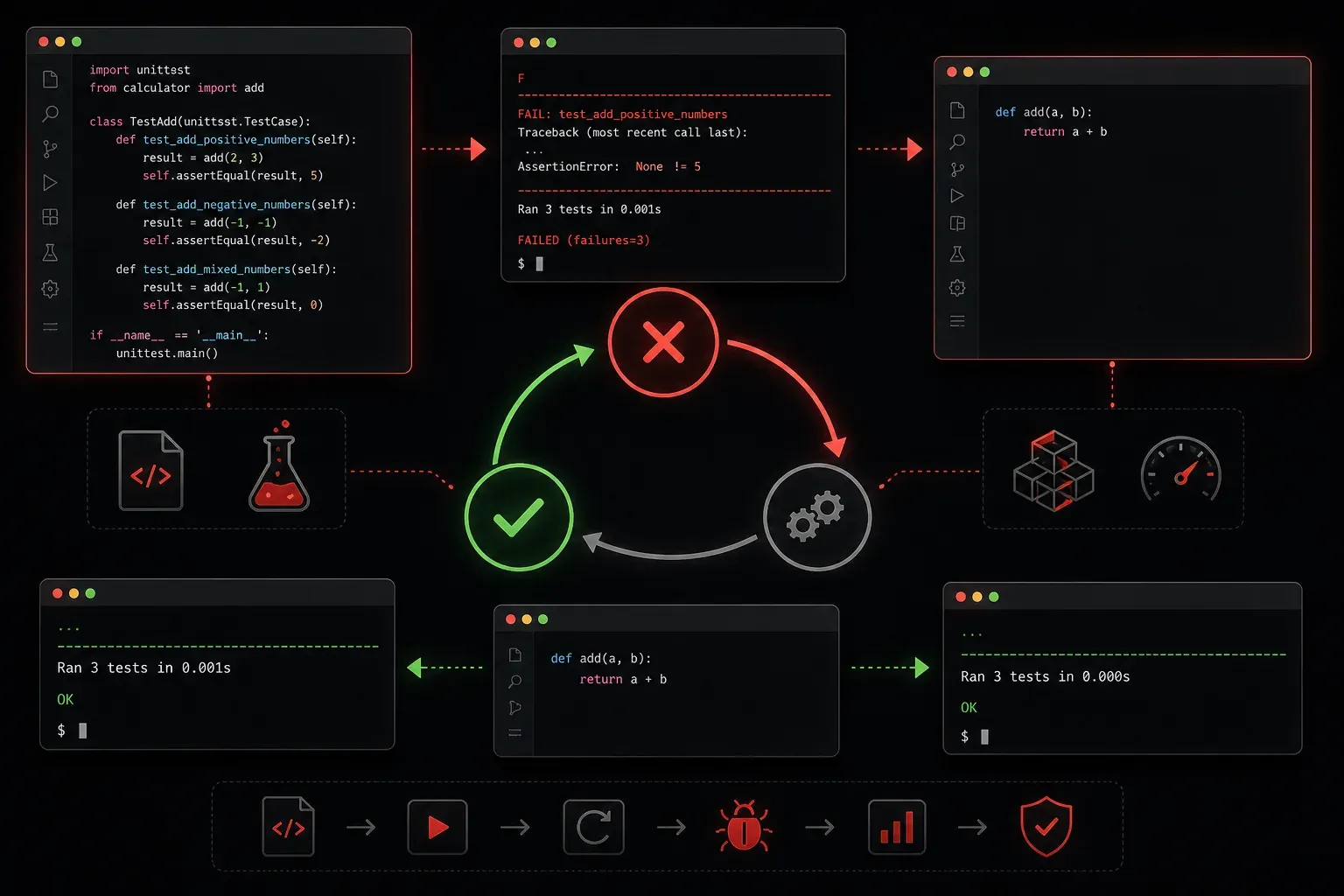
Test-driven development (TDD) transforms how you write code by flipping the traditional development process on its head. Instead of writing code first and testing later, TDD requires you to write tests before any functional code exists. This approach leads to better code design, fewer bugs, and more confidence when making changes, especially valuable when developing network automation tools and scripts.
Understanding the TDD Cycle
The TDD process follows a simple three-step cycle known as Red-Green-Refactor:
- Red: Write a failing test for the functionality you want to implement
- Green: Write the minimal code necessary to make the test pass
- Refactor: Improve the code while keeping tests passing
This cycle ensures you never write code without a corresponding test, and you never write more code than necessary to fulfill your requirements.
Prerequisites for This Guide
To follow along with the code examples in this guide, you'll need:
- Basic familiarity with Python programming
- Understanding of Python's unittest module
- Python installed on your system (version 3.6 or higher recommended)
If you're new to Python or unittest, consider reviewing Python basics and unittest documentation before proceeding with the TDD examples.
Step-by-Step Implementation Guide
Step 1: Start with a Failing Test
Let's implement test-driven development with a practical example for network automation. Suppose you need a function to validate IP addresses for network configuration scripts. Start by writing a test that describes the expected behavior:
import unittest
from ip_validator import validate_ip

class TestIPValidator(unittest.TestCase):
    def test_valid_ipv4_address(self):
        result = validate_ip("192.168.1.1")
        self.assertTrue(result)

    def test_invalid_ipv4_address(self):
        result = validate_ip("999.999.999.999")
        self.assertFalse(result)

if __name__ == '__main__':
    unittest.main()
At this point, running the test will fail because the validate_ip function doesn't exist yet. This is your "Red" phase.
Step 2: Write Minimal Code to Pass
Now create the simplest implementation that makes your test pass:
# ip_validator.py
import re

def validate_ip(ip_address):
    # Simple regex pattern for IPv4 validation
    pattern = r'^(?:(?:25[0-5]|2[0-4][0-9]|[01]?[0-9][0-9]?)\.){3}(?:25[0-5]|2[0-4][0-9]|[01]?[0-9][0-9]?)$'
    return bool(re.match(pattern, ip_address))
Run your tests again. They should now pass, reaching the "Green" phase.
Step 3: Refactor and Improve
With passing tests as your safety net, you can now refactor the code. Perhaps you want to add better error handling or support for IPv6:
import ipaddress

def validate_ip(ip_address):
    try:
        ipaddress.ip_address(ip_address)
        return True
    except ValueError:
        return False
Run your tests after refactoring to ensure everything still works.
TDD for Network Automation Tasks
TDD proves especially valuable when developing network automation tools. Here are common network automation scenarios where TDD shines:
- Configuration validation: Testing functions that validate router/switch configurations before deployment
- Network discovery scripts: Ensuring your network scanning tools handle various device types correctly
- SNMP polling utilities: Verifying your monitoring scripts parse SNMP responses accurately
- Backup automation: Testing scripts that backup device configurations to ensure they handle errors gracefully
Example: Testing a Subnet Calculator for Network Planning
def test_calculate_subnet_hosts(self):
    """Test subnet calculation for network planning"""
    result = calculate_usable_hosts("192.168.1.0/24")
    self.assertEqual(result, 254)

def test_invalid_subnet_raises_exception(self):
    """Ensure invalid subnets are handled properly"""
    with self.assertRaises(ValueError):
        calculate_usable_hosts("192.168.1.0/33")
These tests would drive the development of reliable network planning tools used in real-world network administration tasks.
TDD Best Practices
Follow these coding examples and guidelines to maximize TDD effectiveness:
- Write descriptive test names: Use names like
test_returns_false_for_invalid_ip_formatinstead oftest_ip_validation - Keep tests small and focused: Each test should verify one specific behavior
- Test edge cases early: Include tests for empty strings, null values, and boundary conditions
- Run tests frequently: Execute your test suite after every small change
Adding More Test Cases
As you continue this practical guide approach, add more comprehensive tests:
def test_empty_string_returns_false(self):
    result = validate_ip("")
    self.assertFalse(result)

def test_ipv6_address_is_valid(self):
    result = validate_ip("2001:0db8:85a3:0000:0000:8a2e:0370:7334")
    self.assertTrue(result)
Each new test drives you to enhance your implementation, ensuring robust and reliable code.
Common TDD Pitfalls to Avoid
When learning to implement test-driven development, watch out for these mistakes:
- Writing too much code at once instead of taking small steps
- Skipping the refactor phase and accumulating technical debt
- Writing tests that are too complex or test multiple behaviors
- Not running tests frequently enough to catch issues early
What's Next
Now that you understand the TDD steps and have a practical foundation, the next step is learning about different types of testing in software development. We'll explore unit testing versus integration testing, and how to structure your test suites for maximum effectiveness in automation projects, including network automation tools and scripts.