
Comparing Manual and Auto-Summarization Techniques
This post compares manual and auto-summarization techniques across EIGRP, OSPF, and BGP, covering configuration syntax, Null0 behavior, metric inheritance, and component route suppression. It highlights the risks of auto-summarization in discontiguous networks and provides exam-level precision on w

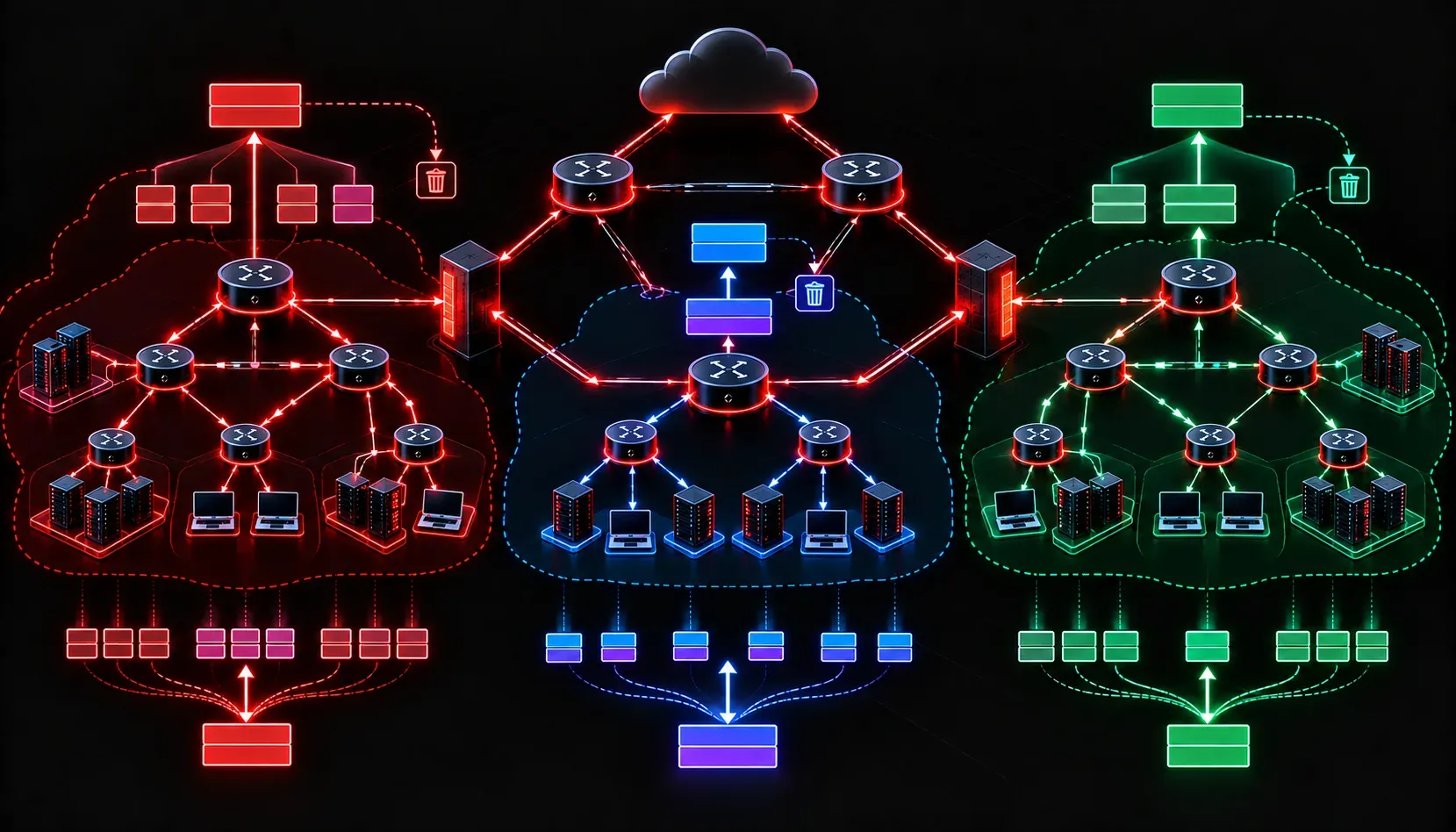
Route summarization is one of those topics that looks straightforward on paper but trips engineers up in production because the behavior varies significantly between protocols, and the choice between manual and automatic summarization carries real consequences for convergence, routing loops, and traffic engineering. This post breaks down both techniques across EIGRP, OSPF, and BGP with enough precision to handle exam scenarios and real-world deployments.
Why Summarization Matters at the ENARSI Level
Summarization reduces the size of routing tables, dampens the propagation of specific-route churn, and limits the blast radius of topology changes. At scale, a flat routing table with thousands of specific prefixes creates unnecessary SPF calculations in OSPF, DUAL recalculations in EIGRP, and update processing overhead in BGP. The tradeoff is always the same: summarization improves scalability at the cost of routing granularity. Your job as a senior engineer is knowing exactly where that tradeoff is acceptable.
Auto-Summarization: Behavior and Risks
Auto-summarization is a classful-era feature still supported in EIGRP (and historically in RIPv2). When enabled, a router summarizes routes to their classful boundary at major network boundaries. The key behavior to internalize: auto-summary only fires when a routing update crosses a major network boundary (for example, when advertising a subnet of 172.16.0.0 out an interface in the 10.0.0.0 major network).
EIGRP Auto-Summary
In modern IOS versions, auto-summary is disabled by default. When enabled, EIGRP summarizes all subnets of a classful network to the classful boundary at discontiguous network boundaries. This is the source of the classic black-hole scenario.
R1(config-router)# auto-summary

! Verify summary routes generated
R1# show ip protocols
R1# show ip eigrp topology | include Summary
The problem with auto-summary in EIGRP is the null0 summary route. When EIGRP generates a summary, it installs a route to the summarized prefix pointing to Null0 with an administrative distance of 5. This prevents routing loops but means traffic destined for subnets that do not exist within the summary will be silently dropped. In discontiguous networks, this creates reachability failures that are notoriously difficult to diagnose because the summary route looks valid in the routing table.
Auto-summary summarization pros and cons in EIGRP: it requires zero per-prefix configuration, but it offers no control over summary boundaries, no control over which subnets are included, and it breaks discontiguous addressing schemes entirely.
RIPv2 Auto-Summary
RIPv2 also supports auto-summary, enabled by default in older IOS versions. The behavior is identical in concept: classful summarization at major network boundaries. Since RIPv2 is rarely deployed in modern enterprise networks, this is more of an exam data point than a production concern. Know that no auto-summary is required under router rip to send subnet-level routes.
Manual Summarization: Protocol-by-Protocol
Manual summarization gives you precise control. You define the summary address and mask explicitly on the interface or neighbor where you want the summary advertised. The specific syntax and behavior differ by protocol.
EIGRP Manual Summary
EIGRP manual summarization is configured at the interface level. The summary is advertised out that interface, and a Null0 route is installed locally for the summary prefix (AD 5) to prevent loops.
R1(config)# interface GigabitEthernet0/1
R1(config-if)# ip summary-address eigrp 100 10.10.0.0 255.255.252.0

! Verify
R1# show ip route eigrp
! Look for the summary entry with "is a summary, Null0"

R1# show ip eigrp topology 10.10.0.0/22
The metric of the EIGRP summary is inherited from the component route with the lowest metric. This is important for exam scenarios: if a component route fails, the summary remains if at least one component route is still valid. When the last component route disappears, the summary is withdrawn and the Null0 route is removed.
OSPF Manual Summary
OSPF summarization is only configurable on ABRs (for inter-area summarization) and ASBRs (for external route summarization). You cannot summarize within an area. This architectural constraint is fundamental to OSPF's link-state design.
! ABR inter-area summarization
R1(config)# router ospf 1
R1(config-router)# area 1 range 10.10.0.0 255.255.252.0

! ASBR external summarization
R1(config-router)# summary-address 192.168.0.0 255.255.252.0

! Verification
R1# show ip ospf border-routers
R1# show ip ospf database summary
R1# show ip route ospf
Unlike EIGRP, OSPF ABR summarization generates a Type 3 LSA for the summary and suppresses the more-specific Type 1/Type 2 LSA details from crossing the area boundary. By default, OSPF also installs a Null0 discard route for the summary on the ABR, which can be disabled with the not-advertise keyword or no discard-route under the OSPF process.
BGP Manual Summary
BGP summarization offers the richest feature set. You have three primary mechanisms: network statement (requires an exact match in the routing table), aggregate-address (summarizes component routes), and redistribution with route maps.
! Aggregate-address: suppresses more-specifics by default with summary-only
R1(config)# router bgp 65001
R1(config-router)# aggregate-address 10.10.0.0 255.255.252.0 summary-only

! Aggregate without suppressing more-specifics
R1(config-router)# aggregate-address 10.10.0.0 255.255.252.0

! Verification
R1# show ip bgp 10.10.0.0/22
R1# show ip bgp summary
R1# show ip bgp neighbors x.x.x.x advertised-routes
The as-set keyword on aggregate-address preserves the AS_PATH information from component routes in the aggregate, which is important for loop prevention in complex topologies. Without as-set, the aggregate carries only the local AS in its path, which can cause routing loops in certain multi-AS designs. BGP manual summarization pros and cons: maximum flexibility and control, but requires careful design to avoid inadvertently suppressing routes that need to remain specific for policy reasons.
Routing Protocols Comparison: Summary of Key Differences
- Auto-summary scope: Available in EIGRP and RIPv2 only. Not applicable in OSPF or BGP.
- Manual summary placement: EIGRP configures on the interface; OSPF configures on ABR/ASBR under the process; BGP configures under the routing process.
- Null0 behavior: Both EIGRP and OSPF install a discard route automatically. BGP does not install a Null0 route by default.
- Component route suppression: OSPF suppresses more-specific LSAs from crossing area boundaries automatically. BGP requires the
summary-onlykeyword to suppress more-specifics to neighbors. - Metric inheritance: EIGRP uses the minimum metric of component routes. OSPF sets the summary metric based on the highest cost component. BGP uses its standard best-path selection for the aggregate.
When to Use Each Approach
Auto-summarization is only appropriate in homogeneous classful environments with no discontiguous addressing, which describes almost no modern network. Avoid it in production unless you are maintaining a legacy RIP deployment and have verified the addressing scheme permits it.
Manual summarization is the standard for any serious deployment. Use it at EIGRP redistribution boundaries, OSPF area boundaries, and BGP peering sessions where prefix count reduction is required by policy or ISP contract. Always verify your summary covers exactly the prefixes you intend, and document the Null0 implications for your operations team.
What's Next
With summarization techniques covered across all major IGPs and BGP, the next logical step is diving deeper into OSPF path selection and area design, where summarization decisions directly influence SPF behavior and inter-area routing policy. Understanding how Type 3 LSAs are generated, filtered, and manipulated at ABRs ties directly back to the summarization concepts covered here and is heavily tested in the ENARSI exam.
Tools and resources for this topic
- CCNP ENARSI 300-410 Official Cert Guide — The definitive ENARSI study resource by Raymond Lacoste. Covers advanced routing, services, and troubleshooting.