
MPLS vs VPN vs SD-WAN: Picking the Right WAN
A comprehensive comparison of MPLS, IPsec VPN, and SD-WAN technologies for enterprise WAN connectivity, covering performance, cost, complexity, and ideal use cases for each approach.

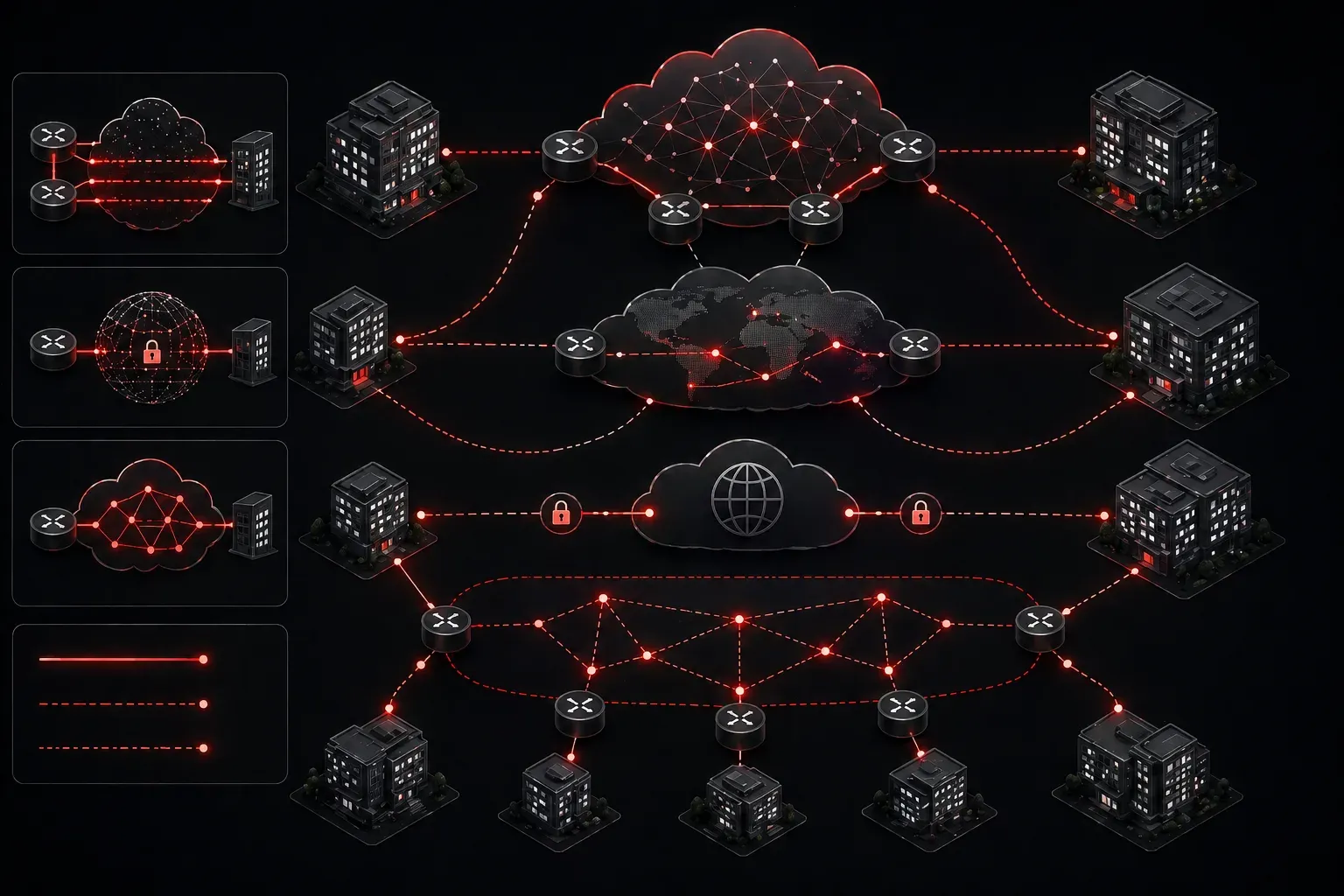
When connecting remote offices to your headquarters, you'll encounter three main WAN technologies: MPLS, IPsec VPN, and SD-WAN. Each has distinct advantages and trade-offs that make them suitable for different scenarios. Let's break down what makes each unique and when to choose one over the others.
MPLS: The Traditional Enterprise Choice
Multi-Protocol Label Switching (MPLS) creates a private network path between your locations through your service provider's infrastructure. Think of it as having dedicated lanes on a highway, your traffic gets priority treatment and predictable performance.
Key Benefits:
- Guaranteed bandwidth and low latency
- Built-in Quality of Service (QoS) for voice and video
- High reliability with SLAs typically offering 99.9% uptime
- Private network isolation reduces security risks
Drawbacks:
- Expensive, especially for smaller sites
- Long deployment times (often 30-90 days)
- Limited flexibility for cloud connectivity
- Vendor lock-in with your service provider
Security Considerations: While MPLS provides traffic isolation through private circuits, it does not inherently encrypt data. Organizations handling sensitive information may need to implement additional encryption layers on top of MPLS connections.
MPLS works best for organizations with mission-critical applications requiring consistent performance, such as financial trading firms running real-time systems, healthcare networks transmitting patient data, or manufacturing companies with time-sensitive production systems.
IPsec VPN: The Cost-Effective Alternative
IPsec VPNs create encrypted tunnels over the public internet to connect your sites. Instead of dedicated circuits, you're using shared internet infrastructure with security added through encryption.
Key Benefits:
- Significantly lower cost than MPLS
- Quick deployment - often same-day activation
- Built-in encryption for security
- Flexibility to connect from anywhere with internet access
Drawbacks:
- Performance varies with internet quality
- No guaranteed bandwidth or latency
- Encryption adds processing overhead
- More complex to troubleshoot connectivity issues
Security Considerations: IPsec VPNs provide strong encryption by default, making them suitable for transmitting sensitive data over public networks. However, the security depends on proper key management and regular security updates.
VPN WAN solutions excel for small to medium businesses with limited budgets, remote workers needing secure access, distributed retail locations with basic connectivity needs, or as backup connections to primary MPLS circuits.
SD-WAN: The Modern Hybrid Approach
Software-Defined WAN combines multiple connection types (MPLS, broadband, LTE) into a single, intelligent network. It uses software to dynamically route traffic across the best available path based on real-time conditions.
Key Benefits:
- Cost reduction by leveraging cheaper internet circuits
- Improved cloud application performance
- Centralized policy management and visibility
- Automatic failover and load balancing
- Rapid deployment of new sites
Drawbacks:
- Requires skilled staff or managed services
- Initial complexity in design and implementation
- Dependence on internet connectivity quality
- Potential for vendor lock-in with SD-WAN platforms
Security Considerations: Modern SD-WAN platforms typically include built-in encryption and can integrate with cloud security services. However, security capabilities vary significantly between vendors, making a thorough evaluation essential.
SD-WAN shines for cloud-first organizations migrating from on-premises data centers, retail chains needing to connect hundreds of locations cost-effectively, or companies wanting to reduce MPLS dependency while maintaining enterprise-grade features and centralized management.
Making the Right Choice for Your Enterprise WAN
Your decision should align with three key factors:
Performance Requirements: Choose MPLS if you need guaranteed performance for critical applications. SD-WAN works well for cloud-heavy environments. IPsec VPN suits less demanding applications.
Budget Constraints: IPsec VPN offers the lowest per-site cost. SD-WAN provides middle-ground pricing with better features than basic VPN. MPLS commands premium pricing for premium service.
Technical Complexity: MPLS requires minimal on-site technical expertise. IPsec VPN needs moderate networking knowledge. SD-WAN demands the highest technical skills but offers the most flexibility.
Many enterprises today aren't choosing just one technology. The MPLS vs SD-WAN decision often becomes "MPLS and SD-WAN" - using SD-WAN to manage multiple transport types including MPLS circuits, creating a hybrid approach that maximizes both performance and cost-effectiveness.
What's Next
Now that you understand the high-level differences between these WAN technologies, the next step is diving deeper into SD-WAN architecture and implementation. We'll explore how SD-WAN controllers work, overlay networks, and the specific features that make SD-WAN attractive for modern enterprises.