
Advanced Configuration for Route Redistribution: Avoiding Common Pitfalls
This post covers advanced route redistribution configuration strategies including administrative distance manipulation, route tagging for loop prevention, and granular control using prefix lists and route maps. Learn how to avoid common redistribution pitfalls in enterprise environments.

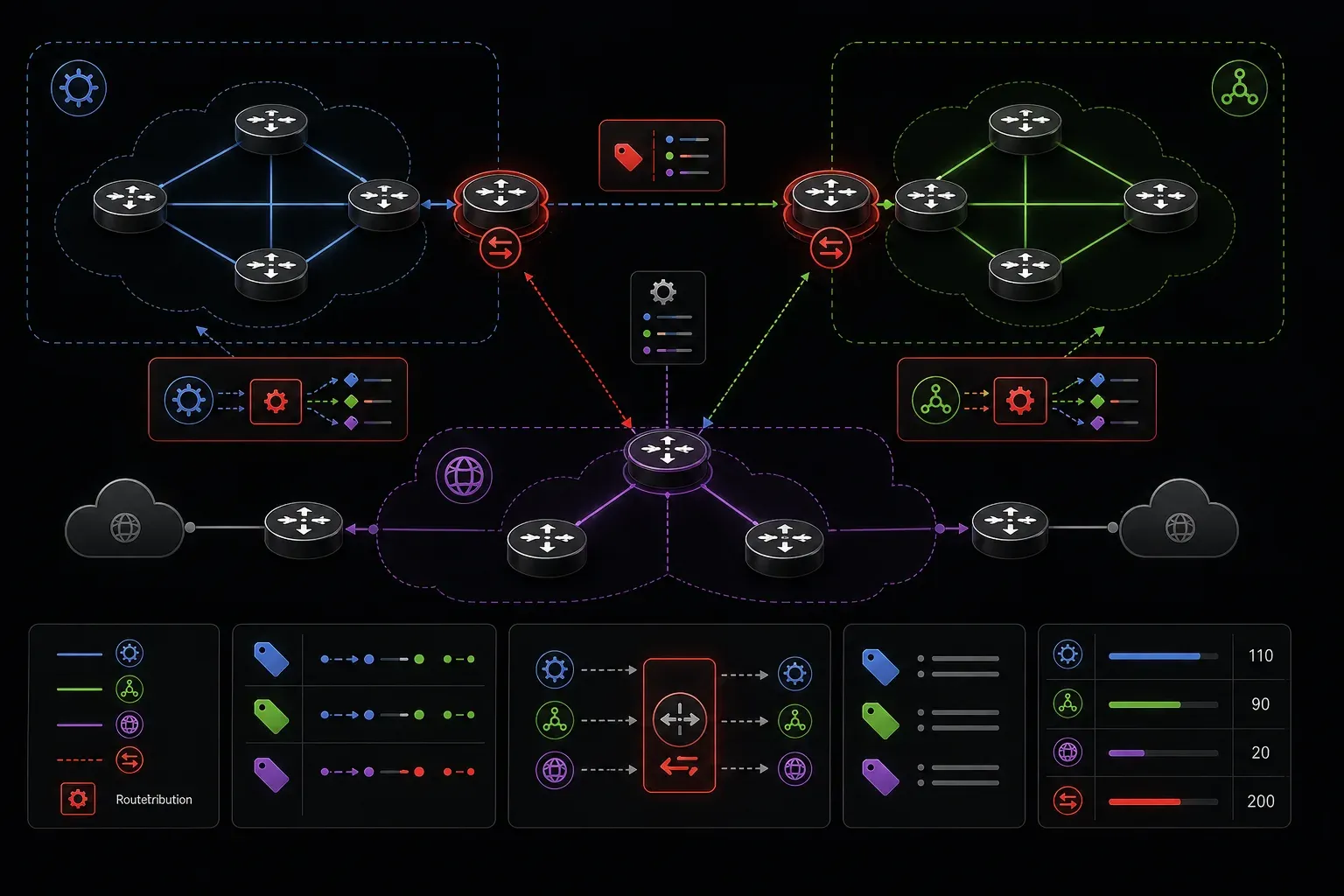
Route redistribution represents one of the most powerful yet dangerous tools in enterprise routing. While basic redistribution concepts are straightforward, production implementations require sophisticated configuration strategies to avoid routing loops, suboptimal paths, and convergence issues. This deep dive examines advanced configuration techniques that separate successful enterprise deployments from troubleshooting nightmares.
Understanding Administrative Distance in Multi-Protocol Environments
The foundation of advanced route redistribution configuration lies in understanding and controlling administrative distance. Administrative distance (AD) values indicate the trustworthiness of routing information sources, with lower values indicating greater trust. Understanding default AD values is crucial for predicting routing behavior in multi-protocol environments.
Default administrative distances for common routing protocols:
- EIGRP internal routes: 90
- OSPF routes: 110
- EIGRP external routes: 170
- OSPF external routes: 115
These default values often create suboptimal routing decisions when multiple protocols coexist, requiring careful manipulation:
router ospf 1
 distance ospf external 115 inter-area 110 intra-area 110
 redistribute eigrp 100 metric 20 subnets

router eigrp 100
 distance eigrp 90 170
 redistribute ospf 1 metric 1544 2000 255 1 1500
This configuration prevents EIGRP external routes (AD 170) from overriding OSPF routes, while OSPF external routes (AD 115) remain less preferred than EIGRP internal routes (AD 90) due to the default administrative distance values for these protocols. The key insight: administrative distance should reflect your network design hierarchy, not default protocol values.
Route Tagging for Loop Prevention
Route tags provide the most reliable method for preventing redistribution loops in complex topologies. Advanced implementations use systematic tagging schemes that identify route sources and redistribution paths.
! OSPF to EIGRP redistribution with tagging
route-map OSPF-TO-EIGRP permit 10
 set tag 100

router eigrp 100
 redistribute ospf 1 metric 1544 2000 255 1 1500 route-map OSPF-TO-EIGRP
 distribute-list route-map DENY-TAG-200 in

! EIGRP to OSPF redistribution with different tag
route-map EIGRP-TO-OSPF permit 10
 set tag 200

router ospf 1
 redistribute eigrp 100 metric 20 subnets route-map EIGRP-TO-OSPF
 distribute-list route-map DENY-TAG-100 in

! Deny routes with opposing tags
route-map DENY-TAG-100 deny 10
 match tag 100
route-map DENY-TAG-100 permit 20

route-map DENY-TAG-200 deny 10
 match tag 200
route-map DENY-TAG-200 permit 20
This bidirectional tagging strategy ensures routes learned through redistribution are never redistributed back to their source protocol, eliminating routing loops regardless of topology complexity.
Prefix Lists and Route Maps for Granular Control
Production redistribution requires surgical precision in route selection. Combining prefix lists with route maps provides granular control over which routes are redistributed and how their attributes are modified.
! Define specific networks for redistribution
ip prefix-list CORE-NETWORKS seq 10 permit 10.1.0.0/16 le 24
ip prefix-list CORE-NETWORKS seq 20 permit 10.2.0.0/16 le 24
ip prefix-list CORE-NETWORKS seq 30 deny 0.0.0.0/0 le 32

! Advanced route map with multiple conditions
route-map SELECTIVE-REDIST permit 10
 match ip address prefix-list CORE-NETWORKS
 match metric 1 4294967295
 set metric 1544 2000 255 1 1500
 set tag 100

route-map SELECTIVE-REDIST deny 20
This configuration redistributes only core network ranges while excluding default routes and applying specific metrics. The match metric clause ensures only directly connected or low-metric routes are redistributed, preventing propagation of poor-quality paths.
Metric Manipulation Strategies
Effective metric manipulation requires understanding each protocol's metric calculation and convergence behavior. EIGRP's composite metric provides more granular control than OSPF's simple cost model.
! Different metrics for different route types
route-map EIGRP-REDIST permit 10
 match ip address prefix-list LAN-NETWORKS
 set metric 10000 100 255 1 1500

route-map EIGRP-REDIST permit 20
 match ip address prefix-list WAN-NETWORKS
 set metric 1544 20000 255 1 1500

route-map EIGRP-REDIST permit 30
 set metric 1544 2000 255 1 1500

router eigrp 100
 redistribute ospf 1 route-map EIGRP-REDIST
This approach assigns favorable metrics to LAN networks (low delay), less favorable metrics to WAN networks (high delay), and default metrics to everything else, creating a hierarchy that reflects actual network performance characteristics.
BGP Integration Considerations
When redistributing into BGP, additional attributes become critical for controlling path selection and preventing routing policy violations.
route-map IGP-TO-BGP permit 10
 match ip address prefix-list CUSTOMER-NETWORKS
 set origin igp
 set local-preference 150
 set community 65001:100

route-map IGP-TO-BGP permit 20
 match ip address prefix-list INTERNAL-NETWORKS
 set origin igp
 set local-preference 200
 set community 65001:200

router bgp 65001
 redistribute eigrp 100 route-map IGP-TO-BGP
The community values enable downstream policy application, while local preference ensures internal routes are preferred over customer routes in path selection.
Security Considerations in Route Redistribution
Route redistribution can introduce significant security vulnerabilities if not properly configured. Unauthorized route advertisements, route hijacking, and information disclosure are critical concerns that require proactive mitigation strategies.
Key security considerations include:
- Route Filtering: Implement strict filtering to prevent advertisement of internal networks to external domains
- Authentication: Enable routing protocol authentication to prevent unauthorized route injection
- Prefix Length Limits: Use prefix length restrictions to prevent more-specific route attacks
- Network Segmentation: Limit redistribution scope to prevent unnecessary route propagation between security zones
! Security-focused route map
route-map SECURE-REDIST permit 10
 match ip address prefix-list AUTHORIZED-NETWORKS
 match tag 100
 set local-preference 50

route-map SECURE-REDIST deny 20
 description "Deny all unauthorized routes"

! Prefix list with length restrictions
ip prefix-list AUTHORIZED-NETWORKS seq 10 permit 10.1.0.0/16 ge 16 le 24
ip prefix-list AUTHORIZED-NETWORKS seq 20 deny 0.0.0.0/0 le 15
Comprehensive Verification and Monitoring
Advanced redistribution configurations require comprehensive verification to ensure proper operation and identify potential issues before they impact production traffic.
! Verify redistribution operation and administrative distances
show ip route eigrp | include 110
show ip route ospf | include 170
show ip route summary
show ip protocols

! Monitor route tags and sources
show ip route tag 100
show ip route longer-prefixes 10.1.0.0/16
show ip route protocol eigrp

! Check route map statistics and BGP attributes
show route-map SELECTIVE-REDIST
show ip bgp community 65001:100
show ip bgp summary

! Verify route filtering effectiveness
show ip route filter-list
show ip access-lists
show ip prefix-list detail

! Monitor redistribution-specific metrics
show ip eigrp topology detail-links
show ip ospf database external
Regular monitoring of these outputs helps identify unexpected route propagation, metric inconsistencies, authentication failures, or policy violations that could indicate configuration errors, security issues, or topology changes.
Performance and Scalability Optimization
Large-scale redistribution can impact router performance and network stability. Implementing summarization at redistribution boundaries reduces routing table size and improves convergence times.
router eigrp 100
 redistribute ospf 1 metric 1544 2000 255 1 1500 route-map OSPF-TO-EIGRP

! Summarize redistributed routes
interface GigabitEthernet0/0
 ip summary-address eigrp 100 10.1.0.0 255.255.0.0 5
Summary routes with administrative distances lower than the redistributed routes prevent routing loops while reducing protocol overhead and memory consumption.
What's Next
With advanced redistribution configuration mastered, the next logical step involves implementing path control mechanisms like Policy-Based Routing (PBR) to override routing table decisions based on traffic characteristics, source addresses, or application requirements.
Tools and resources for this topic
- CCNP ENARSI 300-410 Official Cert Guide — The definitive ENARSI study resource by Raymond Lacoste. Covers advanced routing, services, and troubleshooting.