
Corporate Data Protection Strategies for AI Systems
This post explores corporate data protection strategies specifically designed for AI systems, covering classification, access controls, technical measures like differential privacy, and governance frameworks to safeguard sensitive information while enabling AI innovation.

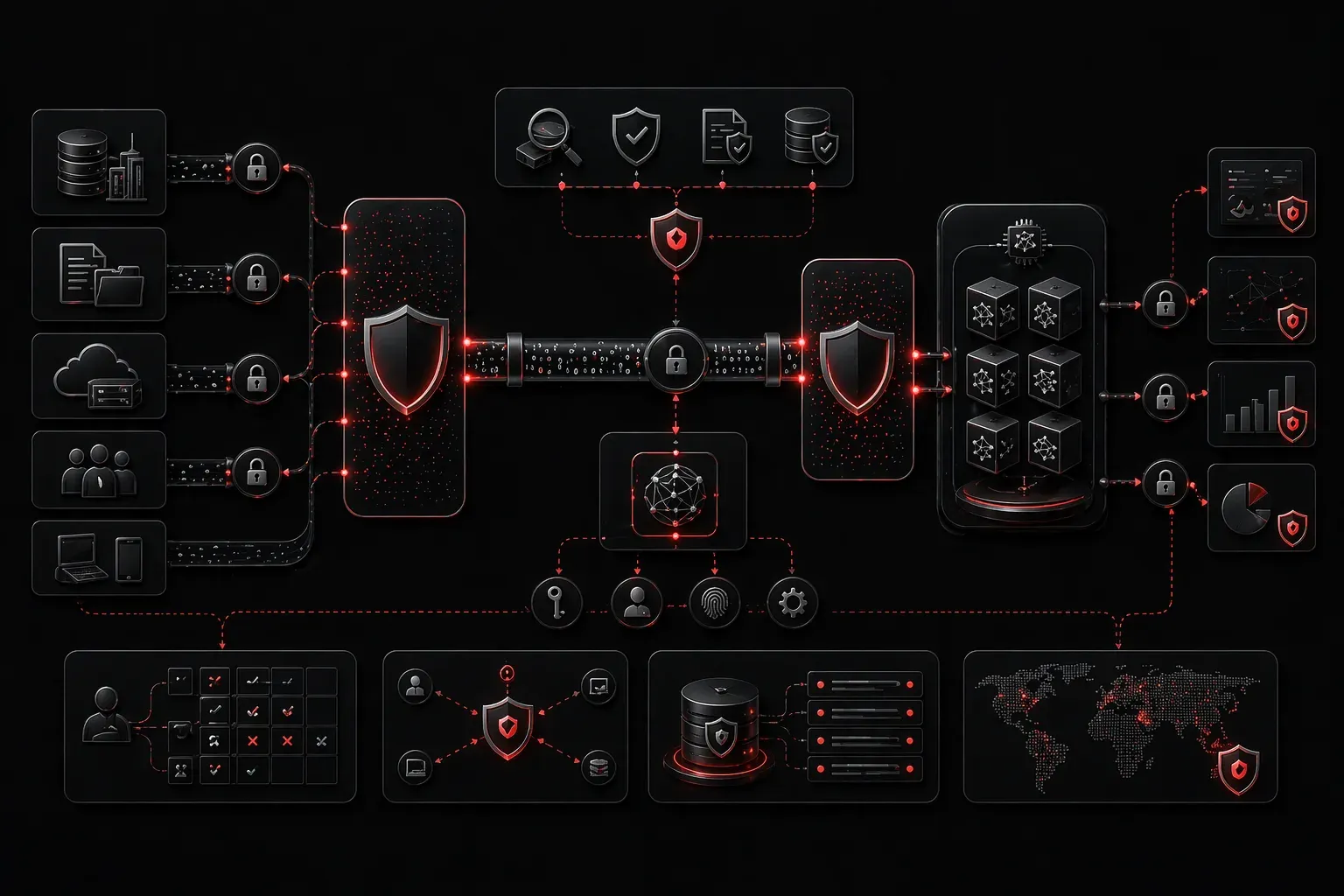
When organizations deploy AI systems, they face unique challenges in protecting sensitive corporate data. Unlike traditional applications, AI systems often require access to vast amounts of data for training and inference, creating new attack vectors and privacy risks that require specialized protection strategies.
Understanding AI-Specific Data Risks
AI systems present distinct data protection challenges. Machine learning models can inadvertently memorize and leak training data through techniques like model inversion attacks. Additionally, AI systems often aggregate data from multiple sources, potentially exposing correlations that weren't visible in isolated datasets.
The key risks include:
- Model extraction attacks where attackers reverse-engineer proprietary models
- Training data exposure through model outputs or intermediate processing
- Inference attacks that reveal sensitive information about individuals in datasets
- Data aggregation risks from combining previously safe datasets
Core Corporate Data Protection Strategies
Data Classification and Access Controls
Implement a robust data classification system specifically designed for AI workflows. Corporate data should be categorized by sensitivity level, with corresponding access controls that follow the principle of least privilege.
Essential classification levels include:
- Public: Safe for any AI system use
- Internal: Requires approved AI systems only
- Confidential: Restricted AI use with additional safeguards
- Restricted: Prohibited from AI training without explicit approval
Data Minimization and Purpose Limitation
Apply data minimization principles by ensuring AI systems only access the minimum data necessary for their specific purpose. This reduces exposure risk and aligns with privacy regulations like GDPR.
Practical implementation involves:
- Conducting regular data audits to identify unnecessary data collection
- Implementing automated data lifecycle management
- Using synthetic data for development and testing when possible
- Establishing clear data retention policies for AI systems
Technical Protection Measures
Differential Privacy
Implement differential privacy techniques to add mathematical guarantees that individual data points cannot be identified from AI model outputs. This approach adds controlled noise to datasets while preserving statistical utility for machine learning.
When configuring differential privacy, organizations typically start with an epsilon value between 1 and 10, with lower values providing stronger privacy guarantees but potentially reducing model accuracy.
Federated Learning
Consider federated learning architectures where AI models are trained across decentralized data sources without centralizing sensitive information. This approach keeps corporate data within organizational boundaries while still enabling collaborative AI development.
Key benefits include:
- Data never leaves the source organization
- Reduced risk of large-scale data breaches
- Compliance with data localization requirements
- Maintained model performance across distributed datasets
Governance and Monitoring
AI Data Governance Framework
Establish a comprehensive governance framework that includes data stewardship roles, approval processes for AI data use, and regular compliance auditing. This framework should integrate with existing data governance policies while addressing AI-specific requirements.
Critical components include:
- AI data usage approval workflows
- Regular model auditing for data leakage
- Incident response procedures for AI-related data breaches
- Continuous monitoring of data access patterns
Encryption and Secure Processing
Implement encryption for data at rest, in transit, and during processing. Emerging techniques like homomorphic encryption allow computation on encrypted data, enabling AI processing without exposing raw information.
For immediate implementation, focus on:
- End-to-end encryption for data pipelines
- Encrypted storage for training datasets
- Secure enclaves for sensitive AI processing
- Regular key rotation and management
What's Next
Now that you understand core corporate data protection strategies for AI systems, the next step is implementing specific privacy-preserving techniques. In our upcoming post, we'll dive deep into differential privacy implementation and explore how to balance privacy protection with model performance in real-world AI deployments.