
What Are Network Access Methods?
Network access methods determine how devices connect and communicate on networks. This beginner-friendly guide covers contention-based access (CSMA/CD, CSMA/CA), token-based systems, and modern switched Ethernet using simple analogies to explain complex networking concepts.

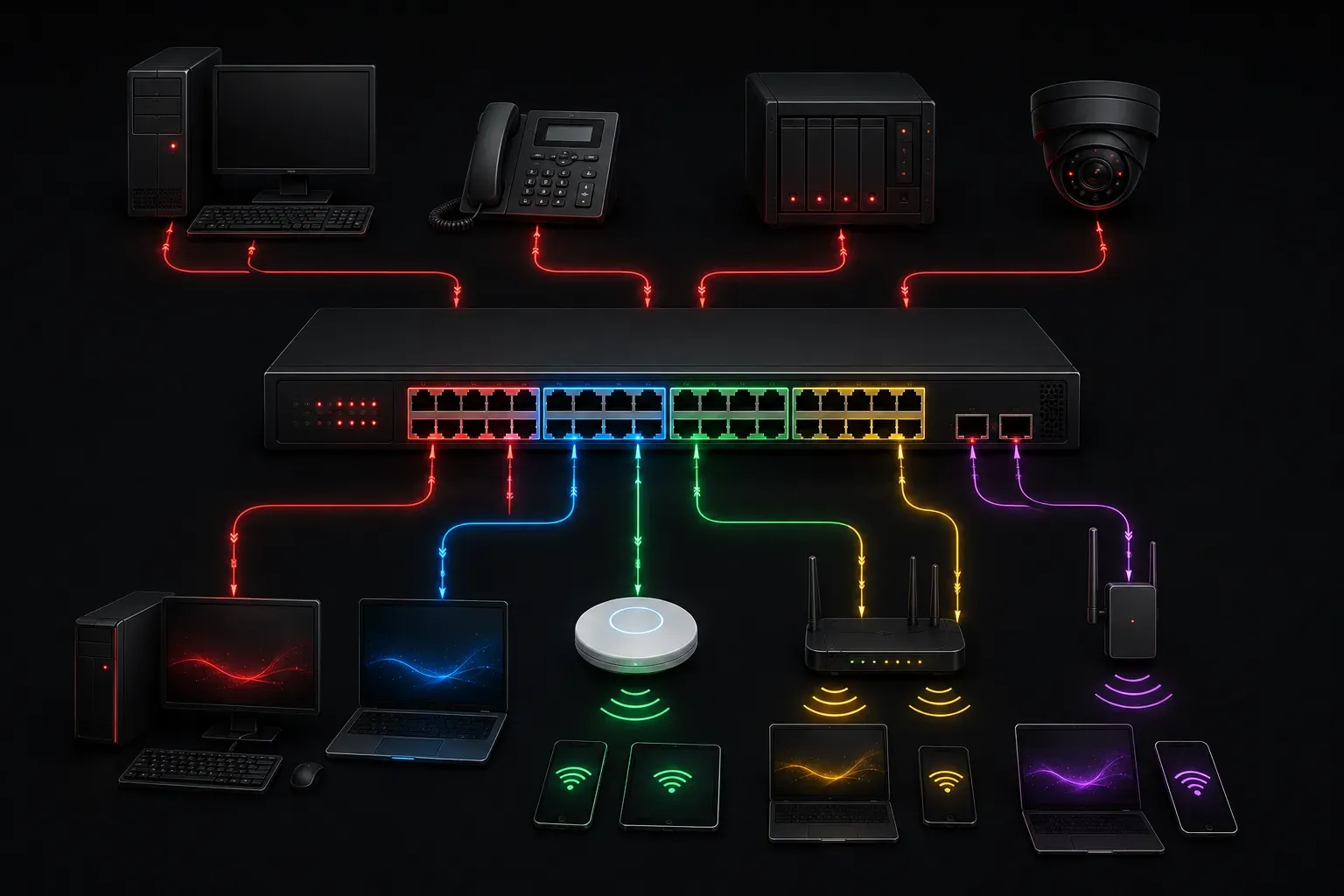
When you connect your laptop to Wi-Fi or plug an Ethernet cable into your computer, you're using what network engineers call network access methods. Think of these as different ways devices can join and communicate on a network; like different entrances to a building, each with its own rules and characteristics.
Understanding network access methods is fundamental to grasping how modern networks operate. Let's explore the main types you'll encounter in real-world environments.
Contention-Based Access (CSMA/CD and CSMA/CA)
The most common network access method you use daily is contention-based access. Imagine a busy conversation at a party, people listen before speaking, and sometimes two people start talking at once, creating an awkward moment where both stop and try again.
This is exactly how CSMA/CD (Carrier Sense Multiple Access with Collision Detection) works in traditional Ethernet networks:
- Carrier Sense: Devices listen to the network before transmitting
- Multiple Access: Multiple devices share the same network medium
- Collision Detection: When two devices transmit simultaneously, they detect the collision and retry
Modern switched Ethernet networks have largely eliminated collisions by creating separate collision domains for each port. A collision domain is a network segment where data packets can collide with one another when being sent. It's important to note that CSMA/CD is not used in full-duplex Ethernet connections, where devices can send and receive data simultaneously without the risk of collisions.
Wireless networks use CSMA/CA (Collision Avoidance) instead. Since Wi-Fi devices can't easily detect collisions over radio waves, they use techniques like random backoff timers to avoid collisions before they happen. When a potential collision is detected, devices wait for a random amount of time (measured in microseconds) before attempting to transmit again, helping to spread out transmission attempts and reduce interference.
Token-Based Access
Token-based access works like passing a talking stick in a meeting. Only the device holding the "token" can transmit data. Once finished, it passes the token to the next device in sequence.
While less common today, token-based methods like Token Ring were popular in enterprise networks during the 1980s and 1990s because they provided predictable access times and no collisions. However, they required more complex management and didn't scale as well as Ethernet, leading to their decline in favor of switched Ethernet solutions.
Polling-Based Access
In polling-based systems, a central controller asks each device in turn if it has data to transmit. Think of a teacher calling on students one by one; each student only speaks when called upon.
This method is used in specialized industrial networks and some legacy systems, where centralized control is crucial for timing and reliability.
Modern Access Methods
Today's networks primarily use switched Ethernet, which creates dedicated collision domains for each port. When you plug into a switch port, you get:
- Full-duplex communication (send and receive simultaneously)
- No collisions to worry about
- Dedicated bandwidth for your connection
- Automatic speed and duplex negotiation
You can verify your connection method on most systems. On a Windows machine, use:
ipconfig /allLook for "Link Speed" and "Duplex" in the output to see your connection details.
On Linux or macOS:
ethtool eth0This command displays detailed information, including link speed (such as 1000Mb/s), duplex mode (Full or Half), and auto-negotiation status. If you see "Link detected: yes" and "Duplex: Full", you're using modern switched Ethernet with full-duplex communication.
Wireless Access Methods
Wi-Fi networks use CSMA/CA with additional coordination mechanisms:
- Distributed Coordination Function (DCF): Basic contention-based access
- Point Coordination Function (PCF): Optional polling-based access for time-sensitive traffic
- Enhanced Distributed Channel Access (EDCA): Quality of Service enhancements in modern Wi-Fi
These methods ensure that your video calls get priority over file downloads, improving your overall wireless experience.
Choosing the Right Access Method
Different network access methods suit different scenarios:
- Switched Ethernet: Best for most wired connections
- Wireless (CSMA/CA): Essential for mobile devices and flexible deployments
- Token-based: Industrial environments requiring predictable timing
- Polling: Specialized applications with strict central control requirements
What's Next
Now that you understand how devices access networks, the next logical step is exploring how they identify themselves on those networks. In our next post, we'll dive into MAC addresses – the unique identifiers that make network communication possible at the data link layer.
Tools and resources for this topic
- CompTIA Network+ Study Guide — Comprehensive N10-009 exam preparation covering all five domains.