
Tagging in Loop Prevention: Configuration and Best Practices
Route tagging provides sophisticated loop prevention in complex enterprise networks by assigning metadata to routes during redistribution. This post covers configuration strategies, hierarchical tagging schemes, and integration with other filtering mechanisms for comprehensive routing loop preventi

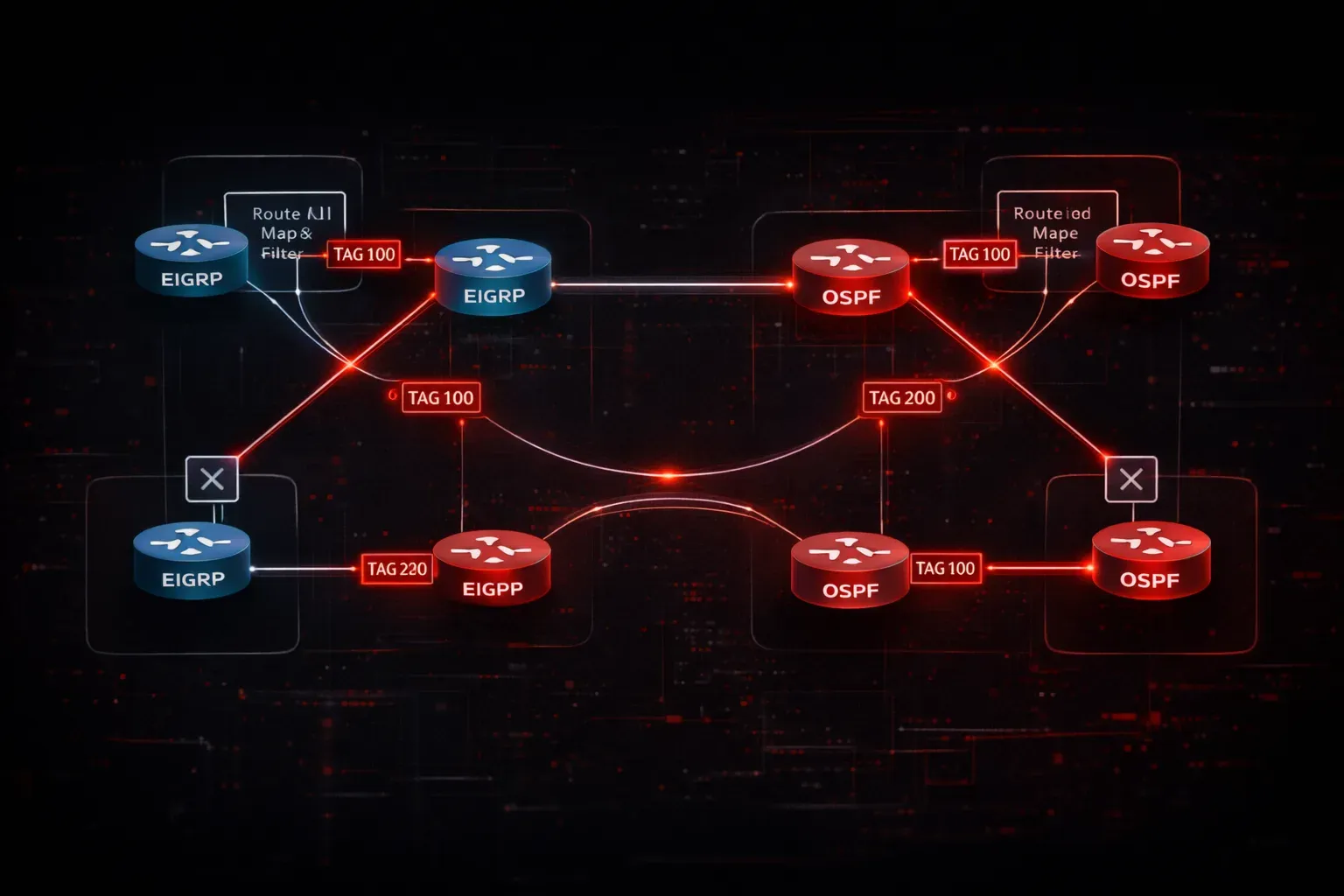
Loop prevention tagging represents one of the most sophisticated mechanisms for preventing routing loops in complex enterprise networks. While basic loop prevention relies on administrative distance and split horizon, tagging provides granular control over route propagation and redistribution scenarios where traditional methods fall short.
Understanding Route Tagging Architecture
Route tagging assigns metadata to routing information as it traverses different routing domains. Tags travel with routes through redistribution points, enabling routers to make intelligent decisions about route acceptance or rejection based on the tag value rather than just the destination prefix.
The tag field exists in multiple routing protocols:
- EIGRP uses a 32-bit tag field in routing updates
- OSPF external LSAs carry a 32-bit tag field
- RIP version 2 includes a 16-bit tag field
- BGP communities serve a similar tagging function
Core Tagging Configuration
Implement tagging through route maps during redistribution. The fundamental configuration pattern involves setting tags when redistributing routes and filtering based on those tags at redistribution boundaries.
router eigrp 100
 redistribute ospf 1 route-map SET-TAG-OSPF
 distribute-list route-map DENY-TAG-OSPF in

route-map SET-TAG-OSPF permit 10
 set tag 100

route-map DENY-TAG-OSPF deny 10
 match tag 100
route-map DENY-TAG-OSPF permit 20
This configuration prevents routes originally from EIGRP domain 100 from being readvertised back into EIGRP after passing through OSPF redistribution.
OSPF External Route Tagging
OSPF provides explicit tagging support for external routes through the tag parameter in redistribution:
router ospf 1
 redistribute eigrp 100 subnets tag 200
 distribute-list route-map FILTER-EIGRP-TAGS in

route-map FILTER-EIGRP-TAGS deny 10
 match tag 200
route-map FILTER-EIGRP-TAGS permit 20
Verify tagging implementation with show ip route and show ip ospf database external:
R1#show ip ospf database external 10.1.1.0

OSPF Router with ID (1.1.1.1) (Process ID 1)

Type-5 AS External Link States

LS age: 342
Options: (No TOS-capability, DC)
LS Type: AS External Link
Link State ID: 10.1.1.0 (External Network Number )
Advertising Router: 2.2.2.2
LS Seq Number: 80000001
Checksum: 0x8B3C
Length: 36
Network Mask: /24
Metric Type: 2 (Larger than any link state path)
TOS: 0
Metric: 20
Forward Address: 0.0.0.0
External Route Tag: 200
Advanced Tagging Strategies
Hierarchical Tagging Scheme
Develop a systematic tagging architecture that encodes routing domain information. A common approach uses the routing protocol AS number or process ID as the base tag value:
- EIGRP AS 100 routes: tag 100
- OSPF process 1 routes: tag 1000
- RIP routes: tag 2000
- Connected routes: tag 5000
route-map TAG-CONNECTED permit 10
 match interface Loopback0
 set tag 5000
route-map TAG-CONNECTED permit 20

router eigrp 100
 redistribute connected route-map TAG-CONNECTED
Multi-Point Redistribution Control
In networks with multiple redistribution points, implement coordinated tagging to prevent loops across the entire topology:
! Router A - EIGRP to OSPF redistribution
router ospf 1
 redistribute eigrp 100 subnets tag 100
 distribute-list route-map NO-OSPF-TAGS in

! Router B - OSPF to EIGRP redistribution
router eigrp 100
 redistribute ospf 1 route-map TAG-OSPF-ROUTES
 distribute-list route-map NO-EIGRP-TAGS in

route-map TAG-OSPF-ROUTES permit 10
 set tag 1000

route-map NO-EIGRP-TAGS deny 10
 match tag 100
route-map NO-EIGRP-TAGS permit 20

route-map NO-OSPF-TAGS deny 10
 match tag 1000
route-map NO-OSPF-TAGS permit 20
Tagging Best Practices
Documentation and Standardization
Establish clear tagging standards across the organization. Document tag meanings and maintain consistency:
- Reserve tag ranges for specific purposes (1-999 for EIGRP domains, 1000-1999 for OSPF processes)
- Use meaningful tag values that correlate to network design
- Implement tags at all redistribution boundaries, not just problematic ones
Verification and Monitoring
Regular verification ensures tagging functions correctly. Key commands include:
show ip route tag 100
show ip protocols
show route-map TAG-ROUTES
debug ip routing
Monitor for unexpected tag propagation that might indicate configuration errors:
R1#show ip route 192.168.1.0
Routing entry for 192.168.1.0/24
  Known via "eigrp 100", distance 90, metric 2816, tag 200
  Tag 200, type internal
  Redistributing via ospf 1
  Last update from 10.0.1.2 on Serial0/0, 00:05:23 ago
Integration with Prefix Lists
Combine tagging with prefix filtering for comprehensive loop prevention:
ip prefix-list DENY-DEFAULT seq 5 deny 0.0.0.0/0

route-map COMPREHENSIVE-FILTER deny 10
 match tag 100
route-map COMPREHENSIVE-FILTER deny 20
 match ip address prefix-list DENY-DEFAULT
route-map COMPREHENSIVE-FILTER permit 30
 set tag 200
Troubleshooting Tag-Based Loops
When routing loops persist despite tagging, systematically verify tag propagation across redistribution boundaries. Common issues include:
- Inconsistent route map application across multiple redistribution points
- Tag values not properly filtered at ingress points
- Missing route maps on backup redistribution paths
Use debug ip routing and show ip route tag to trace tag behavior through the network topology.
What's Next
With tagging fundamentals established, the next crucial topic addresses route filtering and prefix lists. These mechanisms work alongside tagging to provide comprehensive control over route advertisement and acceptance in complex redistribution scenarios.
Tools and resources for this topic
- CCNP ENARSI 300-410 Official Cert Guide — The definitive ENARSI study resource by Raymond Lacoste. Covers advanced routing, services, and troubleshooting.