
CDP vs LLDP: Understanding the Differences
Compares Cisco Discovery Protocol (CDP) and Link Layer Discovery Protocol (LLDP), explaining their key differences, use cases, and when to choose each protocol for network discovery in different environments.

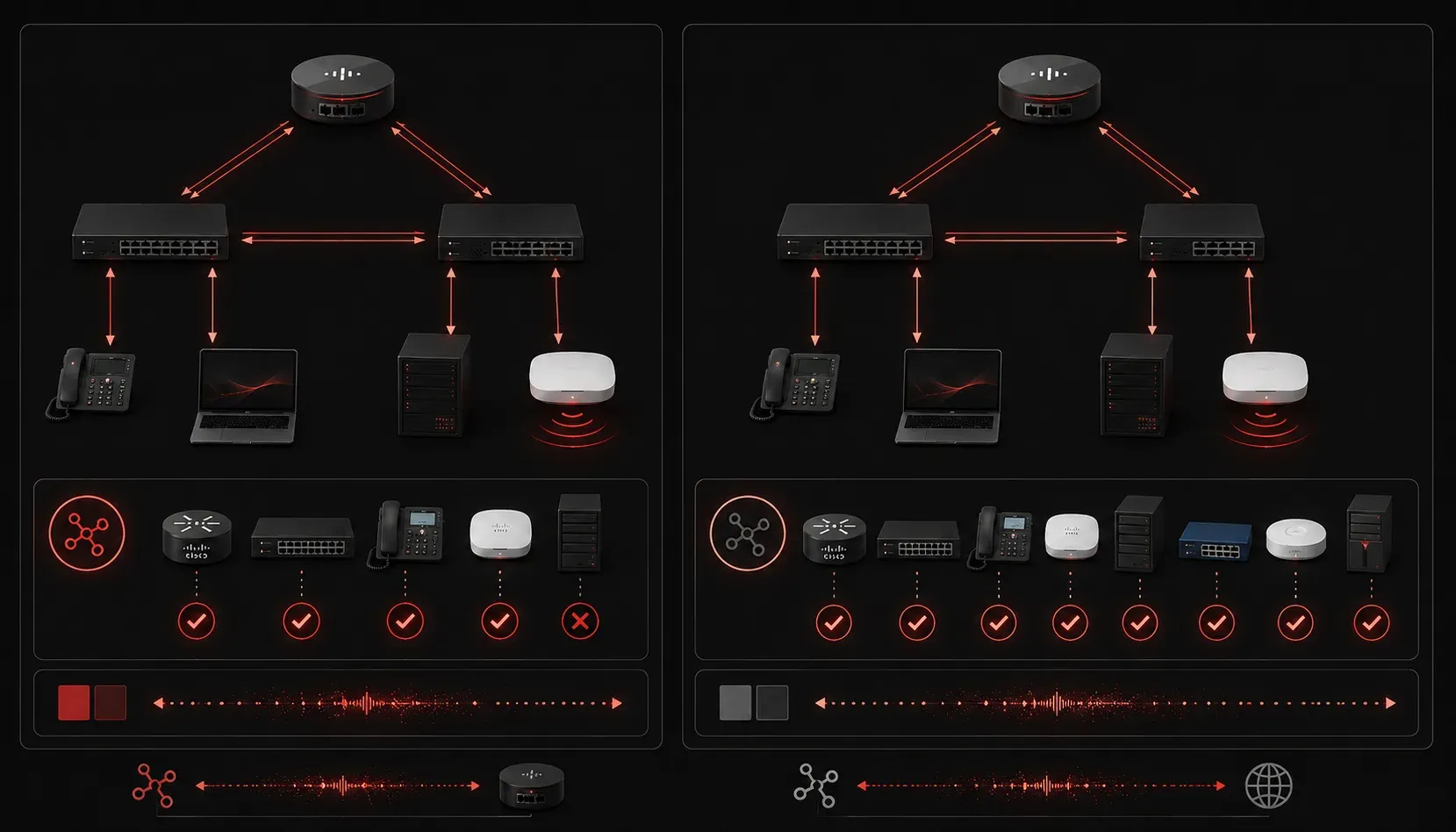
When you're managing a network, knowing what devices are connected and how they're linked together is crucial. Two protocols help with this network discovery task: Cisco Discovery Protocol (CDP) and Link Layer Discovery Protocol (LLDP). While they serve similar purposes, understanding their differences will help you choose the right tool for your network environment.
What Are Discovery Protocols?
Network discovery protocols allow devices to share basic information about themselves with their directly connected neighbors. This information typically includes device names, IP addresses, platform types, and interface details. Think of these protocols as a way for network devices to introduce themselves to their immediate neighbors.
Both CDP and LLDP operate at Layer 2 (Data Link Layer), which means they work regardless of the Layer 3 protocol configuration. Even if IP isn't configured, these protocols can still function.
Cisco Discovery Protocol (CDP)
CDP is Cisco's proprietary discovery protocol, enabled by default on most Cisco devices. It runs automatically and shares information every 60 seconds by default.
Key CDP Characteristics:
- Proprietary: Only works between Cisco devices
- Enabled by default: Runs automatically on Cisco equipment
- Layer 2 operation: Uses multicast address 01:00:0C:CC:CC:CC
- Rich information sharing: Provides detailed device and interface data
To view CDP information on a Cisco device, use these commands:
Router# show cdp neighbors
Router# show cdp neighbors detail
Router# show cdp interface
The show cdp neighbors command displays a summary of connected devices, while the show cdp neighbors detail provides comprehensive information, including IP addresses, software versions, and capabilities.
Link Layer Discovery Protocol (LLDP)
LLDP is an industry-standard protocol defined in IEEE 802.1AB. Unlike CDP, it's vendor-neutral and works with equipment from different manufacturers.
Key LLDP Characteristics:
- Industry standard: Works with equipment from any vendor
- Disabled by default: Must be manually enabled on Cisco devices
- Layer 2 operation: Uses multicast address 01:80:C2:00:00:0E
- Standardized information: Shares basic device and port information
To enable and view LLDP on Cisco devices:
Router(config)# lldp run
Router# show lldp neighbors
Router# show lldp neighbors detail
Protocol Comparison: CDP vs LLDP
Here's a direct comparison of these network discovery protocols:
Compatibility
CDP: Cisco devices only - creates vendor lock-in but provides deeper integration with the Cisco ecosystem.
LLDP: Multi-vendor support - essential in mixed-vendor environments.
Default Behavior
CDP: Enabled automatically on Cisco devices, making network discovery immediate.
LLDP requires manual configuration, giving administrators control over when it's used.
Information Richness
CDP: Shares extensive details including power requirements, VLAN information, and native VLAN settings.
LLDP provides standardized basic information focused on essential connectivity data.
Security Considerations
Both protocols can expose sensitive network topology information to potential attackers. Discovery protocols transmit device details in plaintext, including hostnames, IP addresses, and software versions that could aid reconnaissance efforts. In security-sensitive environments, consider disabling CDP globally and only enabling LLDP on specific interfaces where inter-vendor communication is necessary. Additionally, implement network access control and monitoring to detect unauthorized devices attempting to gather discovery information.
When to Use Each Protocol
Use CDP when:
- Working in an all-Cisco environment
- You need detailed device information for troubleshooting
- Integration with Cisco management tools is important
Use LLDP when:
- Managing a multi-vendor network
- Compliance requires industry-standard protocols
- Connecting Cisco devices to non-Cisco equipment
- Working with VoIP phones from different vendors that require LLDP for power negotiation
- Implementing network automation tools that rely on standardized discovery protocols
- Integrating with third-party network monitoring and management platforms
- Meeting regulatory requirements that mandate vendor-neutral protocols
Many networks run both protocols simultaneously, using CDP for Cisco-to-Cisco communication and LLDP for interoperability with other vendors.
What's Next
Now that you understand the differences between CDP and LLDP, the next step is learning how to configure and troubleshoot these protocols in practice. We'll explore hands-on configuration scenarios and examine how these discovery protocols integrate with network management and monitoring tools.
Tools and resources for this topic
- CCNA Official Cert Guide (Wendell Odom) — The definitive CCNA study resource. Both volumes cover the 200-301 exam blueprint in full.
- Wendell Odom CCNA Vol 1 — Covers networking fundamentals, switching, and routing basics.
- Wendell Odom CCNA Vol 2 — Covers advanced routing, WAN, infrastructure services, and security.